
Reading
Reading
Description
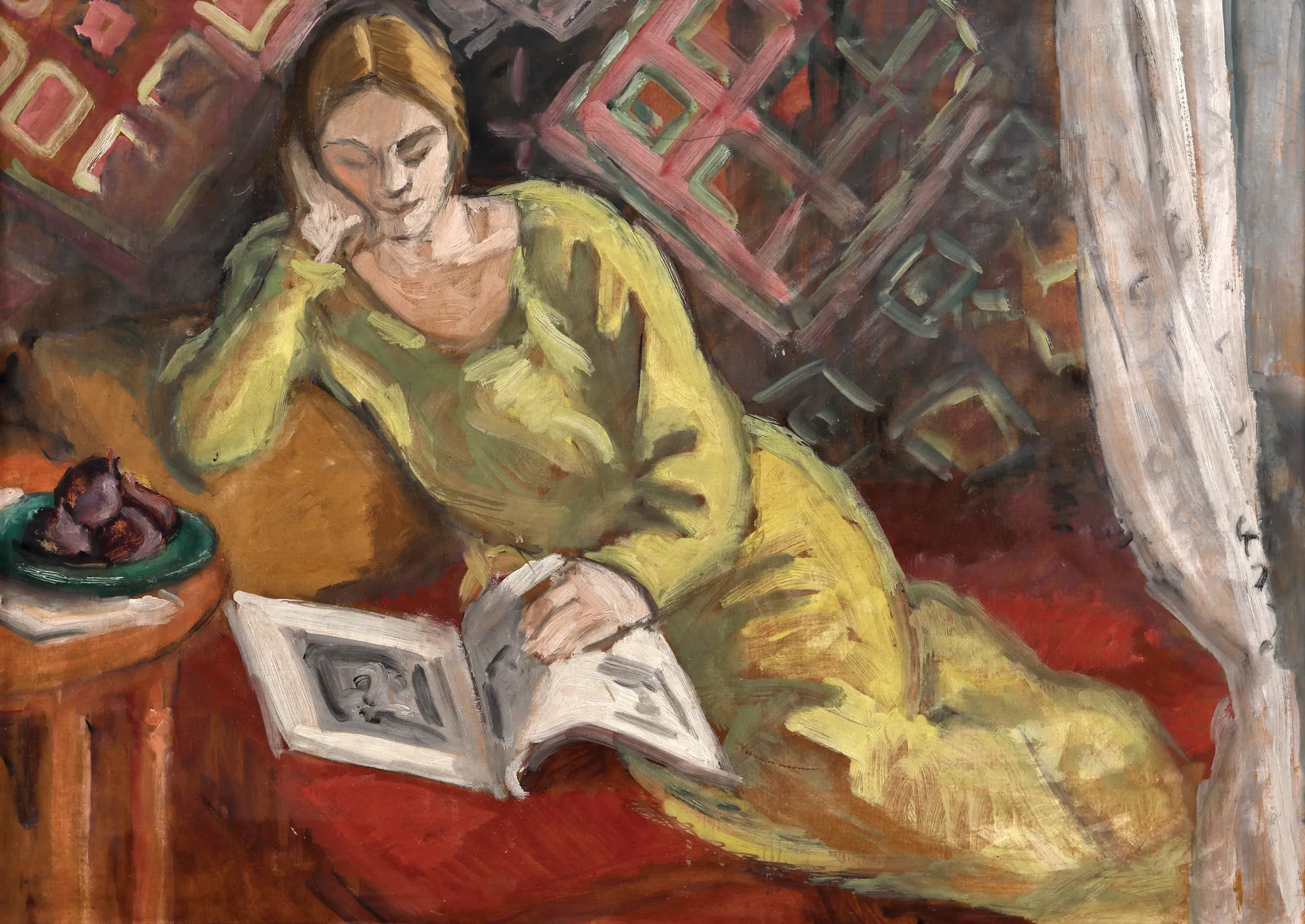
A classical spirit, fascinated by order and balance, Theodor Pallady is the creator of a rational work, projected against a background of permanence. Educated in France, in Paris, in Aman Jean’s workshop, and then at the School of Beaux Arts, the artist would become one of the most appreciated painters of modern art, being noted by Parisian critique, where he made his artistic debut ("The Universal Exhibition", 1900), as well as by the one in Bucharest, his eulogists including personalities such as Gustave Kahn, Jean Royère, Tudor Arghezi, Francisc Șirato, Lucian Blaga, Nicolae Tonitza et al. Being perceived as an "artist-interpreter", the universe of his creation orbits, particularly after his return from Paris, around the intimist framework, where themes such as the nude, still life, the portrait, self-portrait and the interior, to which he often returns, in view of perfecting it. In this intimist framework we encounter woman - the muse of his work, the one to whom he mostly dedicates enigmatic interpretations. He depicts her in the Bohemian atmosphere of his workshop, in states of contemplation or in waiting, reading or resting in armchairs or on sofas. Drawn by the intimate atmosphere, rather by than a glowing plein-air, the artist builds the decor of his room with care and inspiration - the sofa, the armchair, the table decorated with cases, Baudelaire’s and Mallarmé’s books having a significant contribution to the construction of his reveries. (G.M.)
Biography
MÂNDRESCU, Anatol, „Theodor Pallady”, Ed. Meridiane, București, 1971. ȘORBAN, Raoul, „Theodor Pallady”, Ed. MEridiane, București, 1975. CEBUC, Alexandru, „Pallady”, Ed. Monitorul Oficial R.A., București, 2008.
Sizing
Width 81.5, Height 59, Sizing info 59 Ã 81,5 cm
Signature
signed right side, with black, "T. Pallady"
Medium
oil on cardboard
Location
Artmark românia