The photos of the lot are informative and indicative, and cannot provide a highly detailed view of the object from all angles. We recommend a careful physical inspection of the lot before bidding.
CEBUC, Alexandru, "Grigorescu", Official Gazette, 2017.
OPRESCU, George, "Nicolae Grigorescu", Meridiane Publishing House, Bucharest, 1963.
VLAHUȚĂ, Alexandru, "The painter Grigorescu - His life and work", Alexandru Vlahuță, Bucharest, 1910.
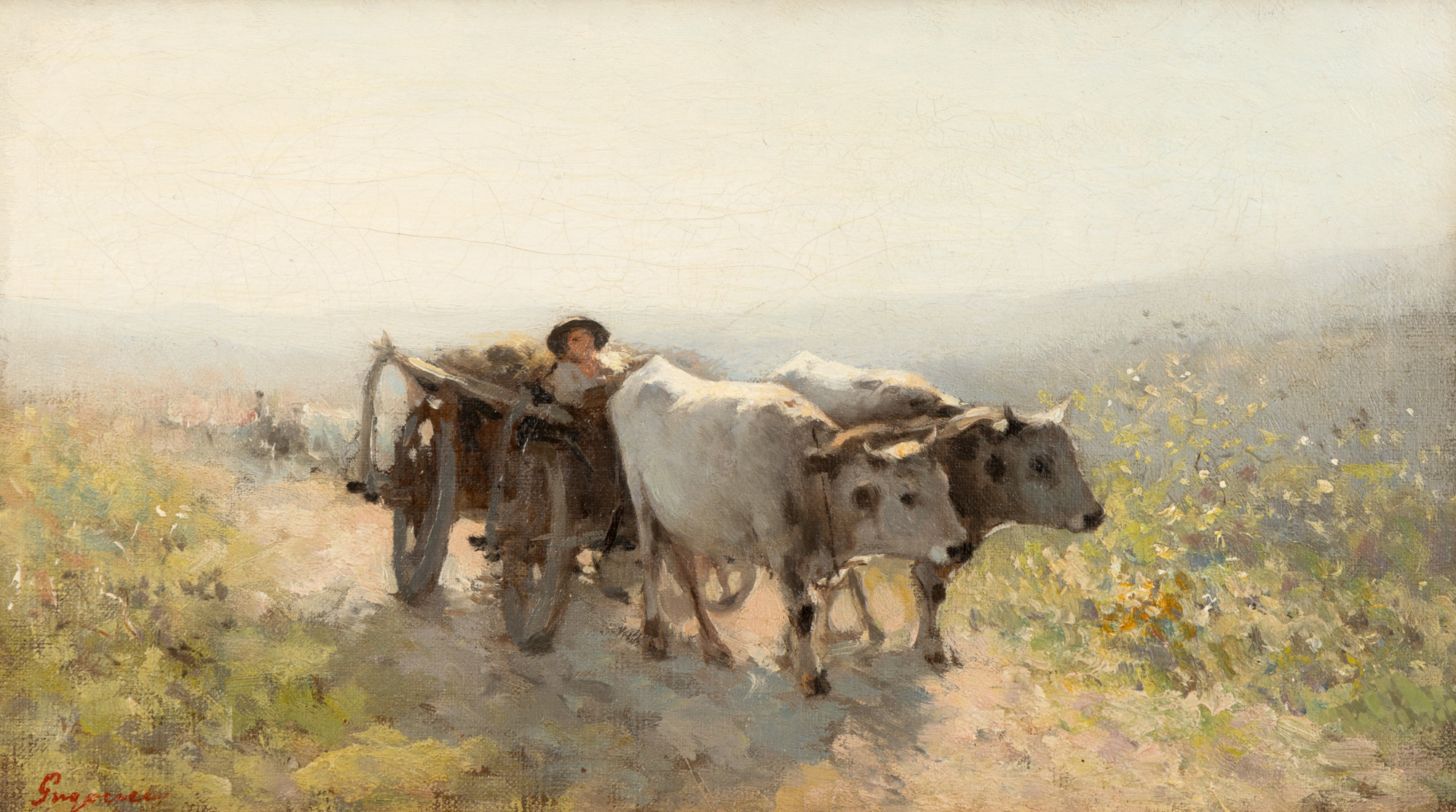
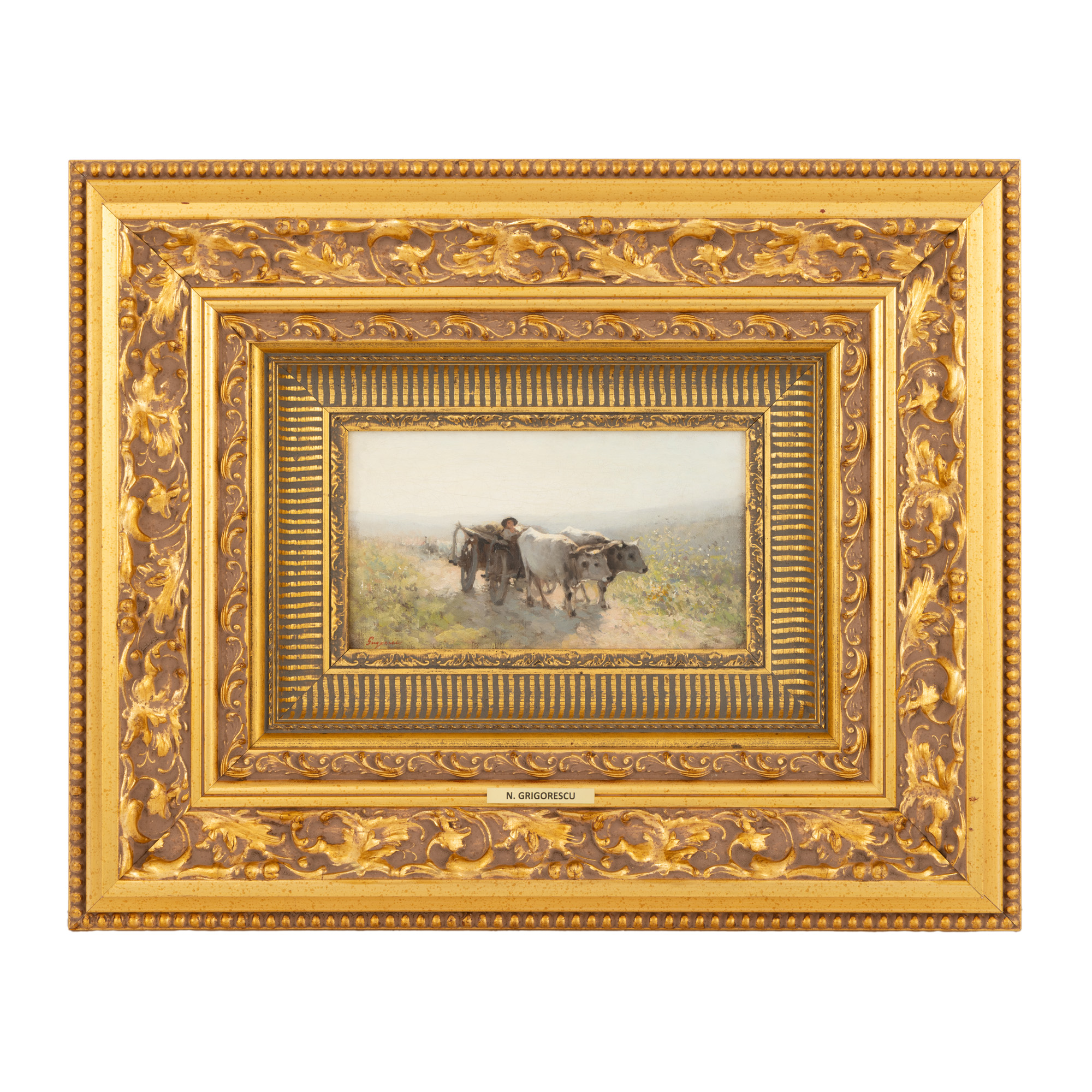
oil on canvas, 16.5 x 28 cm, signed bottom left, in red, "Grigorescu"
Grigorescu was shaped around artists like Camille Corot, Gustave Courbet or Jean-François Millet. He assimilated and filtered their experiences, his early work invoking the grandeur of nature, Courbet's realism and the figure of the peasant as derived from the art of Millet.
His time at Barbizon represented one of the essential premises of the formation of his profoundly original vision, marked by the preference for realism and spontaneous language. Grigorescu studied at Barbizon in the 1860s, where he directly interacted with painters such as Millet, Corot, and Rousseau, painted en plein-air and focused on the study of light and the landscape's atmosphere.
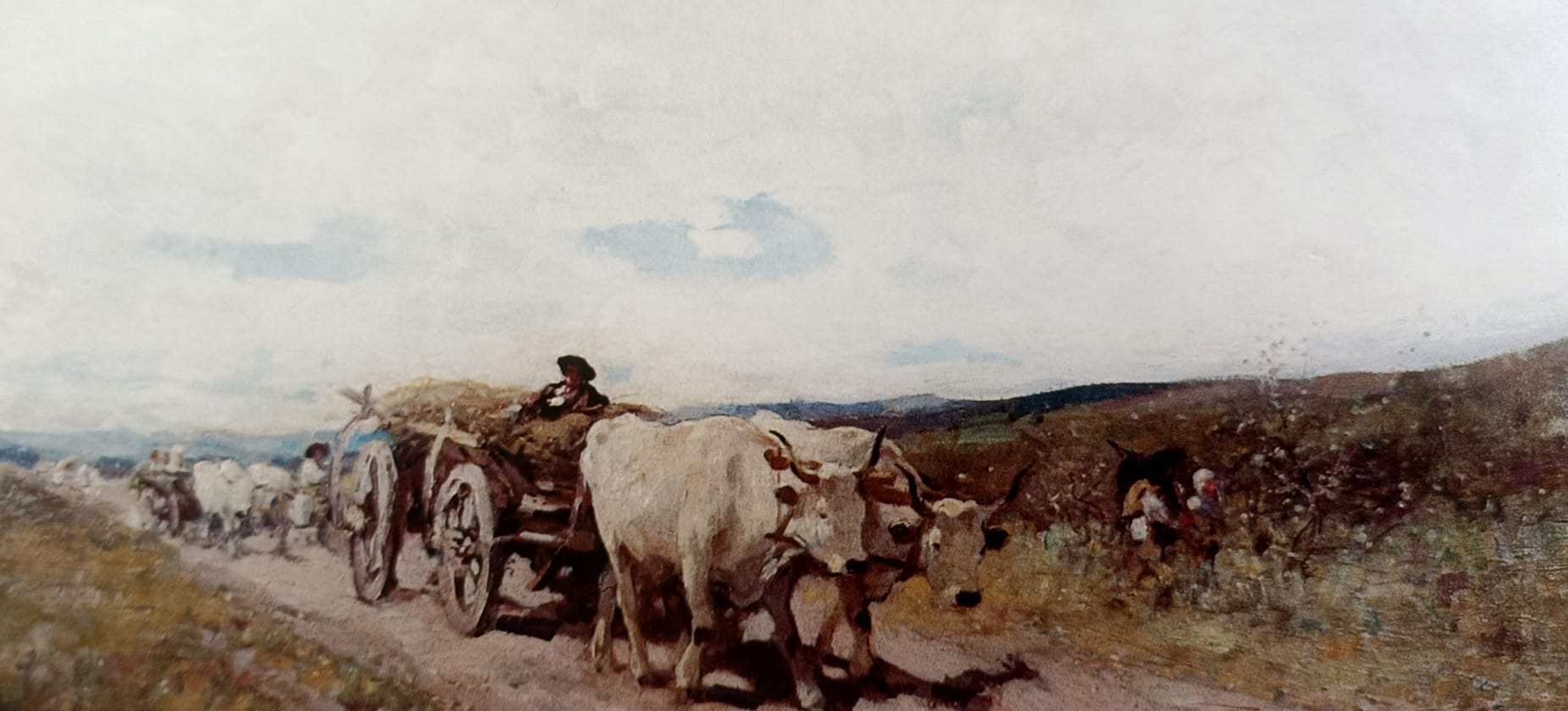
From Barbizon to Câmpina, the main concern of the Romanian artist was nature. He flawlessly painted silhouettes of peasants captured in the poses of everyday pastoral life, and the ox cart becomes his preferred thematic cycle, especially in the maturity phase of his work, such as ”Returning from the Field”, ”Convoy of Ox Carts by Twilight” or ”Returning from the Market”.
Grigorescu started to paint the theme of ox carts around the 1870s, developing it during his maturity period. The theme appears after returning from France when he settled more in his hometown, after his studies at Barbizon where he gleaned the technique and painting style of French artists.
The ox carts become the emblematic motif of his creation, where during his maturity period from the 1870s to 1900s he started to create more and more works with this theme which symbolises rural tranquility, the bond between man and nature and the Romanian national specificity.
Grigorescu will develop a recognisable style of his own, marked by free and luminous brushwork, interest in the Romanian landscape, rural life scenes, warm colour, and poetic atmosphere.
He studies the oxen with extraordinary patience and captures them with special attention in his works. He paints endless picturesque rows, herds returning from the field, groups caught as they approach or recede from the foreground, as well as the subtle integration of man and animal in nature. He studies oxen in their natural surroundings, on country roads, in the fields, at rest or in movement. This careful observation of animals allowed him to reproduce: the massive structure of the body, muscle tension or the correct position of the limbs.
From the vitality in the foreground to the secondary layers that gently fade away, Grigorescu paints the humble villager and rural life in the countryside. He suggests the physiognomies of his characters, either through a careful distribution of light or using strong accents of light and shadow. He chooses nature as his model and dedicates a substantial part of his creation to ox carts.
He manages to create a special harmony between the shepherds of the flocks and the animals represented, as can also be seen in the work at hand, which is also part of his artistic maturity period and depicts an ox cart returning from the field. Through this theme, he captures authentic rural life, free from academic idealizations, approaching the everyday and real landscape observed in nature.
Grigorescu's works combine elements of realism with influences of impressionism and the Barbizon School.
Moreover, the work illustrates the freedom of describing light and fields, and how the artist captures luminous effects on canvas, as well as respect for the simple life of peasants. Thus, "The Ox Cart" is not just a picturesque scene but an important image of Romanian rural identity and one of the most recognised motifs in Romanian art of the nineteenth century.
For clarifications regarding the bidding procedure, hammer price costs, guarantee, payment, and collection terms for the winning lot, we recommend carefully reading/re-reading the Bidding Regulations.
For additional information regarding the lot and the auction, please contact the Art Consultants Department.
By choosing "Accept all cookies" you agree to the use of cookies to help us provide you with a better user experience and to analyse website usage. By clicking "Adjust your preferences" you can choose which cookies to allow. Only the essential cookies are necessary for the proper functioning of our website and cannot be refused
Cookie settings
Our website stores four types of cookies. At any time you can choose which cookies you accept and which you refuse. You can read more about what cookies are and what types of cookies we store in our Confidentiality Policy.
are necessary for technical reasons. Without them, this website may not function properly.
are necessary for specific functionality on the website. Without them, some features may be disabled.
allow us to analyse website use and to improve the visitor's experience.
allow us to personalise your experience and to send you relevant content and offers, on this website and other websites.