The photos of the lot are informative and indicative, and cannot provide a highly detailed view of the object from all angles. We recommend a careful physical inspection of the lot before bidding.
PAULEANU, Doina, Nicolae Tonitza, Ed. Official Monitor R.A., Bucharest, 2014. VLASIU Ioana, "Tonitza images of childhood", Târgu Mureș, 2019.
ȘORBAN, Raoul, Tonitza, Ed. Meridians, 1973.
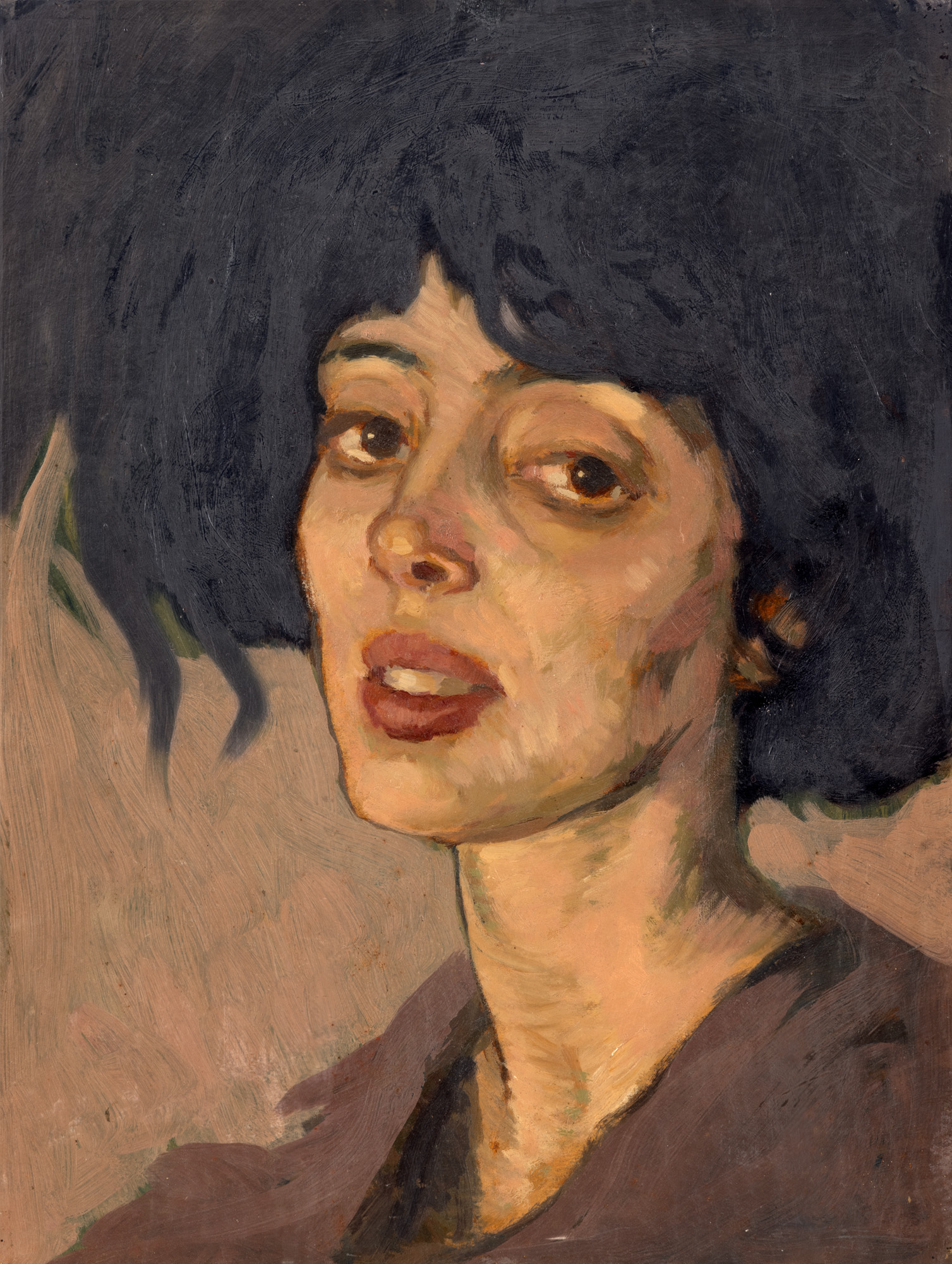
oil on cardboard, 38.5 x 29 cm
Notes
on the back, noted and authenticated by Ecaterina Tonitza, in red, "Original by N.N. Tonitza 1918, E. N. Tonitza, 1944"
PROVENANCE
The collection of the painter Ştefania Manoliu Bereilh.
After the period of 1911-1913, Tonitza began to paint female portraits, but in a still academic manner, with realist influences. These would become a central theme, after the First World War, where the subject of portraits took shape during the 1920s-1930s.
In the 1920s, female portraits became frequent and acquired the typical features of his style such as the large, almond-shaped eyes, melancholic expression, warm colors, introspective expression and fragility. During this same period, he began to paint portraits of his wife.
Alongside the presence of children, the feminine presence is constantly found in his repertoire, its depiction and contemplation being one of the themes debated by the artist throughout his entire activity.
At Balcic, in the attic or in the interiors of his own home, the woman remained a favorite subject for the artist, evoked both through drawings and paintings. The period spent at Valeni de Munte with members of his family was an opportunity for Tonitza to observe and study, his children (Irina, Catrina, Petru), along with his wife (Ecaterina), becoming his favorite models.
Most of his portraits include a single face, as the artist wishes to focus more on a single human figure and allocates enough time to depict not only the physiognomy, but also the model's entire psychology, like the present work focusing on capturing the face of a woman who is represented in semi-profile and looks towards the observer.
As for the present work, it depicts a woman in a calm and meditative attitude. The identity of the character is that of Ecaterina Tonitza, the artist's wife, due to the intimate nature and affective expression of the portrait.
The portrait captivates the face of a female character in a static, meditative attitude, typical of his portraits. The composition is simple and balanced, centered on the face of the character. The figure is depicted frontally, or slightly in profile, and the background is neutral, to highlight the expression of the face.
Tonitza does not aim for a faithful rendering of the details, but the transmission of the state of soul, through simplified shapes and visible brushwork. The light is diffuse, without strong contrasts, delicately modeling the face's features.
The woman's expression is melancholic and sober, suggesting introspection and spiritual depth. The feminine character has black hair, contrasting with the skin color. The eyes are large and round, robust eyebrows, prominent nose, along with full lips. The character's clothing only allows us to see that the woman is wearing an open-necked red blouse. As for the background, the light is diffuse, uniformly distributed, highlighting the large expressive eyes along with the serious and melancholic look.
The female character can also be interpreted as an invocation of a muse or a feminine ideal, a figure that concentrates delicacy and a mysterious aura, defining works by Tonitza such as "The Blue Blouse", "Portrait of a woman" or "Girl in the Interior", "The Nun" or "The Tailor".
In creating the portraits, the faces are round, with a high forehead, idealized, slightly inclined, with the arches of the eyebrows continued with those of the nose.
In addition to these, other important parts that Tonitza takes into account when creating characters are their eyes. The emphasis is on the eyes, on reconstituting the lines of force and details, where in this way, the characters' faces convey a thoughtful, dreamy and melancholic expression to the viewer.
His works highlight, expressively, the character of the person being portrayed, seeking their inner traits, which he synthesizes, vividly expressing the individuality of each model.
The work bears the features of Tonitza's mature style, such as the attention to facial details, emphasis on the eyes and expression, firm contours, and interest in the character's psychology, where most of his works of this kind highlight the increased attention to the person portrayed and observation of the details of each subject.
For clarifications regarding the bidding procedure, hammer price costs, guarantee, payment, and collection terms for the winning lot, we recommend carefully reading/re-reading the Bidding Regulations.
For additional information regarding the lot and the auction, please contact the Art Consultants Department.
By choosing "Accept all cookies" you agree to the use of cookies to help us provide you with a better user experience and to analyse website usage. By clicking "Adjust your preferences" you can choose which cookies to allow. Only the essential cookies are necessary for the proper functioning of our website and cannot be refused
Cookie settings
Our website stores four types of cookies. At any time you can choose which cookies you accept and which you refuse. You can read more about what cookies are and what types of cookies we store in our Confidentiality Policy.
are necessary for technical reasons. Without them, this website may not function properly.
are necessary for specific functionality on the website. Without them, some features may be disabled.
allow us to analyse website use and to improve the visitor's experience.
allow us to personalise your experience and to send you relevant content and offers, on this website and other websites.