


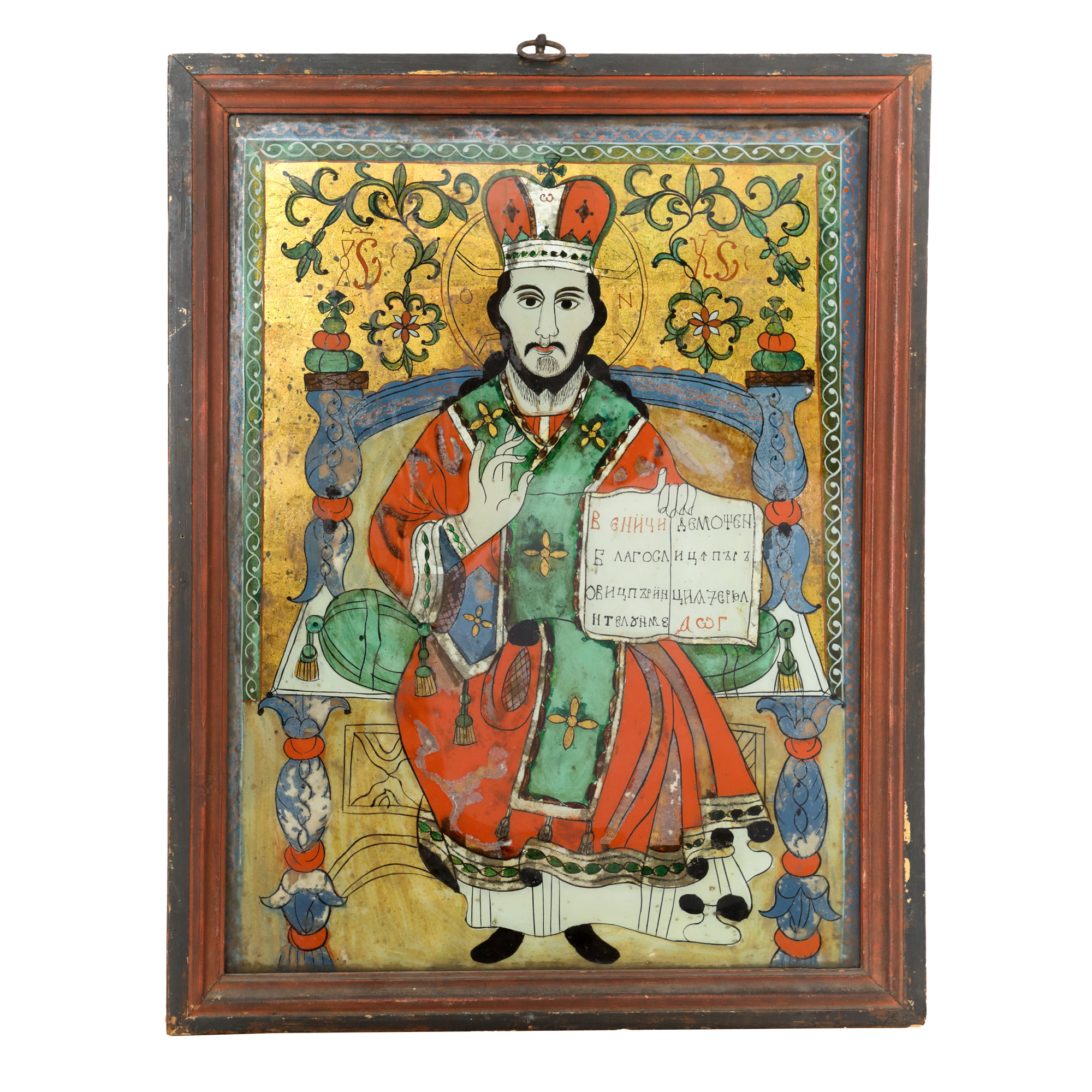
19. Icon on glass, "Jesus Christ King and High Priest, enthroned", first workshop of Nicula, 1803, museum piece, collectible
The photos of the lot are informative and indicative, and cannot provide a highly detailed view of the object from all angles. We recommend a careful physical inspection of the lot before bidding.
19. Icon on glass, "Jesus Christ King and High Priest, enthroned", first workshop of Nicula, 1803, museum piece, collectible
Starting price:
EUR 1.200
Sold
EUR 6.000
tempera gold and silver foil on glaze, gilded and painted frame, with forceps, 62 x 47.5 cm
Research information
Easily identifiable due to their large format and gold foil-covered background, these types of icons were first spotted in Joseni, in Harghita county, in 1900, with the following words: "in the church there are 4 icons painted on glass in the most vivid colors by the priest Sandu in 1796". The first to link Priest Sandu to the town of Iernuțeni, now part of Reghin, was Atanasie Popa. The next bibliographic mention belongs to Ion Apostol Popescu. From his text, it can be deduced that he saw the icons from Joseni, comparing their "special beauty in design and color" with "the glass painting school in Nicula", considering that the latter did not influence the creation of the former, but leaving room for the possibility that Priest Sandu might have learned the trade at Nicula. An important point in studying Transylvanian glass icons is the appearance, in 1975, of a work devoted to Iuliana and Dumitru Dancu, Peasant painting on glass, in which "the Iernuțeni icons" were given a special chapter. Therefore, in the Dancu couple's opinion, Ştefan Meteș is the one who signals them, and Ion Apostol Popescu is the one locating Priest Sandu in Iernuțeni. It is, therefore, even more interesting to establish the paternity of Priest Sandu over the icons representing his work, considering that the only link they could invoke to the Joseni icons is the 1796 date and the immediate later years. However, a new argument is brought up, namely affirmation by local tradition ("the old people in the village and priests from neighboring villages") of the existence in Iernuțeni of an iconographer named Priest Sandu, "around the year 1800", who "would have painted both on wood and on glass". The latest studies in the field argue that the group of icons from Joseni and all others that form a relatively compact group should be separated from the name of Priest Sandu from Iernut and studied separately, as a result of the collective effort of a first Nicula workshop. Such intense activity, developed in a workshop where we see several apprentices successively forming, with such a large irradiation of production, can't be highlighted without also trying to find a location, especially since the artistic phenomenon in question offers enough clues for a plausible answer. It has in fact been indicated, most researchers encountering this type of icon and who did not subscribe to the attribution proposed by the Dancu couple directly endorsing Nicula or – in a more reserved formulation – for a "center in northern Transylvania, probably Nicula". Thus, we can reason that: - all those who form in the workshop in question belong, from a stylistic point of view, to the Nicula center and it would be nonsense to think that they traveled a long way to learn the secrets of painting elsewhere when they had such a talented craftsman at hand; - clumsiness in rendering facial components also lead to Nicula, as a stylistic peculiarity; - the dissemination area of the icons covers, practically, the same space where Nicula's icons are also present, no other center managing to expand as much. Thus, at the level of knowledge accessible to us today, we can say that the icon was created in the entourage of the First Workshop founded in Nicula by a master still anonymous (but who is, erroneously, traditionally designated and known as Priest Sandu from Iernuțeni). (A.D.)
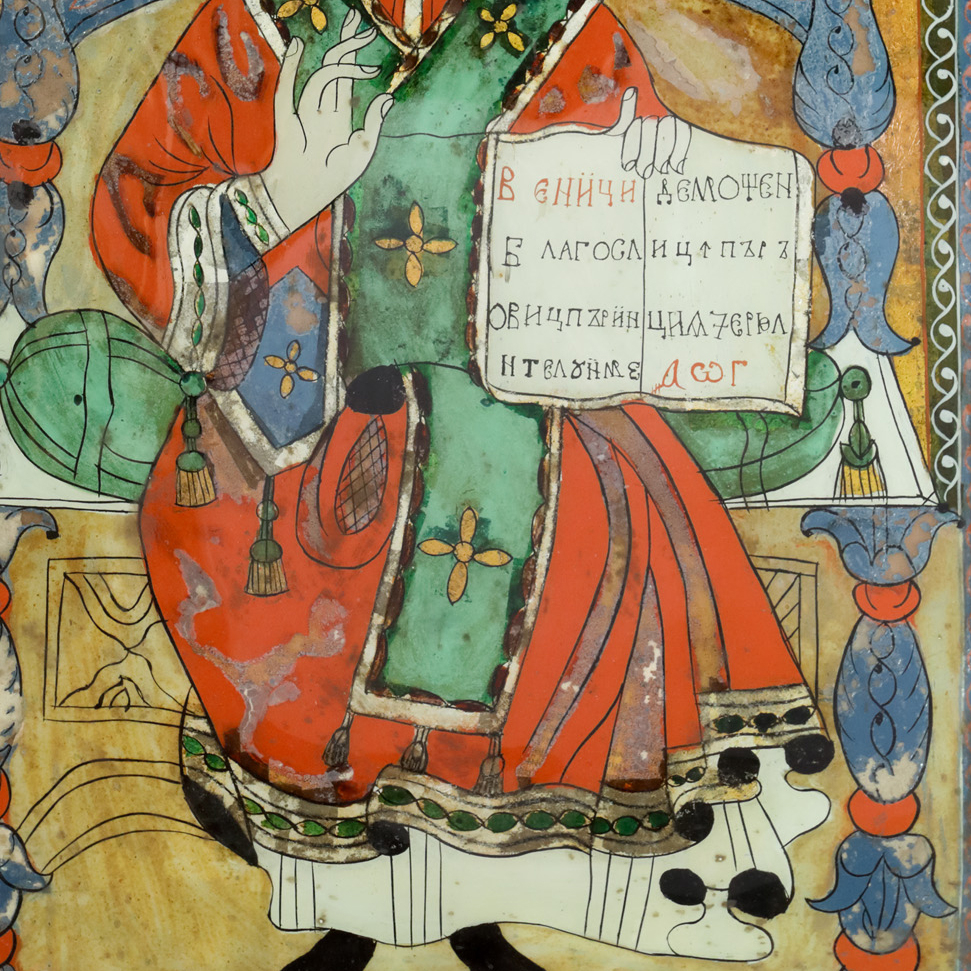
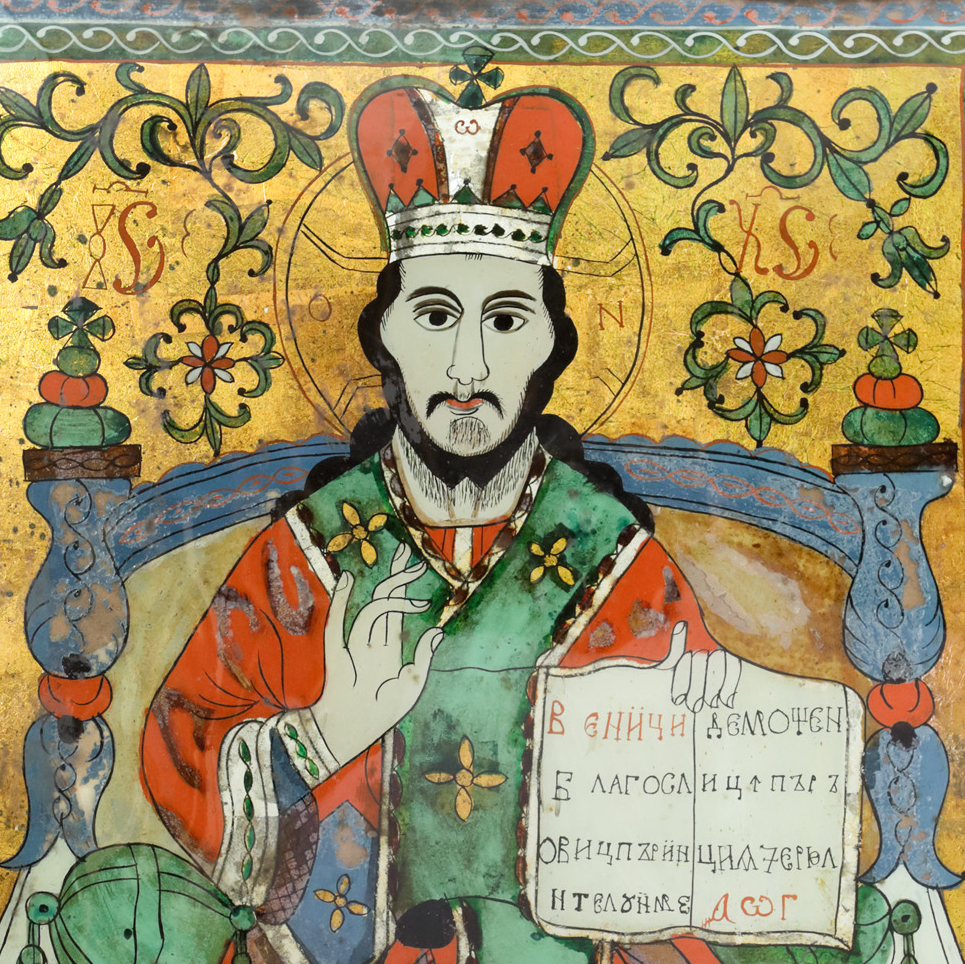
The icon, against a background made from gold leaf, giving it its own light, portrays Jesus Christ on a lavish throne with baroque forms. He is dressed in bishop's robes, blessing with his right hand and holding the open Gospel in his left. He wears a miter on his head and his hair falls in curls on his back. Around his head is a halo. Two garlands of flowers decorate the upper half of the icon. The icon is dated, in red, with Cyrillic characters, on the Gospel "1803". (M.B.)
For clarifications regarding the bidding procedure, hammer price costs, guarantee, payment, and collection terms for the winning lot, we recommend carefully reading/re-reading the Bidding Regulations.
For additional information regarding the lot and the auction, please contact the Art Consultants Department.
SESSION
Brought to you by
Similar lots
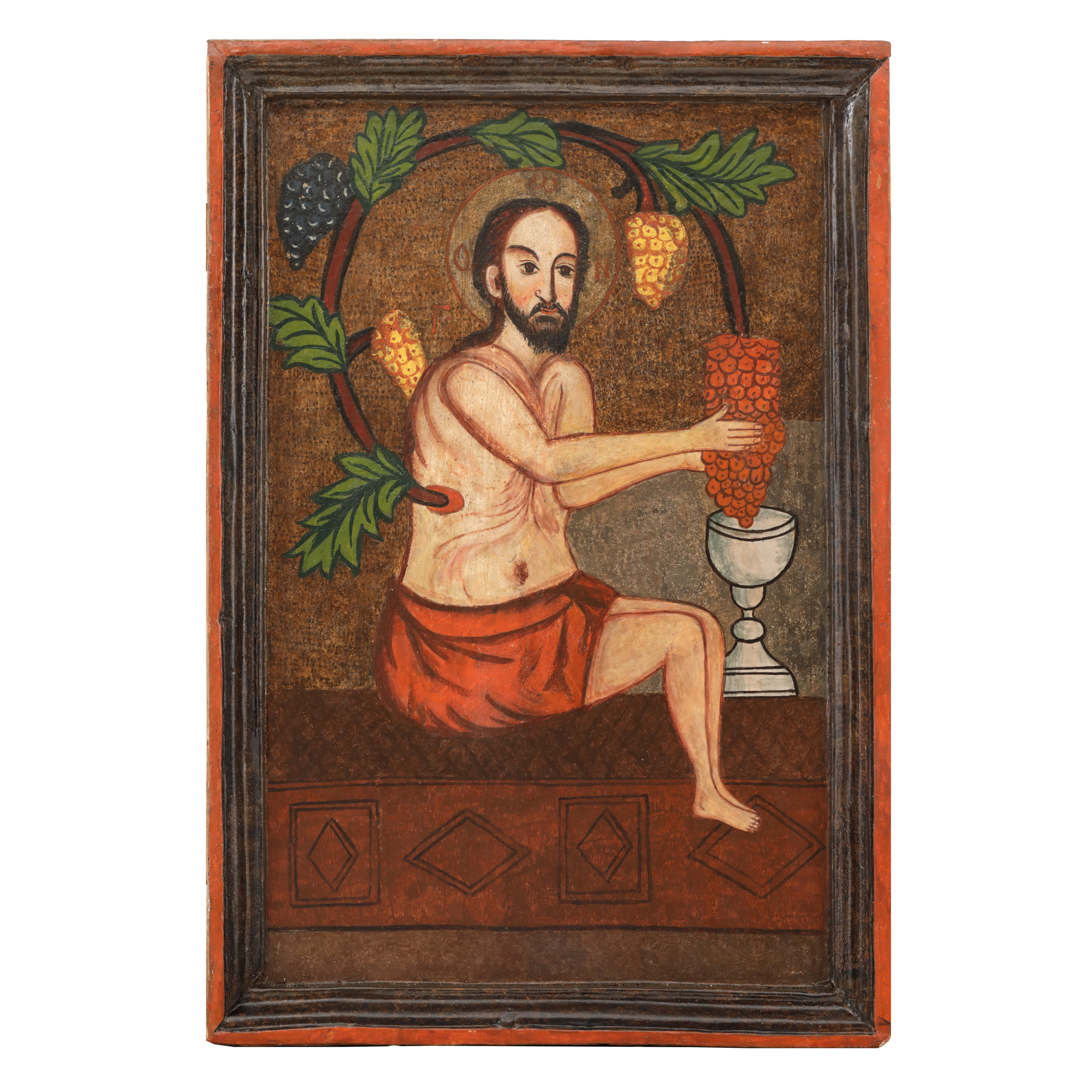
68. "Icon on wood, 'Jesus the True Vine', Transylvanian school, late 18th-beginning of the 19th century"
Starting price:
EUR 800
Not sold
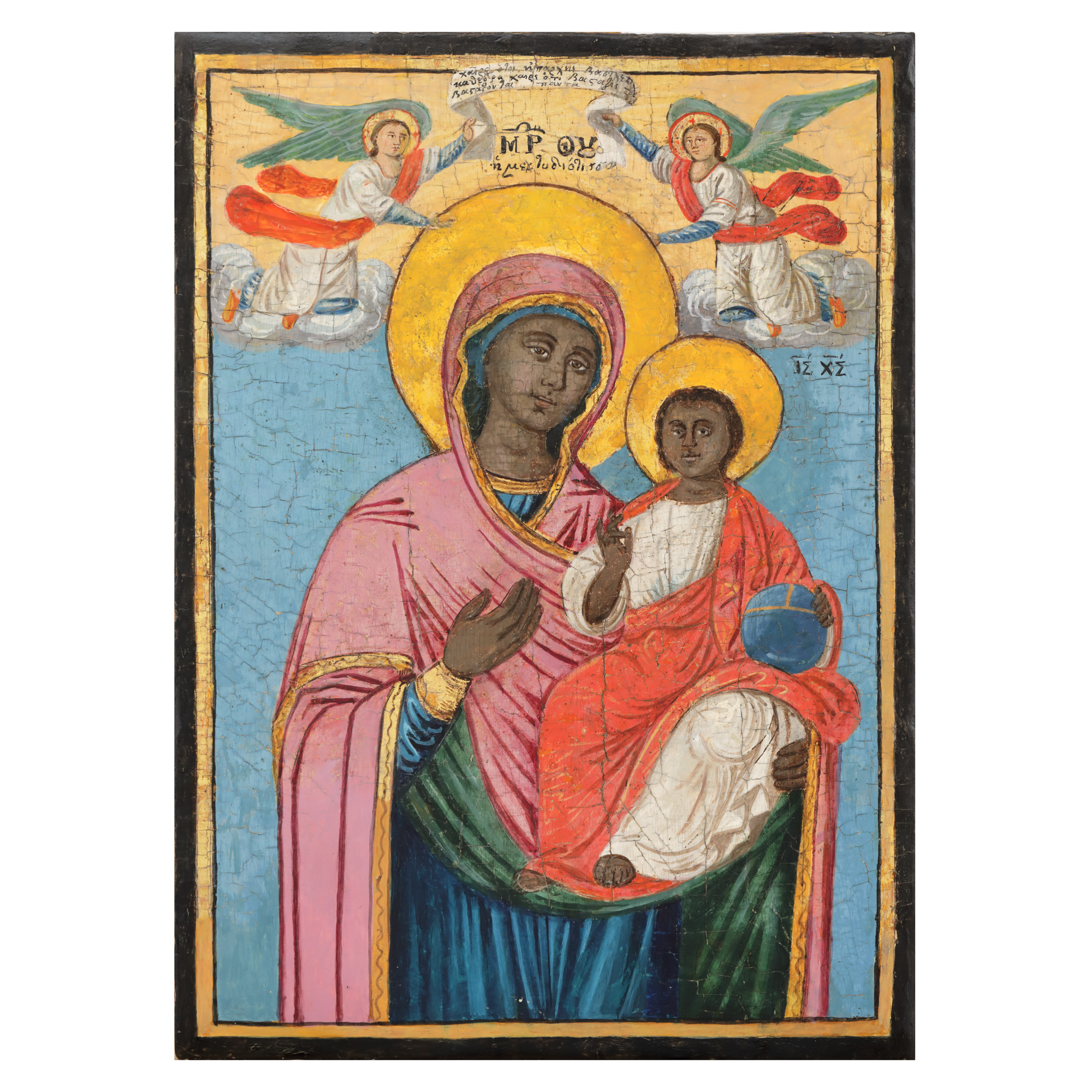
98. Icon on wood, "Mother of God with the Infant (Black Madonna)", south Danubian school of Greek influence, beginning of the 19th century.
Starting price:
EUR 1.000
Not sold
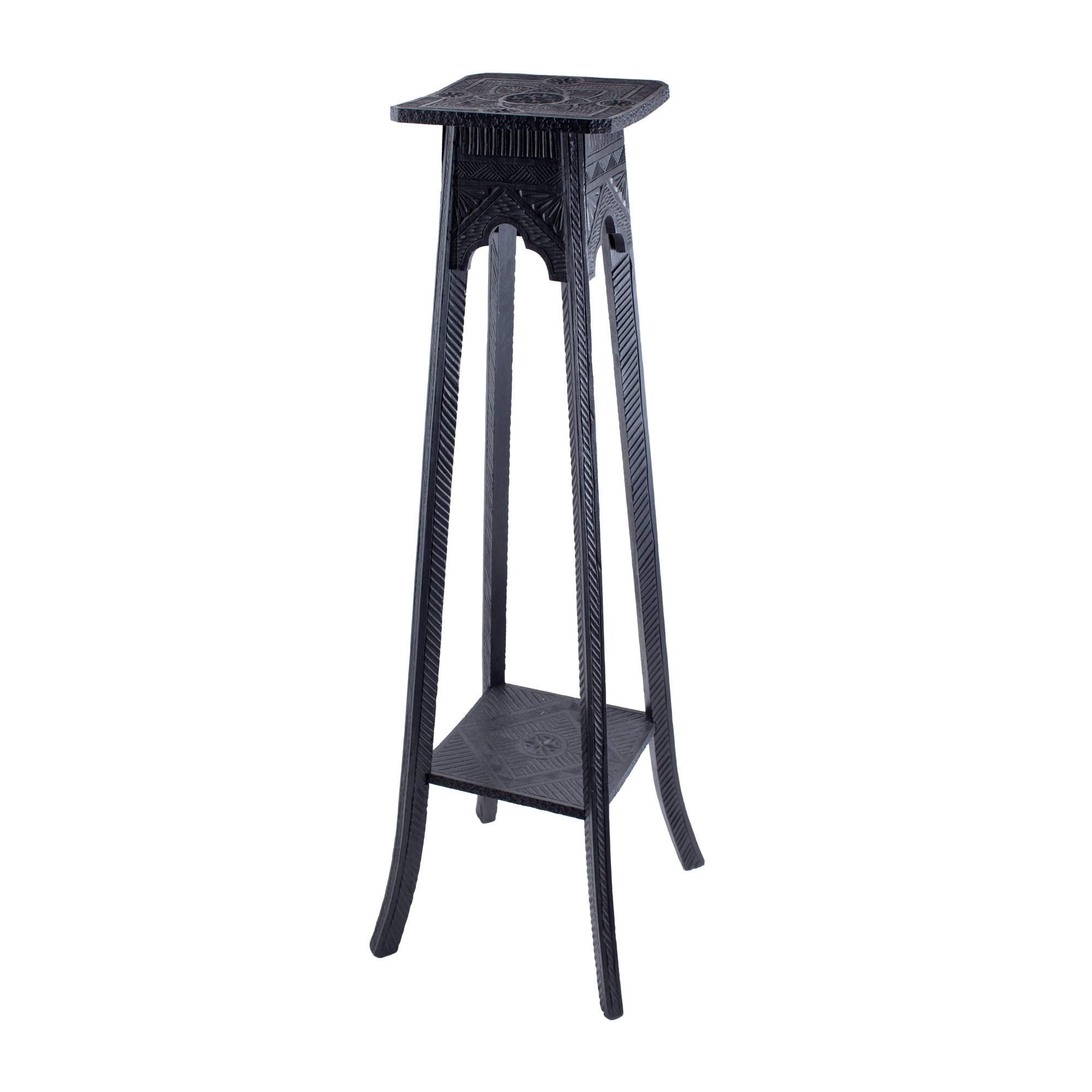
150. Neo-Romanian style pedestal, first half of the 20th century
Starting price:
EUR 150
Sold post auction
EUR 188