The photos of the lot are informative and indicative, and cannot provide a highly detailed view of the object from all angles. We recommend a careful physical inspection of the lot before bidding.
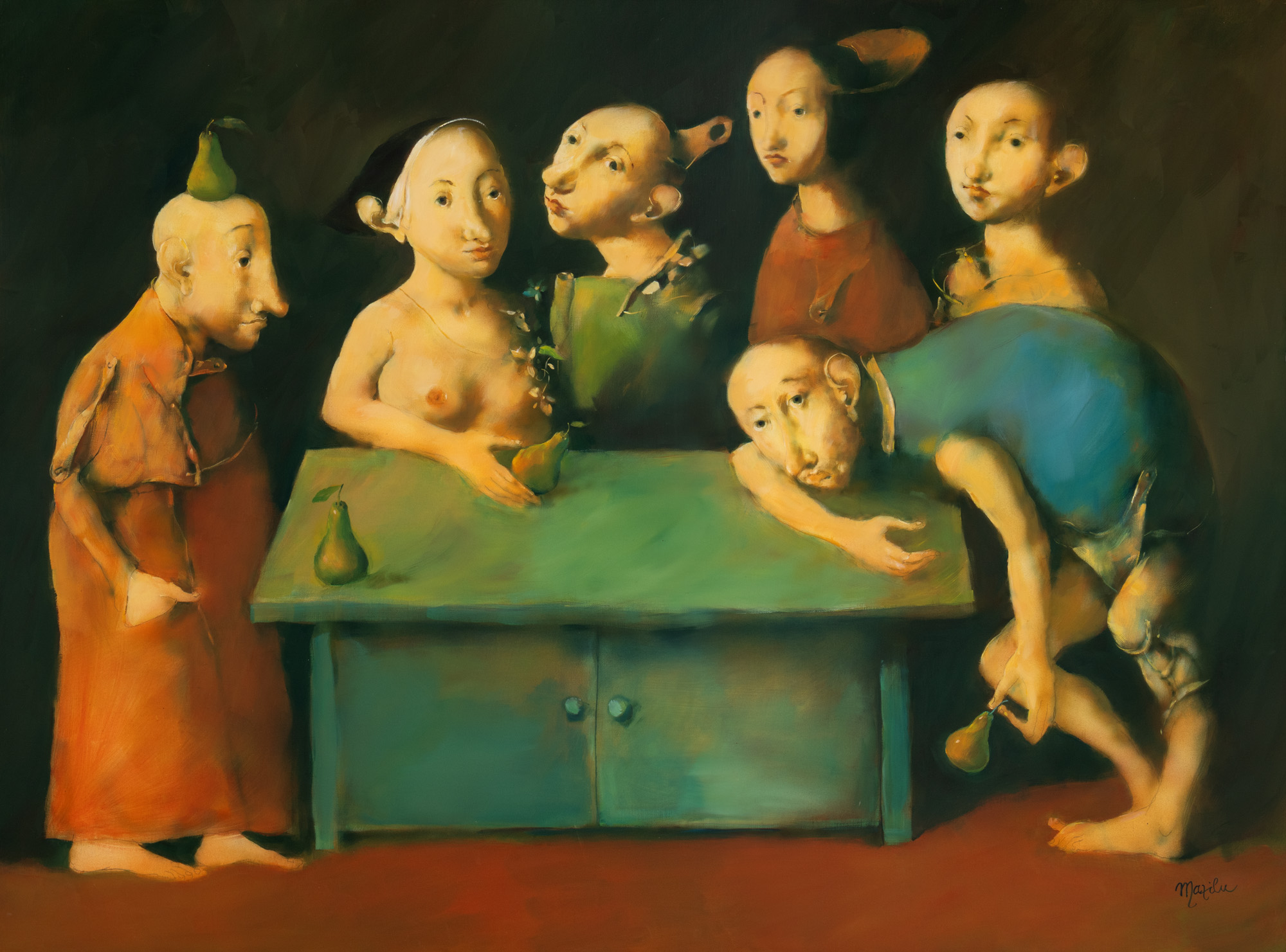
acrylic on canvas, 89 x 116 cm, signed bottom right, in black, "Mazilu"; signed and titled on the back, in black, "Mazilu, The pear festival"
At the antipodes between contemporary surrealism and the influence of Northern Renaissance art, Georges Mazilu amplifies the theatricality of the world composed by juxtaposing the aesthetics of the ugly, consecrated by Charles Baudelaire, and the timeless dimension of beauty. With an all-encompassing expressive force, Mazilu shapes the pictorial structure akin to the Old Masters. The preamble of his artistic universe encompasses satirical images, with anthropomorphic characters, meant to become aggravated pictorial metaphors. Moving to Paris, Georges Mazilu will use estrangement from his own roots, like a key element in his future works. Marked by this transition period, the painter will found his art on the background of personal emotions. Thus, his work transforms in the mid-eighties into an amalgam of inexhaustible variations that designate hybrid figures on a fantastic realm. The quintessence of his work springs from the desire to resurrect allegory and moral statement as a contemporary subject. Evoking the grotesque, his pictorial universe is under the sign of chance, his world being a theatre stage without curtains. Emerging from a world defined by illusion, Mazilu's painting is designed as an organic hybrid manifestation. The painter aims, through his works, to introduce us to the realm of superstition and the supernatural, emphasizing the idea of storytelling.
In the present work, "La fête des poires", the characters are caught in a visual drama. His partially human creatures are concentrated around a pear, a fruit that stands for isolation, becoming like the apple, a sin. The characters are engaged in an almost carnivalesque action, from which we manage to extract psychological notions about the protagonists of the work. Facial expression, gesturing, and skewed gaze are some of the defining elements of the characters present at this scene that cannot be put into exact time. His plastic discourse reflects the complexity of human feelings such as joy, sadness, naivety or duplicity. The figures of the squatty men, with yellow-rosy skin, appear to be of primordial beings that do not belong to our world. "It's a way for me to live in the company of my figures," Georges Mazilu would say about his people.
The distortion of bodies, the chromatic palette that abounds in shades of green, blue, brown, and ochre, and the perennial use of the chiaroscuro contrast provide the suggestion of volume and three-dimensionality. The message of his work is encrypted, the viewer being invited to actively participate in deciphering the metaphors found in the artist's imaginary.
For clarifications regarding the bidding procedure, hammer price costs, guarantee, payment, and collection terms for the winning lot, we recommend carefully reading/re-reading the Bidding Regulations.
For additional information regarding the lot and the auction, please contact the Art Consultants Department.
By choosing "Accept all cookies" you agree to the use of cookies to help us provide you with a better user experience and to analyse website usage. By clicking "Adjust your preferences" you can choose which cookies to allow. Only the essential cookies are necessary for the proper functioning of our website and cannot be refused
Cookie settings
Our website stores four types of cookies. At any time you can choose which cookies you accept and which you refuse. You can read more about what cookies are and what types of cookies we store in our Confidentiality Policy.
are necessary for technical reasons. Without them, this website may not function properly.
are necessary for specific functionality on the website. Without them, some features may be disabled.
allow us to analyse website use and to improve the visitor's experience.
allow us to personalise your experience and to send you relevant content and offers, on this website and other websites.