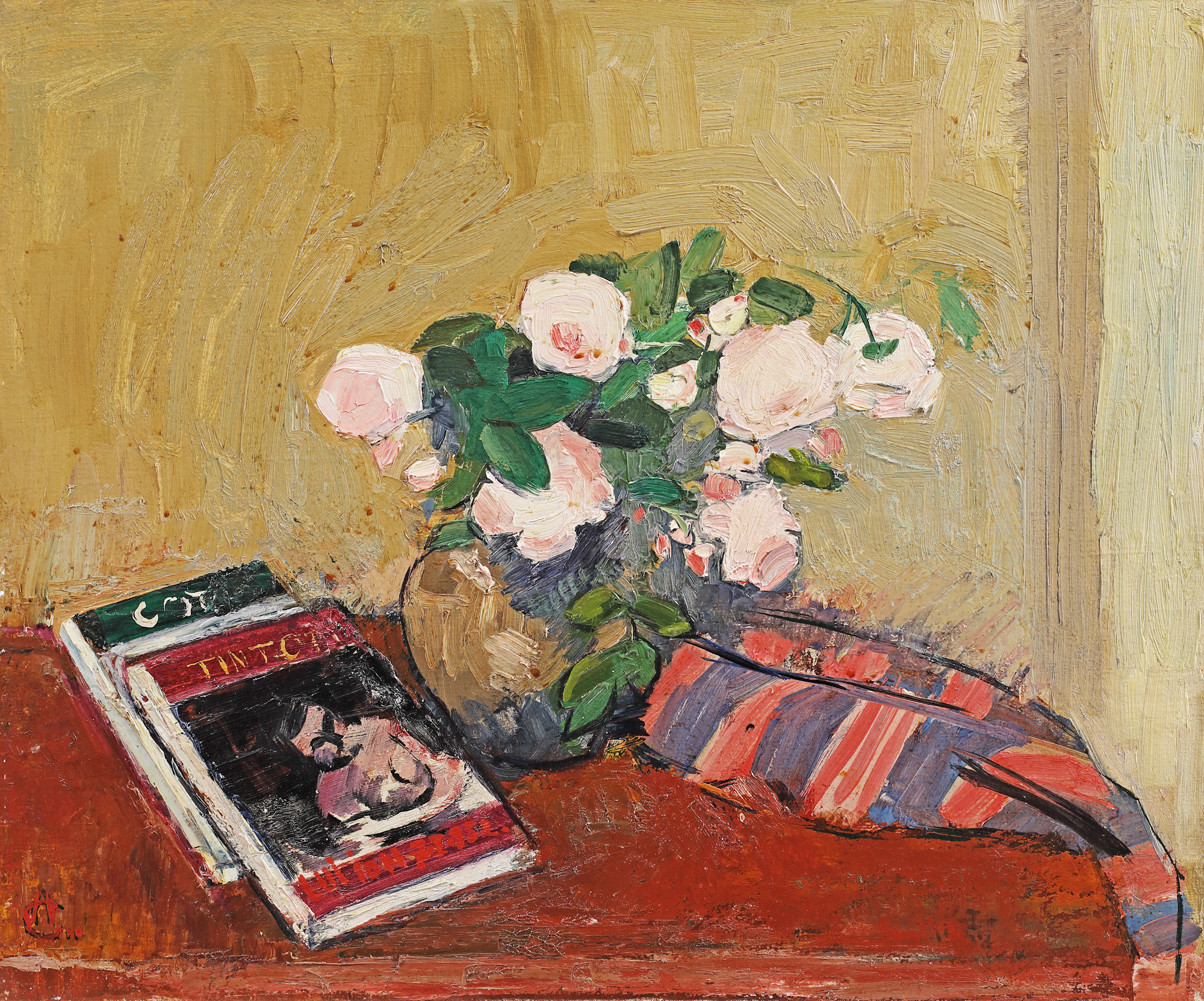
84. Still Life with Roses and Art Catalogues [1952]
The photos of the lot are informative and indicative, and cannot provide a highly detailed view of the object from all angles. We recommend a careful physical inspection of the lot before bidding.
oil on cardboard, 48 x 58.5 cm, 48 Ã 58,5 cm, signed bottom left, with black and red, in monogram, "AC"; dedicated and dated bottom centred, with red, "Lui Ion, 7.I.(1)952"
PROVENANCE
It was part of the historical collection of the composer Ion Dumitrescu until 1994.
Born in 1903 in Tulcea, Alexandru Ciucurencu becomes the apprentice of icon and church painter Mihail Paraschiv in 1916 - at only 13 years of age. The year 1921 coincides with Ciucurencu's admission at the Fine Arts School in Bucharest It is here that he studies drawing and painting under the guidance of G. D. Mirea and Camil Ressu. Between 1926 and 1928, he spent his summers with the Painter Colony in Baia Mare, and beginning with 1931 he becomes a student of the Julian Academy in Paris, furthering his opportunity to work under the wing of artist André Lohte. The latter instils in Ciucurencu the "science of colour", bringing him face to face with the works of the famous artists of the time - Matisse, Cézanne, George Braques or Picasso. However, as his works suggest, his interests are piqued by a harmonized geometry, to the detriment of cubism, which he considers "dry, artificial and devoid in lyricism". In 1932 he returns to the countryside, where he begins to exhibit for the Bucharest crowd.
In terms of the motifs used by the artis, a few favourite subjects stand out: portraits, landscapes or still life. As mentioned before, Alexandru Ciucurencu frankly expresses his preference for a harmonised geometry, and in particular the composition in harmony with light and colour. The author is also best known for his special care for colour. As the successor of post-impressionism, he takes on some of the traits associated with this movement: the autonomy of colour and the use of strong, vivid shades, without being afraid to add black to his works; pronounced brushstrokes are easily distinguished; his subjects are inspired by the immediate, everyday reality, sometimes featuring additional outlining or even being geometrised. In his volume dedicated to the painter, Mircea Deac states that "Ciucurencu brings imbues his still life works with a new pictorial interpretation of the object. The object becomes a pretext for colour, a means of chromatic intensity, a pawn within the composition." "Still Life with Roses and Art Catalogues" summarises this pictorial rendering of the object that becomes a pretext for colour. The mentioned composition describes, on what appears to be a dark-coloured table, the presence of a vase with roses - the shades chosen to illustrate them are rather pastel, while a textile object, rendered with bright colours, appears to the right side of the vase; and a few art catalogues are illustrated on the left, imbued by the painter with dark shades, in contrast to the background wall. The composition is clear, decipherable, accessible to the viewer, well structured; with visible paint brushes – these are more pronounced in the upper part of the painting, while the lower part seems less devoid of these brush accents. The relations between colours and shapes describe the artist’s universe and bring to the fore the pictorial rendering of the object mentioned by Mircea Deac in his book.
For clarifications regarding the bidding procedure, hammer price costs, guarantee, payment, and collection terms for the winning lot, we recommend carefully reading/re-reading the Bidding Regulations.
For additional information regarding the lot and the auction, please contact the Art Consultants Department.