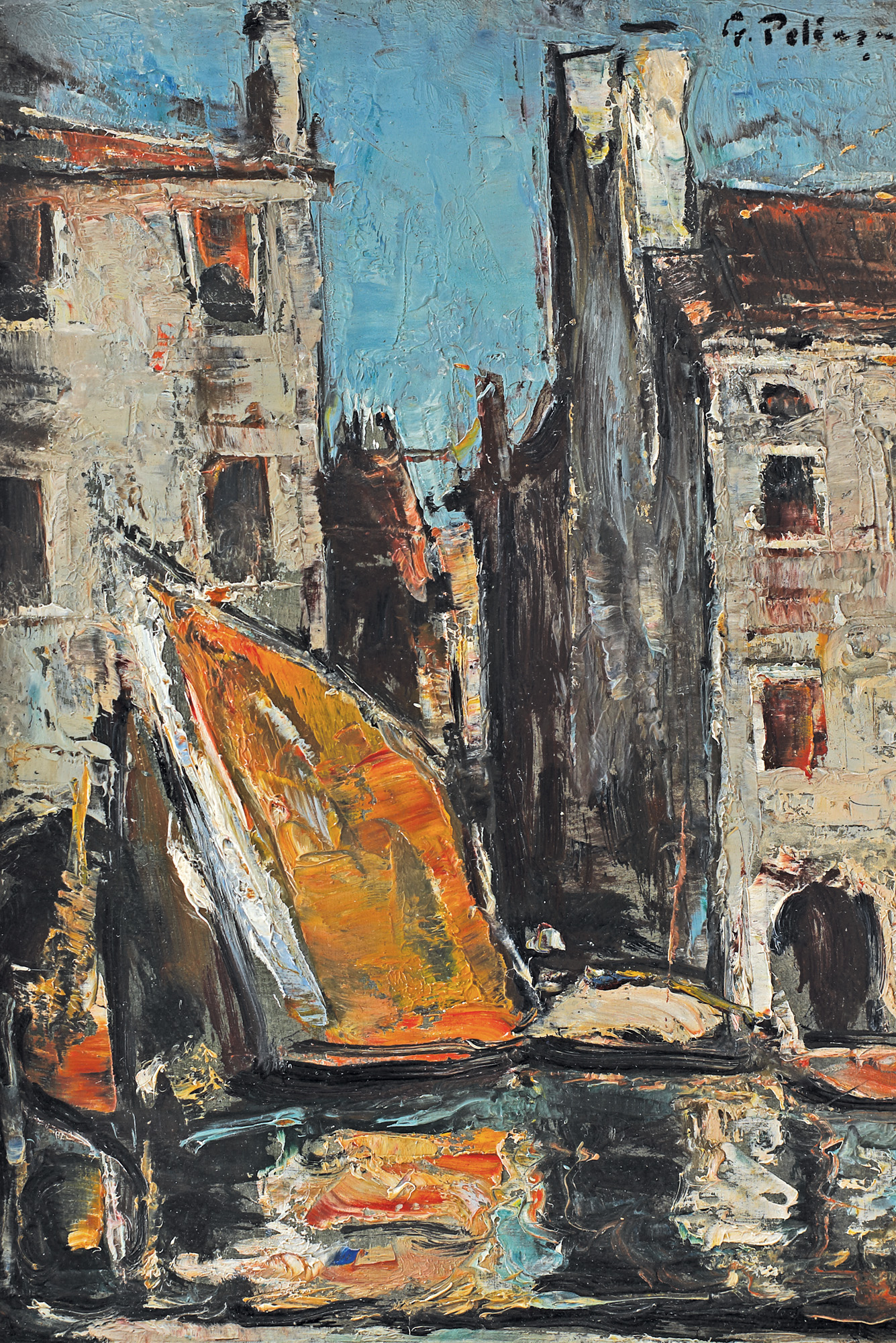
The photos of the lot are informative and indicative, and cannot provide a highly detailed view of the object from all angles. We recommend a careful physical inspection of the lot before bidding.
NADIN, Mihai, "Hans Eder", Meridiane Publishing House, Bucharest, 1973 "Expoziție retrospectivă Hans Eder. 125 de ani de la naștere" ("Hans Eder retrospective exhibition. 125 years since his birth"), Brașov, 2008
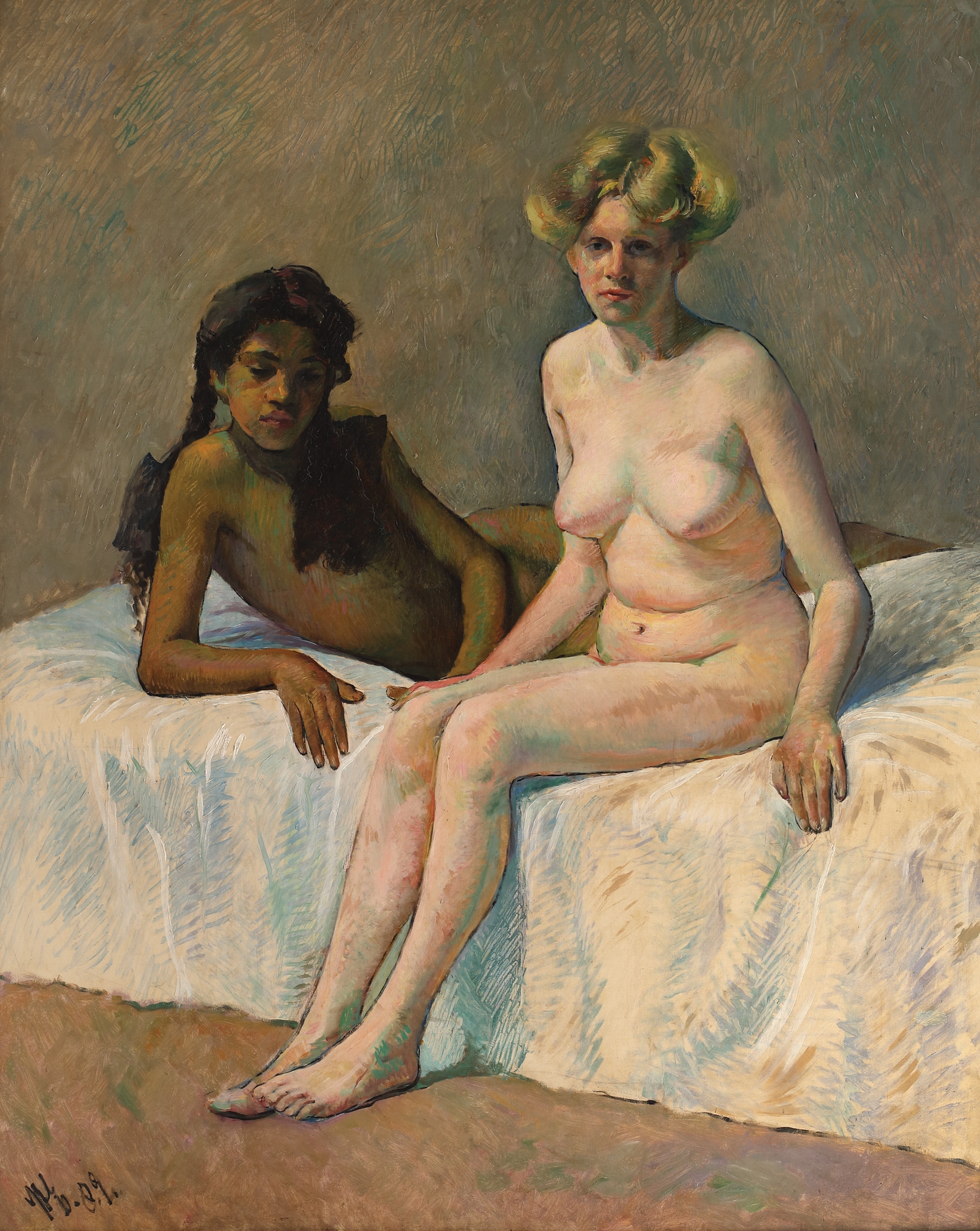
oil on canvas, 149 x 124 cm, 149 Ã 124 cm, signed and dated bottom left, in monogram, with black, "H.E., (19)09"
Research information
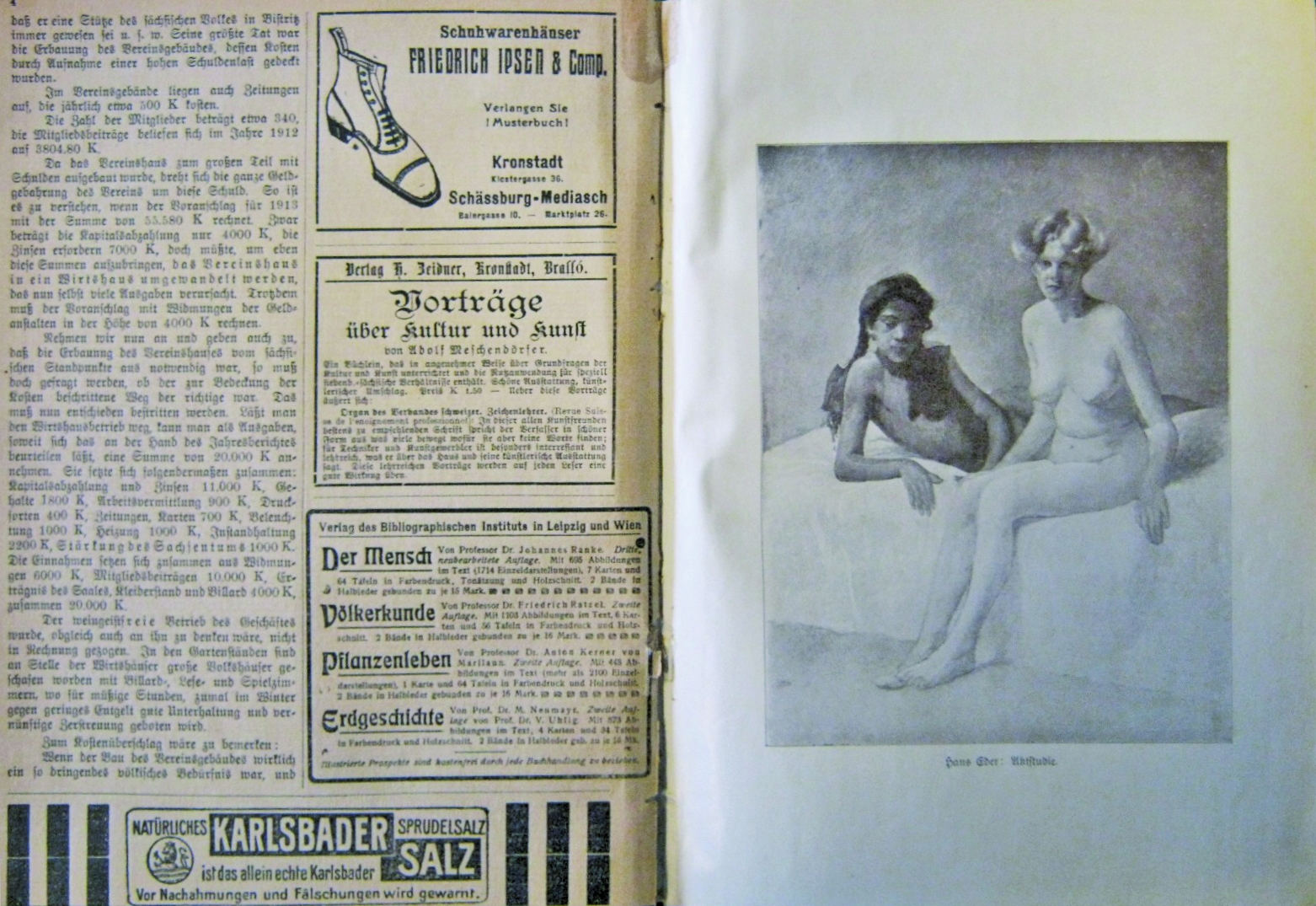
The artwork is reproduced in "Die Karpathen" magazine, 1913, vol. 9, p. 5.
Born in a wealthy family of Transylvanian Saxons, Eder lost his mother the same year he was born. To some extent, we can relate to this biographic aspect, in the form of the deeply sentimental inflexions of that strong expressionism which we are so familiar with. The cultural environment in which he evolved in the first 20 years of his life was exclusively defined around Brașov, the terminus point in the small artistic universe known to Eder until his departure for Germany. The entire study period coincides with the Brașov years, until the age of 20, in 1903, as Hans Eder evolved under the influence of the local artistic centre. At that time, this cultural core took shape around the figure of Ernst Kühlbrandt, a teacher at the Kronstädter Gimnasium, as well as Eder's first teacher. This character's role for the young painter's artistic education is even more important, as the teacher's field of qualification outgrew mere painting, as he was one of the "pillars" of the Brașov society, a poet, a historian, a man of culture. The cultural core of the city of Brașov was held together in the Transylvanian space thanks to Arthur Coulin, and the direct activity in the city's artistic environment will be brought to fruition through the creation of the atelier-school, alongside Friedrich Miess. Eder has also walked through that atelier's door, guided by his thirst for knowledge of two important contemporary painters. Another interesting and important character was Adolf Meschendörfer, a distinguished intellectual who would put a focus on painting, through illustrations and eloquent articles in the publications of those times, presenting it as one of the necessities of Transylvanian society. These activities will polarise around the “Die Karpathen” magazine, one of the few specialistic publications from the first decade of the 20th Century. Meschendörfer speculates the quality of the works of some painters he had met through his friendship with Coulin, and starts including illustrations with that generation's works. The value of Eder's work is recognised, and consequently his works start being analysed and illustrated in this primary source of information offered by the Brașov-based publication. Also in "Die Karpathen" we can admire one of the earliest works remaining for posterity, one of the earliest paintings, “Peisaj pe valea Inn-ului” ("Landscape in the Inn Valley"), where the pictorial tendencies of the first years of practice can be noticed. This deeply impressionist image shows us the involvement extent that Eder experiences when studying all the styles able to offer him a source and a ground of expressiveness. The aforementioned phase is rather easily overcome, but the consequences would make themselves felt in the Post-impressionist palette that he develops in the immediately following period. Although the aforementioned work is linked to the Munich years, being contemporary to his departure for study purposes in 1903, Eder will soon give up on picturesque images in order to focus on an urban micro-universe. In Munich, he initially joins the “Schule für Graphische Künste” under the guidance of Moritz Heymann, and later on he directs himself towards “Kunstakademie”, class of Professor Hugo von Habermann. This first decade of studies, coinciding with the first decade of the 20th Century, is completed with a semester-long journey in Paris, at the “La palette” atelier-school, where, for a few months, he follows Lucien Simon. The urban universe represented a unitary theme in the artistic conception that Eder formulates in the 50 years of plastic activity. The thorough study of the Munich lessons, alongside the time spent in Bruges, Belgium, linked with a completely urban cultural structure, would represent the pillars of that universe assumed by Eder, which would become unique in the Romanian space. A synthesis expressionism, practised in depth especially through the exceptional quality of portraits, Hans Eder's style connects with the spirit of a society avid for profound images, of man amid an unfolding urban scenery. When approaching a classical theme, such as the nude, Eder uses the pictorial complex he had at hand at that date. The actual painting starts showing some future tendencies, which we notice also in the current work. The paintbrush movement exerted on the background seems to be a personal approach of a post-impressionist visual complex, the intermittent paintbrush strokes on the used surface, however, was not used for the chromatic quality offered by the decomposition, but especially for the creation of an expressive frame. The same painting manner also appears more in depth later down the line, while creating skies that remind of Edvard Munch's painting, hence a total appropriation of European Expressionism. Another discussion raised by this work is drawn around the central motif, as the two nudes are the source of a different symbolism. Through a classic connection, we can accept the painting of diversity, of the other, through the appearance of the exotic character. This hypothesis seems to be supported also by the presentation of bodies, as the creole character appears in a relaxed position, lying on a bed and with a discreet smile on her face. The character on the right appears to be in a slightly embarrassed, uncomfortable posture, while his face and hairstyle unmask a stylish character. The composition is pulled together coherently, although the pictorial masses are highly individualised and separated through the large occupied surfaces.
For clarifications regarding the bidding procedure, hammer price costs, guarantee, payment, and collection terms for the winning lot, we recommend carefully reading/re-reading the Bidding Regulations.
For additional information regarding the lot and the auction, please contact the Art Consultants Department.
By choosing "Accept all cookies" you agree to the use of cookies to help us provide you with a better user experience and to analyse website usage. By clicking "Adjust your preferences" you can choose which cookies to allow. Only the essential cookies are necessary for the proper functioning of our website and cannot be refused
Cookie settings
Our website stores four types of cookies. At any time you can choose which cookies you accept and which you refuse. You can read more about what cookies are and what types of cookies we store in our Confidentiality Policy.
are necessary for technical reasons. Without them, this website may not function properly.
are necessary for specific functionality on the website. Without them, some features may be disabled.
allow us to analyse website use and to improve the visitor's experience.
allow us to personalise your experience and to send you relevant content and offers, on this website and other websites.