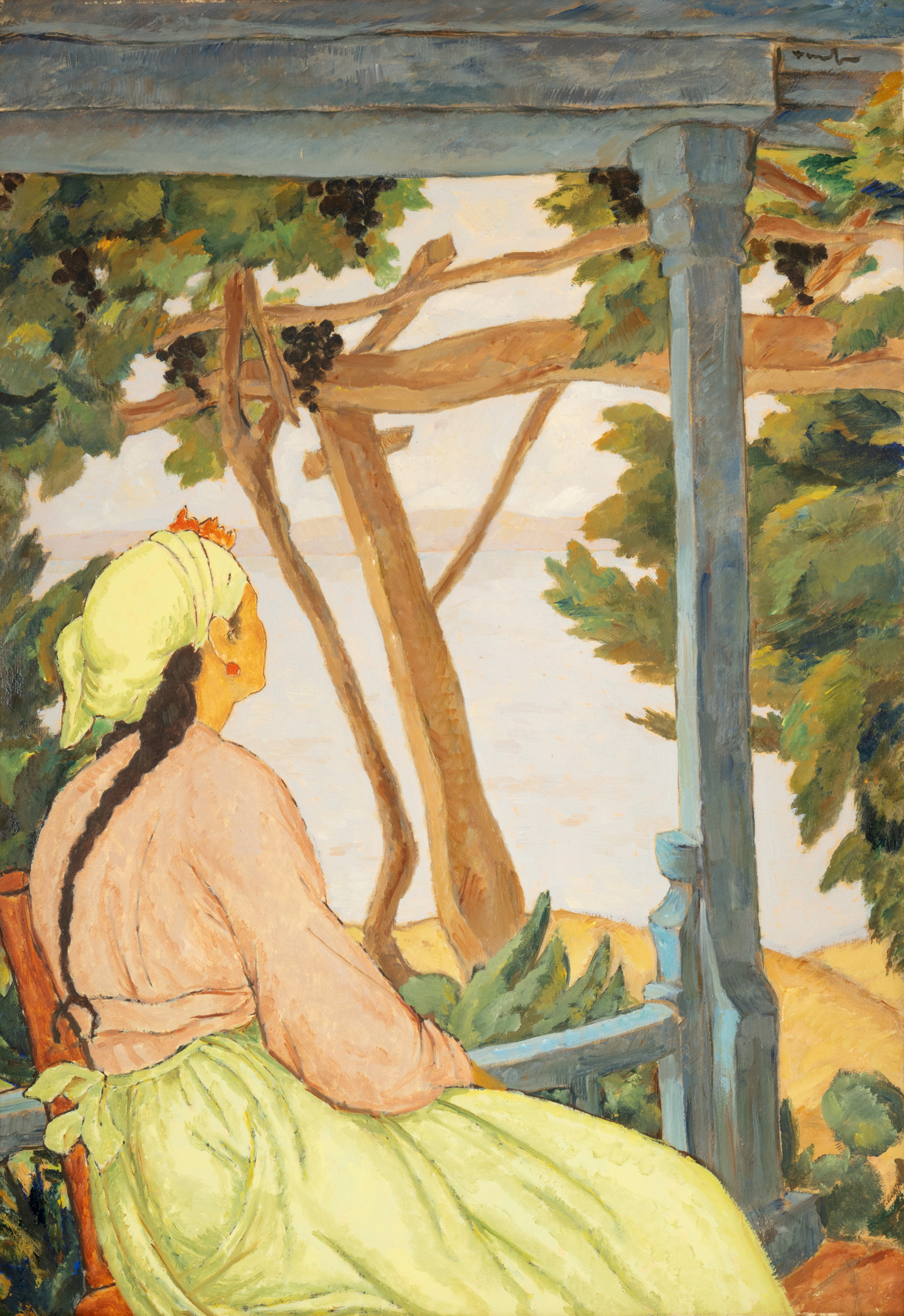
62F. In Balchik (Tatar Woman Looking at the Sea) [1934-1935]
The photos of the lot are informative and indicative, and cannot provide a highly detailed view of the object from all angles. We recommend a careful physical inspection of the lot before bidding.
62F. In Balchik (Tatar Woman Looking at the Sea) [1934-1935]
PĂULEANU, Doina, Nicolae Tonitza, Ed. Monitorul Oficial R.A., Bucharest, 2014.
ȘORBAN, Raoul, Tonitza, Ed. Meridiane, 1973.
oil on cardboard, 102.5 x 71 cm, signed upper right, in black, "Tonitza"
Research information
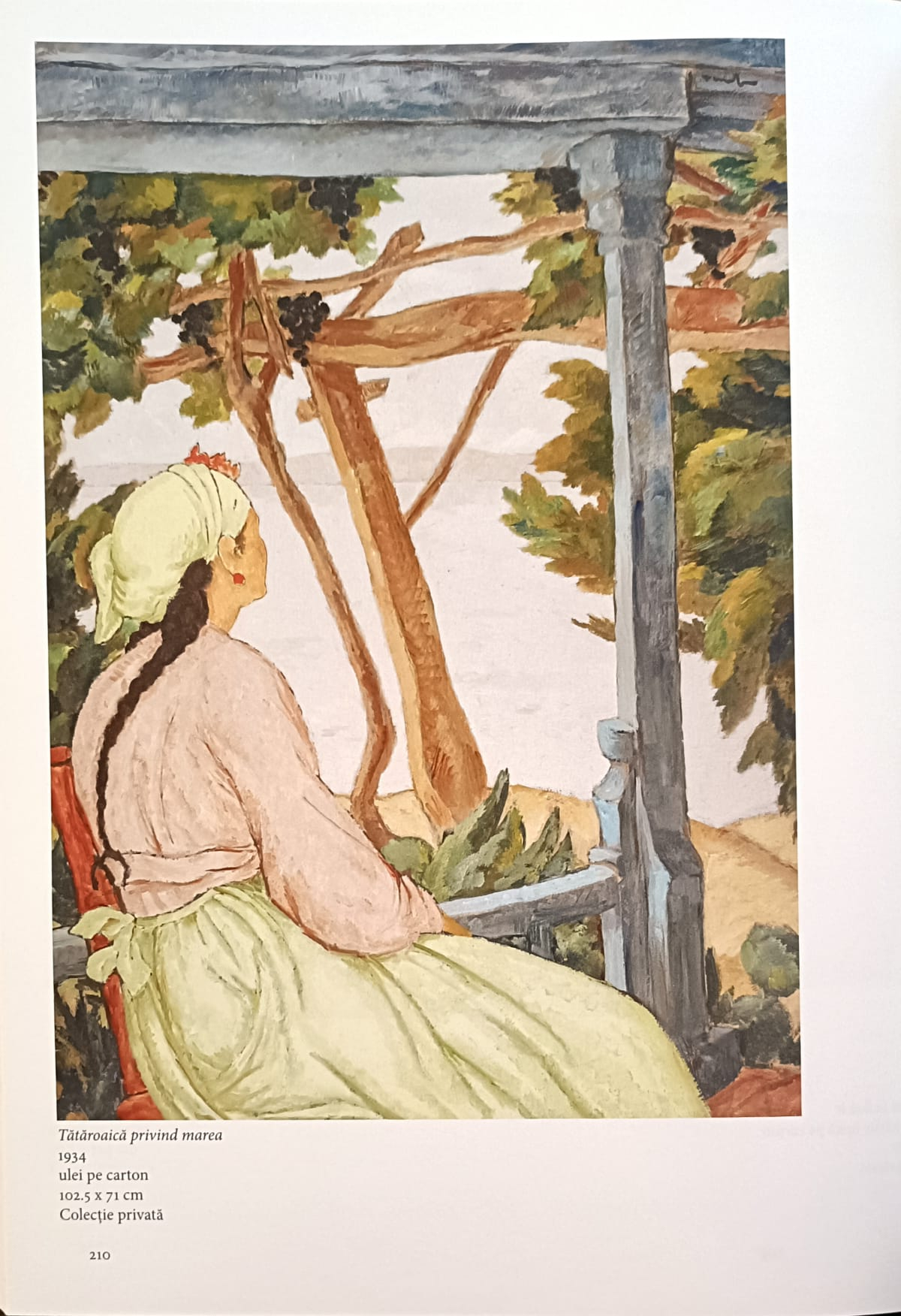
The work was part of the exhibition "Tonitza and the Genius of Childhood", Art Safari, Bucharest, 2019 and is reproduced in the exhibition catalog, page 210.
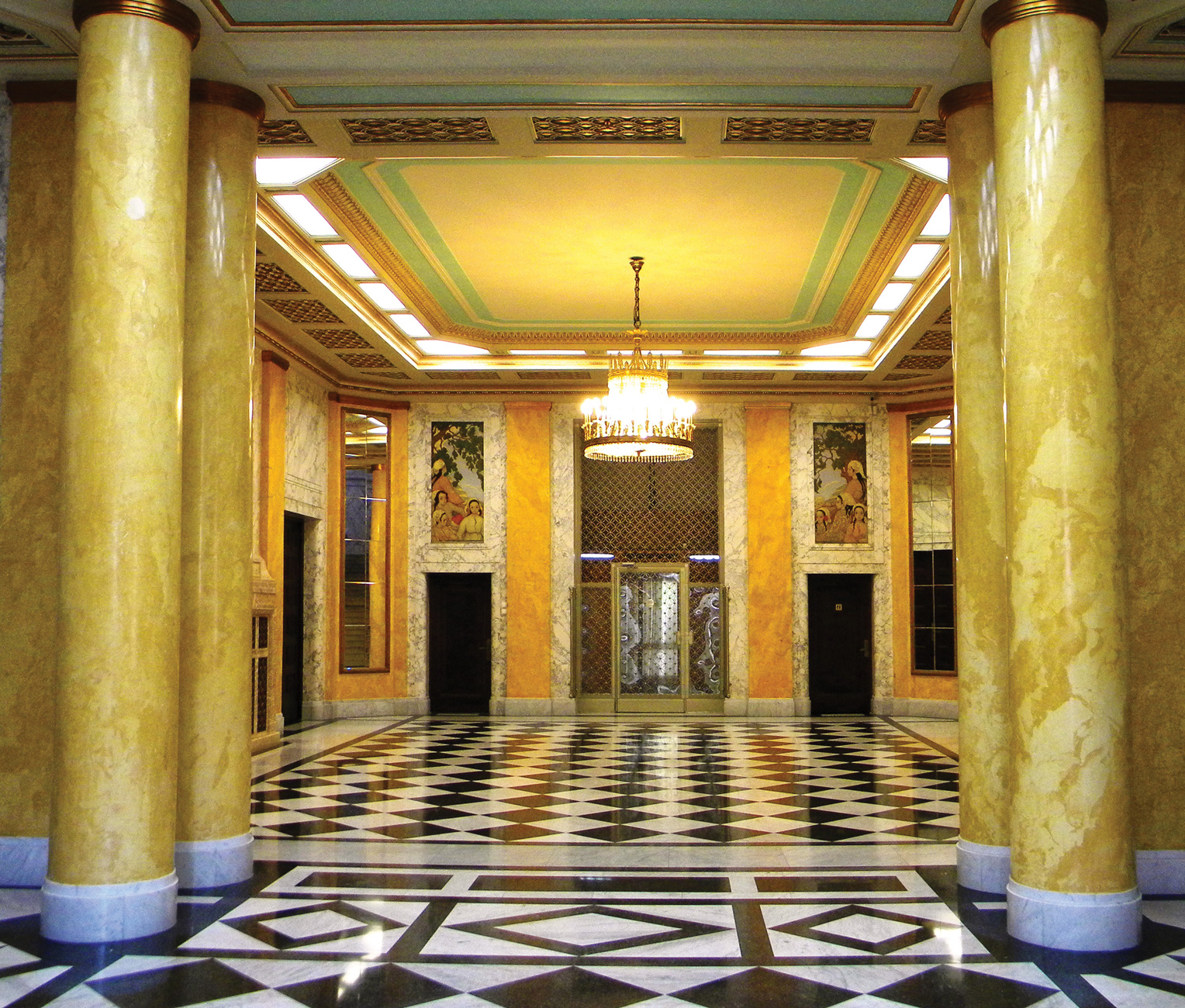
The work, also known as "From the Fisherman's Porch", is related to the order honored by Nicolae Tonitza in 1934-1935 for the decoration of the Royal Palace. The Tatar woman from this painting is found painted on one of the two panels inside the Palace, being also the central subject of this work.
At the Han-Șirato-Tonitza Group exhibition at the Dalles Hall in May 1934, Tonitza exhibited under cat. 46 the work titled "The Blue Porch", a name that entitles us to consider it to be the work in question. This fact is not only reinforced by the subject of the current painting, but also by the fact that the entire exhibition was designed around the oriental universe from Balchik and Mangalia, with all 44 works dedicated to it.
In the landscape of the 1930s Balcic period, Tonitza will capture endless subjects of inspiration. The intimate and picturesque beauty that he discovers here will serve as a model in perfect harmony of color, shape, lines, and movement.
During the years spent in Balcic, the painter will begin to focus on creating female portraits, especially of the Tatar women, creating a series of works inspired by the Black Sea area, using a limited palette of colors, such as: "Eternal Silence", "Balcic Café", "Balcic at dawn", "Osman's Gate", "Turkish Bath", "Cup of coffee" or "Mamut's Café".
Here too, he will meet and fall in love with the Tatar women whom he will begin to capture on the promenade or in the Tatar mahala, bearing names such as: "Abibé", "Cadié", "Demirnà", "Rachiş Ali" or "Hamidé". The artist often paints them, fascinated by their faces, sometimes caught in profile, sometimes in semi-profile, covered by turbans, scarves or clothes. Sometimes he captures them in landscapes, framing them in idyllic picturesque spaces. The promenade, interiors, porch or garden, will be the places where we will most often find them depicted.
The female silhouette, drawn or painted, will always be captured by the painter with elegance, paying attention to details, to the brilliance of color and to the atmosphere of the oriental landscape. Often captured in the porch, on a chair, with thoughtful or melancholic gaze, Tonitza's Tatar women will depict true ideals of pictorial beauty.
The summers spent in Balcic will fill Tonitza's canvases with cafes, traditional houses, flower shops, mosques, porches, mahalale, the charming gulf of the dobrogean space or the portraits of Turks, the odalisques or the small Tatar women. The mirage of the oriental world will give a new rhythm to the creations made in Balcic, and the sinuous arabesques of the lines will appear more and more in the work specific to this period. The artist captures the atmosphere and local color through a considerable reduction of the palette to just a few shades spread over large areas.
Nicolae Tonitza will dedicate a long series of works and characters from the Dobrogea regions. The portraits of the odalisques and the small Tatar women will constantly appear in the form of sketches or works painted in oil. He captures the particular features of the locals of these regions, among which we mention the almond eyes and their mannerist elongation, but he will also use the clothing and scarves characteristic of the area.
Tonitza's Tatar women transcend pure pictorial representation, often being integrated into poetic compositions, full of a romanticism that often defines the painter. The atmosphere of the place, the light, the nuances, the clothes, the ornaments, the interiors, all will participate in the description of the wonderful picturesque settlement. The representations of the Tatar women with almond eyes, nostalgic and withdrawn, in ample clothing and scarves create the appearance of a transparent, sincere universe of Balcic.
His color palette thus becomes the sensitive image of an idea, related to attitudes, thoughts or emotions, used by the artist to evoke what he loved most: people, nature and Balcic.
The work in question is a telling example of the sensitivity with which the artist captures the oriental charm of the place and the delicacy of the female characters. The painting captures a young Tatar woman, portrayed from the back, in a contemplative attitude, looking into the distance towards the expanse of the sea. Her silhouette is slightly bent forward, suggesting a moment of introspection and dreaming as if she were silently listening to the sounds of the waves. The artist does not allow us to see the features and physiognomy of the character portrayed, leaving us to observe more her clothing.
The young woman's clothes are made in delicate shades of green, pale pink and orange, rendered with meticulous attention, and the texture of the fabric seems almost palpable. The young woman portrayed wears on her head a green scarf specific to the Tatar women from the Balcic area, which covers her forehead and which is tied at the back.
The bright, warm chromatic range gives the character an air of fragility, calm and grace. The contrast between the fineness of the clothing colors and the background composed of saturated tones of green and brown, along with the light blue of the porch pillars, in which she is, creates a subtle harmony, amplifying the impression of intimate and protected space, where the light seems to support the entire scene in a gentle atmosphere, transforming the place into a visual and emotional refuge for the young woman who contemplates.
Thus, the painting not only captures the beauty of the moment, but invites the viewer to penetrate the silence and melancholy of this suspended moment in time and space where simple gestures become carriers of depth and sensitivity. (S.S)
For clarifications regarding the bidding procedure, hammer price costs, guarantee, payment, and collection terms for the winning lot, we recommend carefully reading/re-reading the Bidding Regulations.
For additional information regarding the lot and the auction, please contact the Art Consultants Department.