The photos of the lot are informative and indicative, and cannot provide a highly detailed view of the object from all angles. We recommend a careful physical inspection of the lot before bidding.
COMAN, Anton, "Octav Băncilă", State Publishing House for Literature and Art, 1954.
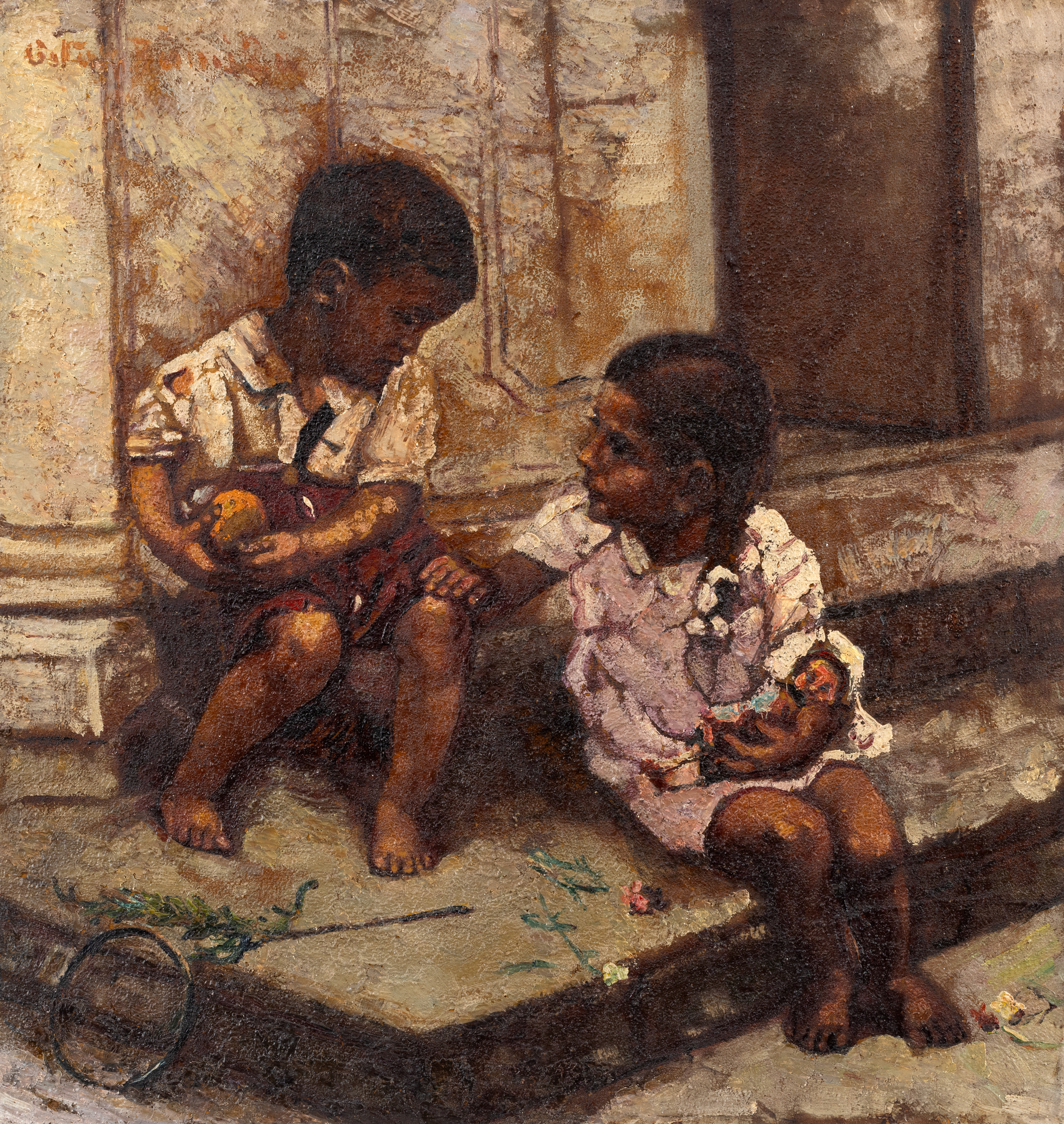
oil on cardboard, 54 x 51 cm, signed top left, in brown, "Octav Băncilă"
"It was at the end of a school holiday, in August. Playing in the yard of the house in Sărărie, I hid among the tall dolls in front of the house and made a human face from clay. To make it as expressive as possible, I put some black coal in its eyes, and from the silk of the corn I matched its hair, beard and mustaches." Octav Băncilă would confide to journalist C. Săteanu in a 1933 interview. This is also the decisive event that led his brother-in-law, Ion Nădejde, to enroll his nephew in the School of Fine Arts. Play as a form of expression and modus vivendi followed him throughout his life, translating into a favorite pictorial motif in adulthood. He himself was the father of ten children, often transposed into his works: "Caught in calculations", "The Punished", "The Little Rebel", "The Goose Attack" or "First Steps" are just some of the works that reveal the artist's family. The current work could also represent a family scene. The playful theme is illustrated through a touching composition, which features two barefoot children, obediently sitting on stairs; holding their toys firmly in their arms. We note the gesture of affection, modest clothing; but also the use of browns and bricks specific to Băncilă. Scenes from rural life would become representative in his work, whether of social or political inspiration. The childhood spent in Botoșani, and later the move to Iași, in the house of his sister, Sofia Nădejde, would undoubtedly contribute to the shaping of this strong thematic cycle in his work. Octav Băncilă therefore grew up in the house on Sărărie Street, next to Sofia, her husband and their six children. The courtyard was the ideal playground for the children, a large yard, with firs and a cornfield. In his reminiscing, Băncilă mentions the play in the cornfield, or climbing the fence, from where he could admire Valea Țicăului. Living in his sister's house was a significant stage in the artist's life, given that the magazine "Contemporanul" had its headquarters at the same location. Being a child, he did not attend the magazine's meetings, but secretly listened to N. Beldiceanu reciting poems. His involvement in the genesis of the magazine was made by unloading, numbering and taking to the post office the publications that had to be delivered. The house on Sărărie Street was located near Creangă's bojdeucă, thus the following narrative becomes even more significant: "Ion Creangă, being with us, took me to him, in his small "bojdeucă", which I painted later. Wise and friendly as he was with children, for he had a godly gift to conquer their souls - Creangă, as tiny as he was, grabbed me by the end of my head, winding his hand behind his neck, and that's how we walked down Sărărie Street to his hovel. We entered the house, Creangă being greeted by his favorite cats. Then we both went out to the porch, from where we admired the enchanting panorama of Ciric and Șorogari, at the foot of which you can see the picturesque projections, the gardens and the hovels in the valley of Țicăului", Octav Băncilă was telling in the same interview.
For clarifications regarding the bidding procedure, hammer price costs, guarantee, payment, and collection terms for the winning lot, we recommend carefully reading/re-reading the Bidding Regulations.
For additional information regarding the lot and the auction, please contact the Art Consultants Department.
By choosing "Accept all cookies" you agree to the use of cookies to help us provide you with a better user experience and to analyse website usage. By clicking "Adjust your preferences" you can choose which cookies to allow. Only the essential cookies are necessary for the proper functioning of our website and cannot be refused
Cookie settings
Our website stores four types of cookies. At any time you can choose which cookies you accept and which you refuse. You can read more about what cookies are and what types of cookies we store in our Confidentiality Policy.
are necessary for technical reasons. Without them, this website may not function properly.
are necessary for specific functionality on the website. Without them, some features may be disabled.
allow us to analyse website use and to improve the visitor's experience.
allow us to personalise your experience and to send you relevant content and offers, on this website and other websites.