
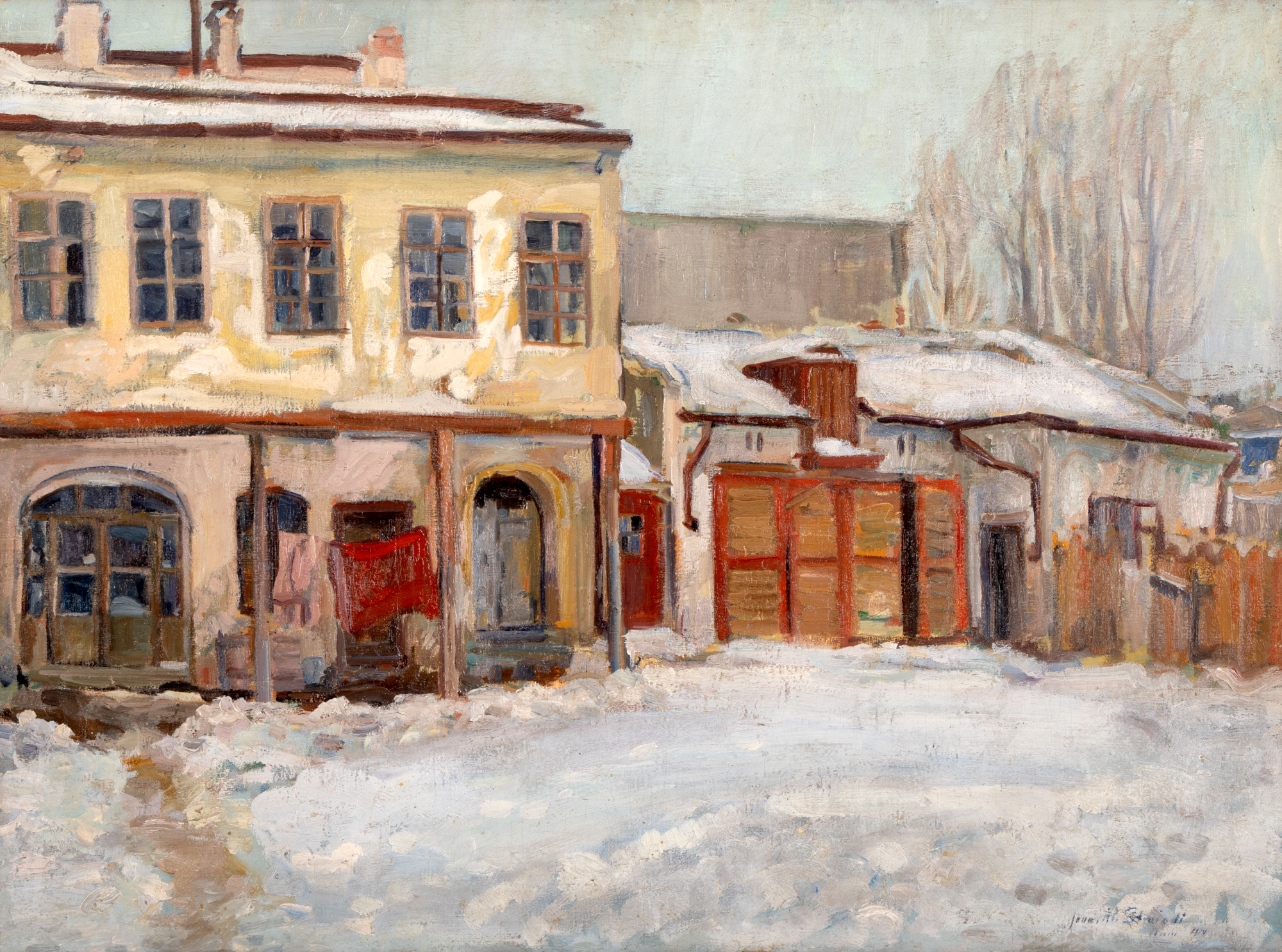
135. The old inn's courtyard [1914]
The photos of the lot are informative and indicative, and cannot provide a highly detailed view of the object from all angles. We recommend a careful physical inspection of the lot before bidding.
135. The old inn's courtyard [1914]
1880, Bucureşti - 1956, Bucureşti
Not sold
Selling price
EUR 14.472
oil on canvas, 61 x 81 cm, signed and dated bottom right, in blue, "Jean Al. Steriadi, Steriadi, 1914"
Jean Alexandru Steriadi's place in Romanian painting was established, justified and valued from the early years of practice, 1900-1910, when he quickly became a part of the elitist selection of creators of beauty in the home space. Starting with the second decade of the 20th century, Steriadi also became a moderator of Bucharest's artistic life, becoming both the director of the Aman Museum (1909), and the Kalinderu Museum (from 1915), his status being entrenched by the role he played in Tinerimea Artistică society. At the same time, his interest in the conservation and valorisation of heritage - the Ioan Andreescu exhibition - would propel him into the ranks of decision makers in Romanian arts.
As for the pictorial component, Steriadi began to outline his own manner, superseding in a way the label that Lucien Simon's influence had marked in the era. He tried to purify the human instances that dominated his visuals, especially the urban ones, and typical social components took a back seat, giving way to a landscape uncontrolled by man. In a response to this thematic refocusing, stylistic changes occur as a direct result of a newly discovered environment flooded with pure hues. Under the spectrum of a new way of perceiving chromatic play, we can translate this mutation, and like a snowball effect, the emphasis of these compositions now falls on light and the incidences they produce.
Of course, the technique also suffers the reverberations of a complete modelling process, and the result is observed in the analysis of brushstrokes. These typical impressionistic characteristics are the result of successive accumulations, with decisive factors being mainly represented by study trips in France. Starting with visiting Brittany year after year, Steriadi's art gradually transforms into the relevant pictoriality of an artist continuously attacked by diverse stylistic inflections. He accepted the impressionistic manner because it is the only one that succeeds in helping him translate his personal way of perceiving and expressing in front of the motif.
Attracted by the pictoriality offered by the forgotten corners of Bucharest, Steriadi adds to this common theme among Romanian landscape painters, painting during the winter. Using the specificity of the moment, the environment flooded with light, Steriadi manages to highlight in several revealing works - done during 1912-1915 - his interest in cold and neutral tones, merged into an entire complex of such unprecedented light. The pictorial factor, together with the picturesque - old houses, inns, anonymous corners of Bucharest - marks Steriadi's landscape painting in the first part of the second decade, when the artist was still considered a typology creator, a portraitist. (I.P.)
For clarifications regarding the bidding procedure, hammer price costs, guarantee, payment, and collection terms for the winning lot, we recommend carefully reading/re-reading the Bidding Regulations.
For additional information regarding the lot and the auction, please contact the Art Consultants Department.
SESSION
Similar lots