The photos of the lot are informative and indicative, and cannot provide a highly detailed view of the object from all angles. We recommend a careful physical inspection of the lot before bidding.
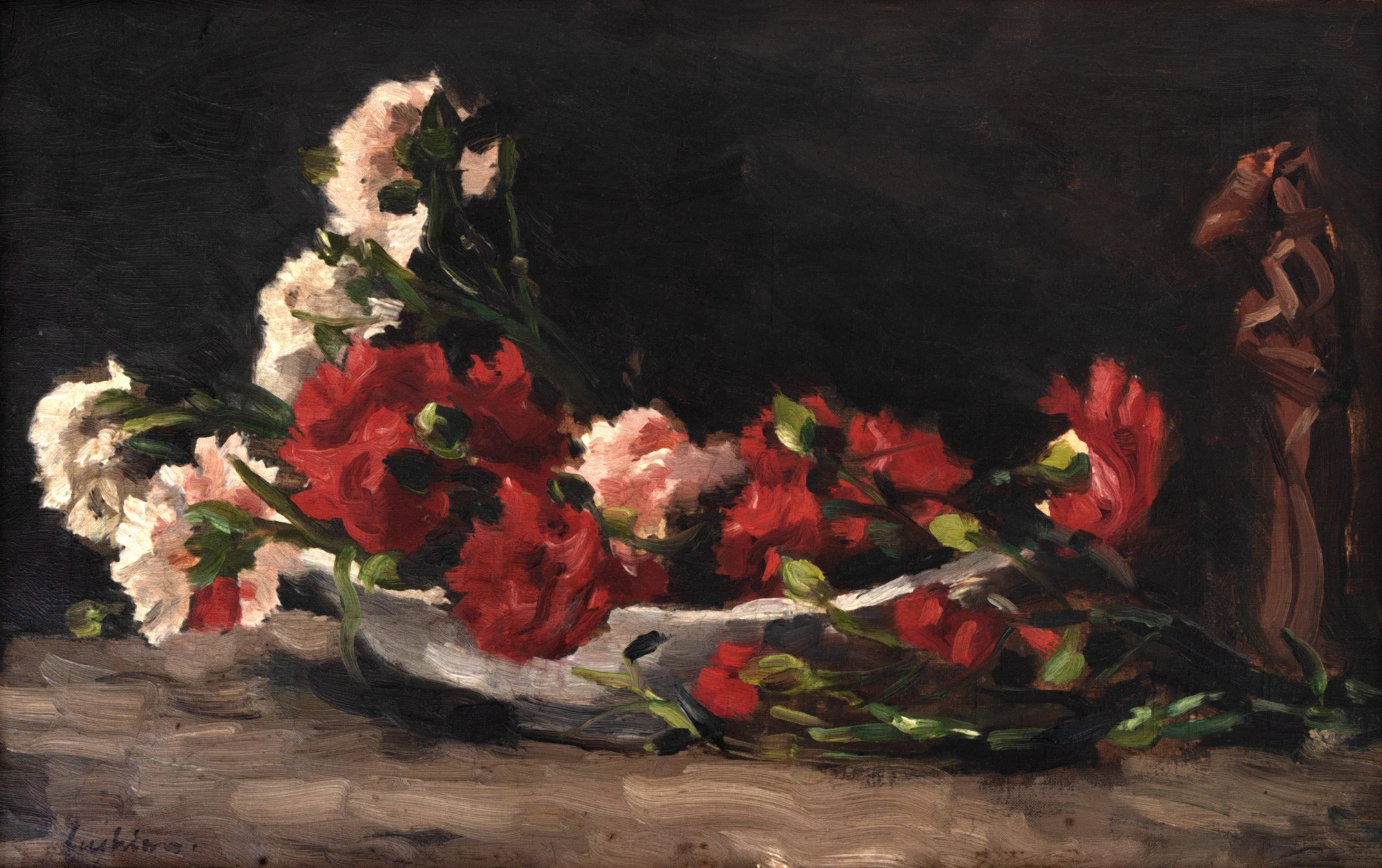
oil on canvas, 32 x 52 cm, signed bottom left, in brown, "Luchian"
The theme of flowers begins to take on special importance around 1905, becoming more and more present after 1908. If in the first part of his artistic career, Luchian is known mainly for landscapes, portraits, and compositions with social themes, in the last period, the flowers come to occupy a central place in his work. In Stefan Luchian's painting, the flowers do not only appear as a decorative subject but become, in the last years of his creation, a real pictorial language. This change is also related to the deterioration of his health, which gradually limits his mobility and the possibility of working outdoors. The static nature offers him the possibility to continue observing and interpreting nature from the inside space. Peonies, anemones, cornflowers, roses, carnations, wildflowers, snowdrops and poppies become recurring subjects. The flowers offer Luchian more than a pictorial motif: they become an opportunity to research light, color, and vibration. The artist does not aim to faithfully reproduce a flower, but to capture the way it transforms under the action of light. The shape is constructed through spots and color touches, through contrasts and chromatic relations. The work captures a static composition made of carnations, where, instead of a bouquet placed in a vase, the flowers are presented individually, arranged horizontally on a plate. In his compositions, the light is not only treated as an exterior effect that falls on the objects, but seems to be contained in the pictorial material itself. The flowers stand out from the background through contrasts of value and color, and white, pink, and especially red gain intensity by referring to darker areas. This concern for light also explains the importance that red acquires in flower painting. Red is one of the colors through which Luchian creates points of maximum visual intensity. In the case of carnations, it is not only used to represent the color of flowers, but to produce accents, rhythm, and vibration. The strong reds are related to the pinks, the white, the green of the leaves, and the browns of the background to capture and highlight the flowers. The red appears recurrently in Luchian's still lifes with flowers, especially in the pictorial cycle dedicated to carnations and in the compositions with roses or anemones, such as: "Carnations" and "Vase with Carnations" from the National Brukenthal Museum, "White Roses" from the Arges County Museum or "Oranges and Red Carnations" from the Art Museum of Constanta. A particular aspect of the composition is that the carnations are not presented in a vase or jug as most of his works, but individually, laid horizontally on a plate. In a vessel, the flowers would be associated with the idea of a bouquet and with the verticality of their growth, and on the plate, they are visually dismembered and brought close to the surface of the work, becoming almost objects of chromatic study. The plate also introduces a daily dimension, where Luchian is repeatedly interested in simple objects and the intimate universe of the interior. Another element within the composition is the small red statuette on the right background of the scene that denotes an air of mystery and loneliness. The symbolism of this statuette in the background can also be viewed in the context of the last years of the artist's life, where it may suggest a symbol of confinement and isolation. The small decorative objects in the background were the only known realities of his restricted universe. As an alternative to the human figure, unable to go out to paint landscapes or live models, Luchian used these figurines as actors. The red statuette serves as a silent witness to his suffering, a projection of his own loneliness in the closed space of the studio, where this enigmatic presence accentuates the dramatic contrast between the vibrant beauty of the flowers and the heavy atmosphere inside the artist. The carnations can therefore be seen as a metaphor for ephemeral beauty: they are intense in color and light, but fragile by their very nature. The artist transforms this fragility into a source of expressiveness, and the simplicity of the motif into a form of depth, where other similar examples of this theme are "Bouquet with Carnations", "Carnations" or "Vase with Carnations", works that are in the collections of important museums in Romania, such as the National Brukenthal Museum in Sibiu, the Bucharest Municipality Museum, or the National Art Museum of Romania.
For clarifications regarding the bidding procedure, hammer price costs, guarantee, payment, and collection terms for the winning lot, we recommend carefully reading/re-reading the Bidding Regulations.
For additional information regarding the lot and the auction, please contact the Art Consultants Department.
By choosing "Accept all cookies" you agree to the use of cookies to help us provide you with a better user experience and to analyse website usage. By clicking "Adjust your preferences" you can choose which cookies to allow. Only the essential cookies are necessary for the proper functioning of our website and cannot be refused
Cookie settings
Our website stores four types of cookies. At any time you can choose which cookies you accept and which you refuse. You can read more about what cookies are and what types of cookies we store in our Confidentiality Policy.
are necessary for technical reasons. Without them, this website may not function properly.
are necessary for specific functionality on the website. Without them, some features may be disabled.
allow us to analyse website use and to improve the visitor's experience.
allow us to personalise your experience and to send you relevant content and offers, on this website and other websites.