The photos of the lot are informative and indicative, and cannot provide a highly detailed view of the object from all angles. We recommend a careful physical inspection of the lot before bidding.
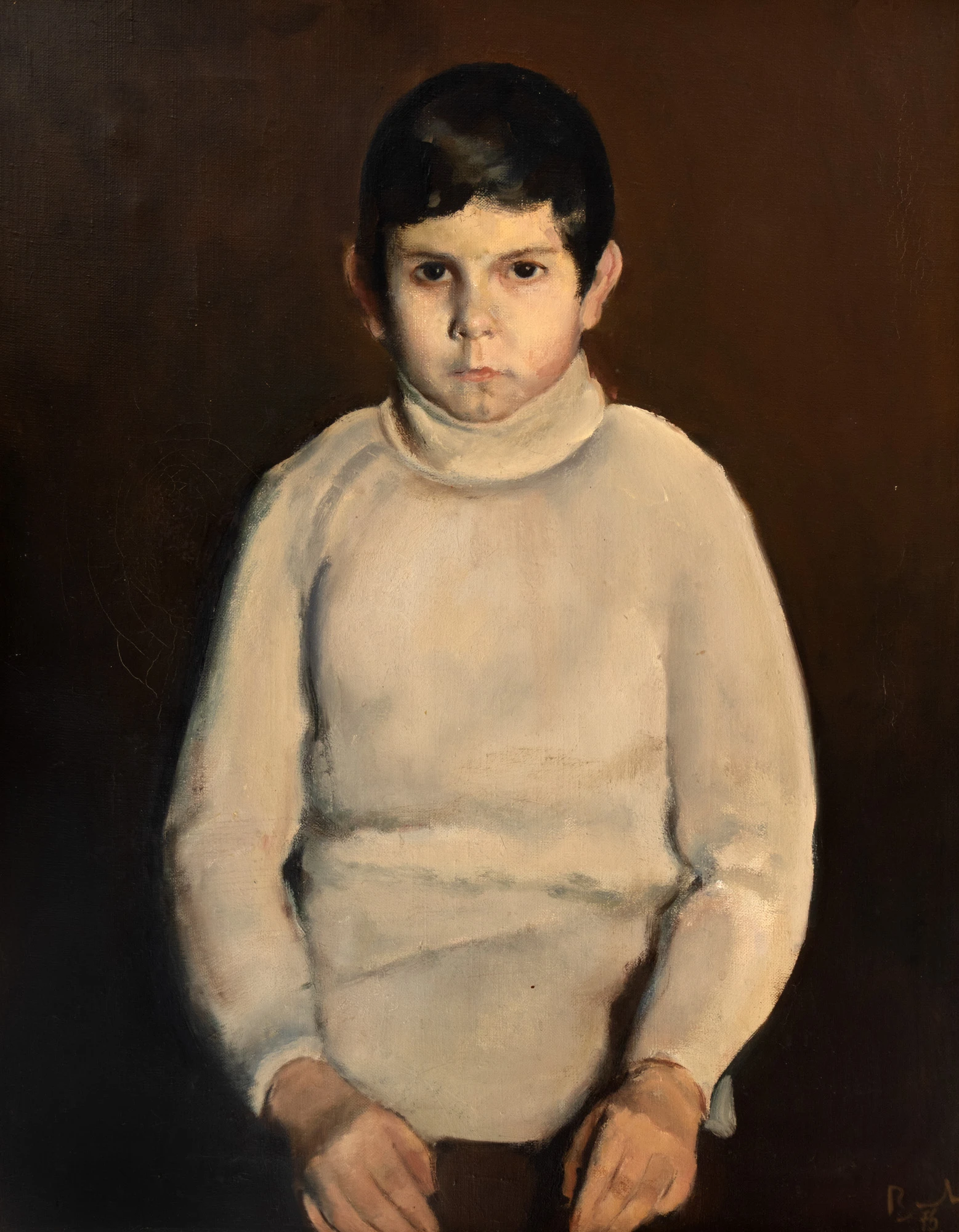
oil on canvas, 81 x 61 cm, signed and dated bottom right, in ochre, "Baba, (19)76"
Notes
On the reverse, signed, dated and noted in brown, "C. Baba, March 1976, Mihăiță Capătă"
The portrait, cleverly integrated into Corneliu Baba's realistic complex, represents one of the last ways through which we can offer our painter to the interwar period. The classicizing style with which Baba approached the painting of the human being is defined by the highly personal manner in which the artist individualized and transformed the painting of the second half of the 20th century. With a lesson often repeated especially in the immediate period after World War II, through frequent social portraits, Baba succeeded in "collecting" a distinguished baggage for the opportunities offered by the painting of the human face. Whether he painted the idyllic, generalized figures that populated the masses of people found in his works, or painted the family and those close to him, the painting never omitted the detail that truly gives significance to the work. Spiritual deepening is the tool through which the artist can truly give a portrait the meaning it needs. The mere photographic appearance could not have been compatible with Baba's character, and the painted faces constantly prove the fact that the model underwent the master's careful analysis.
Furthermore, even in case of this type of art, especially in Baba's case, two coherent parts creating the artistic painting may be identified. The social portrait and the intimate one are the two entities that transform the entire genre into a double-headed complex, a logical arrangement of attribution mechanisms. For the first category, things are obvious, the painting of personalities being a common practice, especially among good portraitists, and even more so in the case of one like Baba, celebrated in his lifetime, collected and appreciated equally. His portraits of Sadoveanu or Lucia Sturdza Bulandra, probably the most famous in this range, introduce Baba to the elite, alongside a G.D. Mirea or Eustațiu Stoenescu. Whether his place alongside the latter two artists is fixed, especially due to the fact that these works belonged to the initial period. The expressive force emanated from these works was the one that defined Baba until the end of his life, even if the painting underwent major changes in the 40 years following the works mentioned above.
Regarding the intimate portrait, where family members or close friends are presented, a change of both frame and atmosphere can be felt. In the objective, cold and insipid frames of the social portraits, Baba was more into accomplishment than effect. In the case of works defined by a personal subject, the atmosphere is the first to change, at least as a subtle visual effect that fixes the significance of the character in the eyes of the painter. In painting his "Mihăiță", Baba does not deny that compositional peculiarity with the help of which he learned and practiced the art of portrait. The painter resorts to the same stereotype in placing the model that we can also identify in the extensive range of portraits made by Stoenescu. The way of painting the character starts from placing this one in the composition, most often being seen in proportion of two thirds, seated, with his gaze previously focused.
The choice for a dark background is not only the choice of a typical way of emphasizing the model, but also Baba's preferred way of conceiving space, black being used amply whenever there is the possibility. The color palette is meager, maybe even more meager than usual, something also indicated by the lack of warm tones that would have strongly contrasted with the gloomy background. Beyond the compositional plane, the work coalesces around the face of young boy, who, from beneath the black bangs as a charred wood, throws piercing glances like only an upset child can do. Baba perfectly captures the emotional state of his model, probably this is also the reason why he creates such an oppressive atmosphere.
For clarifications regarding the bidding procedure, hammer price costs, guarantee, payment, and collection terms for the winning lot, we recommend carefully reading/re-reading the Bidding Regulations.
For additional information regarding the lot and the auction, please contact the Art Consultants Department.
By choosing "Accept all cookies" you agree to the use of cookies to help us provide you with a better user experience and to analyse website usage. By clicking "Adjust your preferences" you can choose which cookies to allow. Only the essential cookies are necessary for the proper functioning of our website and cannot be refused
Cookie settings
Our website stores four types of cookies. At any time you can choose which cookies you accept and which you refuse. You can read more about what cookies are and what types of cookies we store in our Confidentiality Policy.
are necessary for technical reasons. Without them, this website may not function properly.
are necessary for specific functionality on the website. Without them, some features may be disabled.
allow us to analyse website use and to improve the visitor's experience.
allow us to personalise your experience and to send you relevant content and offers, on this website and other websites.