The photos of the lot are informative and indicative, and cannot provide a highly detailed view of the object from all angles. We recommend a careful physical inspection of the lot before bidding.
CLAUSS, James, JOHNSTON, Sarah, "Medeea: Essays on Medeea in myth, literature, philosophy and art", Princeton University Press, 1997. PAVEL, Amelia, "Theodorescu-Sion", Meridiane Publishing House, Bucharest, 1967. SCHOBEL, Doina, CLONARU, Hariton, "Ion Theodorescu-Sion", Meridiane Publishing House, Bucharest, 1971.
oil on cardboard, 41 x 33 cm, 41 Ã 33 cm, signed and dated bottom left, in black, "TSion, 1927"
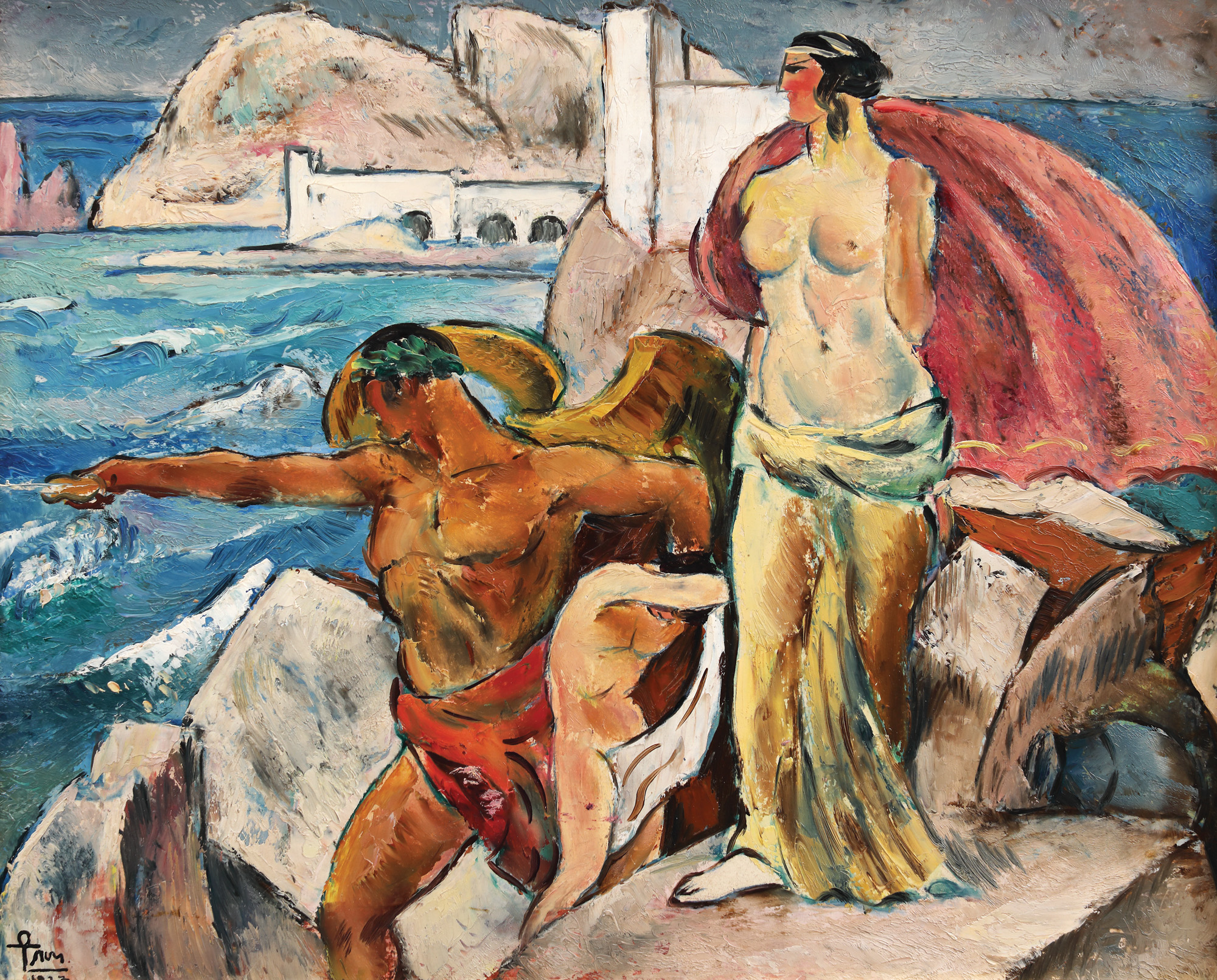
Vianu identified in the compositions of painter Theodorescu-Sion "the specific visual approach people living in the mountains" transposed into a tendency to congest the foreground with large volumes, regardless of the topic approached. Following this compositional structure, Sion recreates the legend of Medea and the Argonauts who went in search of the golden fleece. Over the centuries, Medea’s figure has inspired artists from the most diverse fields. Literature, fine arts, the theatre, opera, or dance are among the fields that gave life to this mysterious character of legends. Unlike most mythical figures, whose attributes have remained constant throughout various interpretations, Medea has been a constantly changing figure since ancient times, with Pindar, Euripides, Apollonius, and Ovid among the authors in whose works it comes to life in the most diverse situations. A complex figure, marked by conflicting desires and a diversity of behaviours, Medea gradually became the symbol of the dichotomy between self and the other, joining these two concepts starting from the difference in vision specific for Greek antiquity, which delineated a differentiation of attitude, in cultural, social and political terms, between the Greeks and the others, usually called barbarians. In fact, Medea raises the possibility of existence of another in one’s own person, of the kind of disruptive activity that threatens from within. Regardless of the variant proposed by the mentioned ancient authors, Medea is always presented as a stranger, a profane and an initiator, a pioneer. She is always the one exiled within Greece, the one who comes from distant lands only to go to others, after a brief period in which she acts as a disturbing factor. Legend has Medea as the one who helps Jason get the golden fleece in exchange for his promise to marry her. Medea gets involved in the various missions to which he is subjected, mainly using tricks, hence her dual image, given that she is initially presented as a saving virgin. It is the same Medeea who will kill her brother for her passion’s sake when she leaves with Jason, but also King Creon and his daughter Creusa, and her own children, to punish Jason for treason. The artist managed to translate the elements of the legend into pictorial language. Bu the sea, on the edge of a cliff, against the background of a landscape that can be found in other works from the same period, such as "Ovid in Exile", the group of characters from the foreground is monumentally defined. Medea is presented to us in her vengeful stance, and the resoluteness of her gaze toward the horizon perhaps marks the moment of departure after obtaining the fleece. Just as the male character in the foreground can be Jason, crowned with laurels after fulfilling the missions to which he was subjected. Between them, of visibly small size, we can see either Absirt, Medea’s younger brother, who was sacrificed in order to allow them to leave, or a symbol of the children of the two. The complexity of the myth compels us to a probable interpretation of the compositional structure, but what surprises us is the representation of Medea, in her vengeful stance, marked by her impressive stature, the intensely red face and the specific Greek posture.
For clarifications regarding the bidding procedure, hammer price costs, guarantee, payment, and collection terms for the winning lot, we recommend carefully reading/re-reading the Bidding Regulations.
For additional information regarding the lot and the auction, please contact the Art Consultants Department.