The photos of the lot are informative and indicative, and cannot provide a highly detailed view of the object from all angles. We recommend a careful physical inspection of the lot before bidding.
The photos of the lot are informative and indicative, and cannot provide a highly detailed view of the object from all angles. We recommend a careful physical inspection of the lot before bidding.
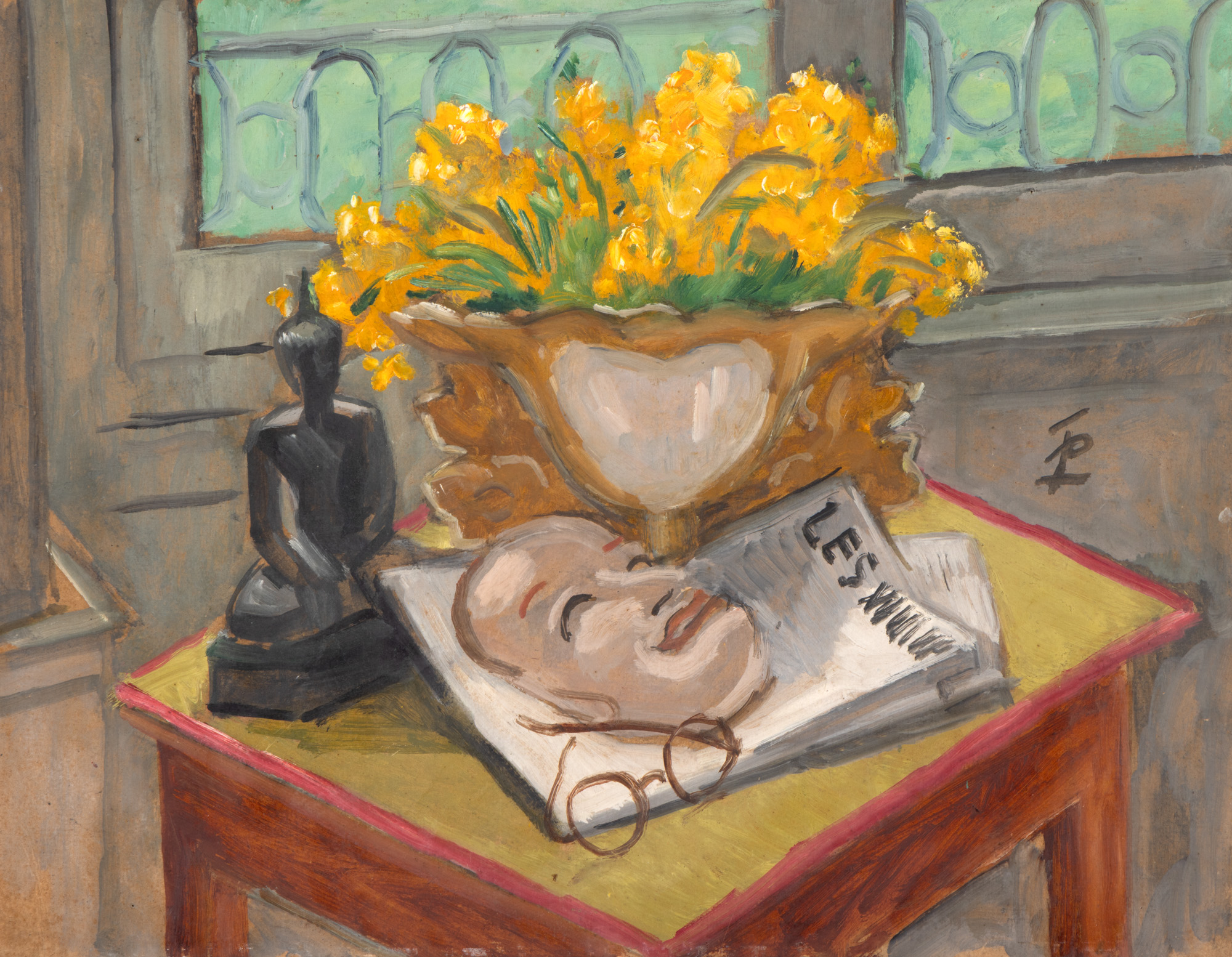
22. Still Life with Kabuki Mask and Buddha [1930-1935]
Along with nudes and intimate scenes, still lifes form a substantial part of Theodor Pallady's work, fitting his artistic spirit and offering him complete freedom in his manner of construction. Familiar with the two-dimensionality of the Parisian school, in Pallady's vision, the elements of still lifes are dematerialized to their pure essence. Even though seemingly modest in nature, Theodor Pallady's props transcend their primary status and are granted a symphony of meanings, rhythms, and colors. Through the material subject matter of his interior compositions, the artist builds his own poetic vision, revealed through expressions, intensities, and harmonies. For instance, by associating the pair of glasses with the newspaper referencing a French publication through its suggestively fleeting title, the artist evokes his own interests and intellectual life: reading, finding information, connecting to Parisian culture and press. It is a discreet autobiographical detail, through which Pallady indirectly inserts himself into the composition. Frequently found in the ambiance of his still lifes are objects (clocks, books, fruits) along with flowers of various species and shades - tulips, chrysanthemums, crocuses, violets, elderflower, daffodils - contributing to the creation of complex compositions, where the everyday, intimate and familiar reveal their symbolic nuances. Here, the daffodils frame the collection of objects, presenting as an arch with a protective function. Notably featured in this work are the mask and a statuette of Buddha. In Pallady's still lifes, the mask represents a symbol of the duality between appearance and essence, seen and unseen. Its presence in an interior scene alludes to the theme of identity and doubling, a recurring motif in the modernist European art of the 20th century, influenced by symbolist and expressionist currents. For Pallady, deeply embedded in Parisian culture and familiar with semiotics, the mask often also evokes the fascination for non-Western cultures, a common sensitivity in the artistic circles of the time. Associated with the Buddha statue, this interpretation gains even more weight. Its presence in a Romanian still life, otherwise populated with flowers, books, and clocks, introduces a meditative dimension. Buddha symbolizes contemplation, inner balance, and detachment from the contingent. These values deeply resonate with the artist's own aesthetics, founded on synthesis, essentialization, and order. Together in the same composition, the mask and Buddha statuette articulate a visual meditation on appearance and depth, on the outer and inner world. Thus, this work represents yet another example of freedom, expressed by the artist as a prospector of construction and synthesis, aimed at creating order and balance based on rhythms and correspondences. (L.M.)
References
ȘORBAN, Raoul, ”Theodor Pallady”, Meridiane Publishing House, Bucharest, 1975
CEBUC, Alexandru, ”Pallady”, Official Monitor R. A. Publishing House, Bucharest, 2008
Dimensions
width 63 cm, height 48.5 cm
Description
oil on cardboard, signed on the right side, in black, "T. Pallady"
Dating
1930-1935
ADDITIONAL INFORMATION
For clarifications regarding the bidding procedure, hammer price costs, guarantee, payment, and collection terms for the winning lot, we recommend carefully reading/re-reading the Bidding Regulations.
For additional information regarding the lot and the auction, please contact the Art Consultants Department.
Detalii
Along with nudes and intimate scenes, still lifes form a substantial part of Theodor Pallady's work, fitting his artistic spirit and offering him complete freedom in his manner of construction. Familiar with the two-dimensionality of the Parisian school, in Pallady's vision, the elements of still lifes are dematerialized to their pure essence. Even though seemingly modest in nature, Theodor Pallady's props transcend their primary status and are granted a symphony of meanings, rhythms, and colors. Through the material subject matter of his interior compositions, the artist builds his own poetic vision, revealed through expressions, intensities, and harmonies. For instance, by associating the pair of glasses with the newspaper referencing a French publication through its suggestively fleeting title, the artist evokes his own interests and intellectual life: reading, finding information, connecting to Parisian culture and press. It is a discreet autobiographical detail, through which Pallady indirectly inserts himself into the composition. Frequently found in the ambiance of his still lifes are objects (clocks, books, fruits) along with flowers of various species and shades - tulips, chrysanthemums, crocuses, violets, elderflower, daffodils - contributing to the creation of complex compositions, where the everyday, intimate and familiar reveal their symbolic nuances. Here, the daffodils frame the collection of objects, presenting as an arch with a protective function. Notably featured in this work are the mask and a statuette of Buddha. In Pallady's still lifes, the mask represents a symbol of the duality between appearance and essence, seen and unseen. Its presence in an interior scene alludes to the theme of identity and doubling, a recurring motif in the modernist European art of the 20th century, influenced by symbolist and expressionist currents. For Pallady, deeply embedded in Parisian culture and familiar with semiotics, the mask often also evokes the fascination for non-Western cultures, a common sensitivity in the artistic circles of the time. Associated with the Buddha statue, this interpretation gains even more weight. Its presence in a Romanian still life, otherwise populated with flowers, books, and clocks, introduces a meditative dimension. Buddha symbolizes contemplation, inner balance, and detachment from the contingent. These values deeply resonate with the artist's own aesthetics, founded on synthesis, essentialization, and order. Together in the same composition, the mask and Buddha statuette articulate a visual meditation on appearance and depth, on the outer and inner world. Thus, this work represents yet another example of freedom, expressed by the artist as a prospector of construction and synthesis, aimed at creating order and balance based on rhythms and correspondences. (L.M.)
ADDITIONAL INFORMATION
For clarifications regarding the bidding procedure, hammer price costs, guarantee, payment, and collection terms for the winning lot, we recommend carefully reading/re-reading the Bidding Regulations.
For additional information regarding the lot and the auction, please contact the Art Consultants Department.
References
ȘORBAN, Raoul, ”Theodor Pallady”, Meridiane Publishing House, Bucharest, 1975
CEBUC, Alexandru, ”Pallady”, Official Monitor R. A. Publishing House, Bucharest, 2008
Dimensions
width 63 cm, height 48.5 cm
Description
oil on cardboard, signed on the right side, in black, "T. Pallady"