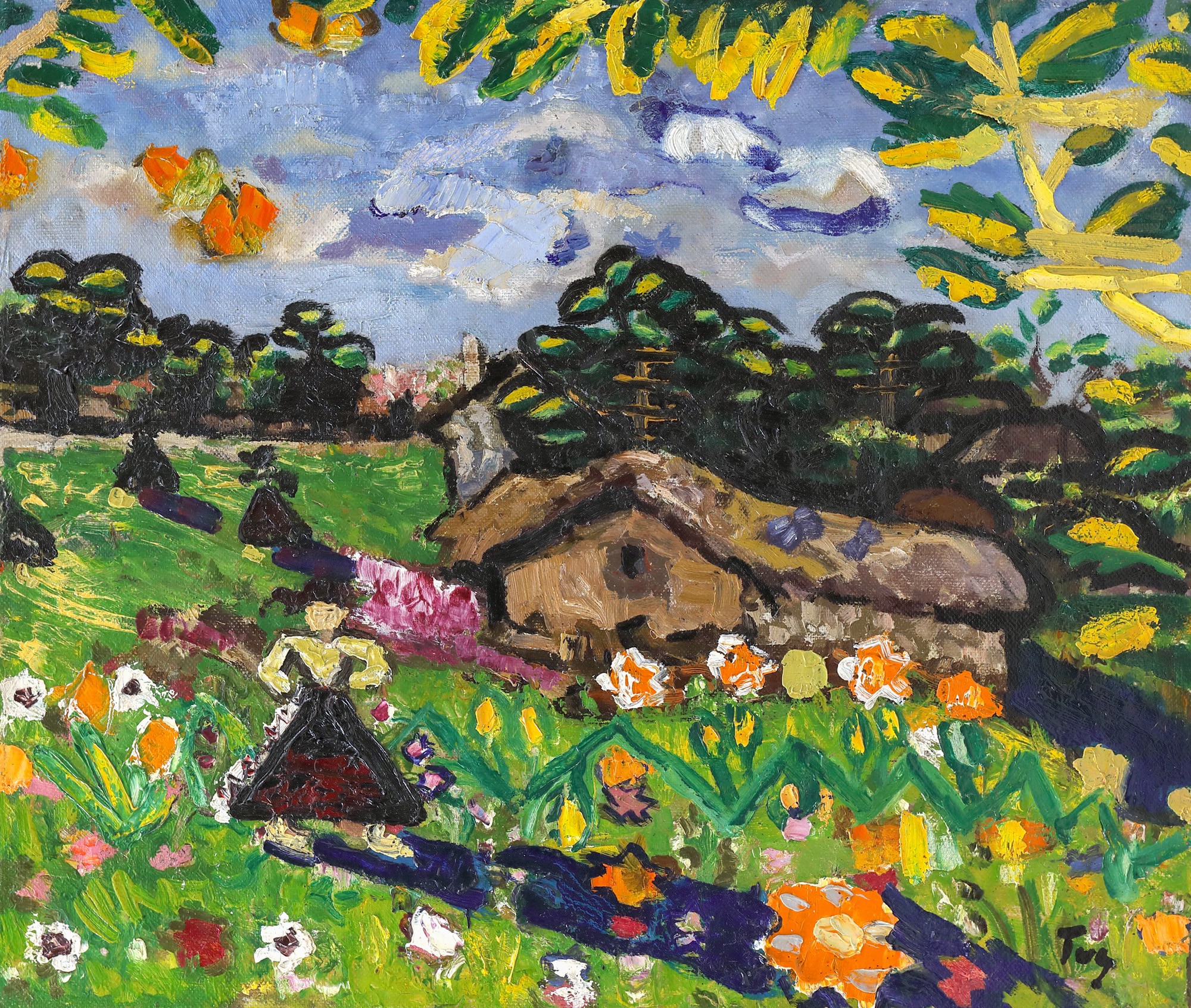

96. Folklore Landscape

1910, Craiova - 1962, Bucureşti

Estimate

EUR 30.000 - 50.000

Sold

EUR 75.000

Session

Thu, 11 July 2024 19:00

Brought to you by

With a tempestuous, excessive temperament, defined by the Dionysian model and dreamlike fantasies, Ion Țuculescu appeared as a painter in 1938, during a solo exhibition organized in the Romanian Athenaeum building. Blessed with the aspirations of a self-educated person, he carried out free studies, "after nature and masters", as he himself claimed. He used his dual vocation, as a biologist and creator, to transcribe onto canvases true pages of nature with the ingenuity of a scientist. He retraced his predecessors' journeys in the Mediterranean Orient and in the important Western capitals, thus gathering the visual material necessary for future artistic experiments. He drew inspiration from Petrașcu, Andreescu, or Luchian, but he also took interest in Van Gogh or Gauguin. However, at the root of his creation remained steadfast - the Romanian folk. Țuculescu asserted himself as an authentic interpreter of nature and excelled particularly in creating landscapes. In 1943 he exhibited for the first time the series of rape fields. Thus he revealed his expressionist-ecstatic vision of the outdoor natural motif, directly juxtaposing it to his unleashed inner nature. His exceptional colorist vocation is accentuated by the harmonious alternation of strong tones and the purposefully exaggerated use of paste. His artistic space, infinite and with unusual materializations, is crisscrossed by an artificial brightness and a brutal chromaticity that became his leitmotif. He surpasses the decorative, purely imitative framework and tends towards the emotional charge of the canvas through the use of an exacerbated palette. His ornamental chords are embedded in black accents, a nuance assimilated from Petrașcu's works. He retains recognizable fragments of the real space he draws inspiration from and modifies them according to his own stimuli. Tuculescu proposes the fantastical aesthetics of fairy tales and often inserts crosses and birds borrowed from folk art. He suggests a new aesthetic order and a different set of values that he gradually transfers to his works. He reinterprets folk elements in a deeply modernized manner and transfers the analytical vision of the biologist into feverish attempts of exhaustive representation of frescoes dedicated to nature.

References

VLASIU, Ion, "Ion Țuculescu"; Meridiane Publishing House, Bucharest, 1966. CÂRNECI, Magda, "Ion Țuculescu", Meridiane Publishing House, Bucharest, 1984.

Dimensions

width 56 cm, height 48 cm

Description

oil on canvas glued on cardboard, signed lower right, in black, "TUC"

Research information

The artwork participated in the Exhibition “Selections from Private Collections of Constanta”, January 25 - March 15, 1970. The artwork participated in the Commemorative Exhibition “Ion Țuculescu. 1910-1970”, Constanta Art Museum, and is also mentioned and reproduced in catalog 7.

PROVENANCE

Dr. Maria Țuculescu's collection. Prof. Neagu Steliana's collection.

ADDITIONAL INFORMATION

For clarifications regarding the bidding procedure, hammer price costs, guarantee, payment, and collection terms for the winning lot, we recommend carefully reading/re-reading the Bidding Regulations.

For additional information regarding the lot and the auction, please contact the Art Consultants Department.

Similar lots

Spring Song

42. Spring Song

Felix Aftene

    Estimate EUR 5.000 - 8.000
    Sold EUR 10.000
Popa Costel

3. Popa Costel

Constantin Piliuţă

    Estimate EUR 600 - 900
    Sold post auction EUR 600