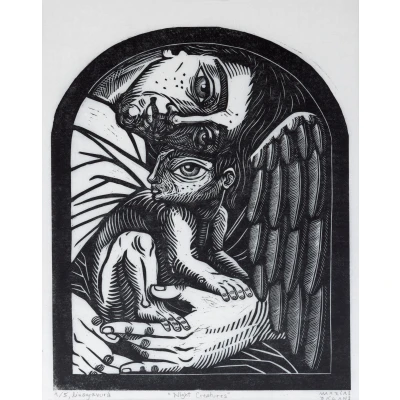
The photos of the lot are informative and indicative, and cannot provide a highly detailed view of the object from all angles. We recommend a careful physical inspection of the lot before bidding.
The work is reproduced in “100 Fundamental Prayers by Tetelu,” Dragoș Mușat, Humanitas Publishing House, Bucharest, 2020, p. 34.
In 2003, artist Dragoș Mușat created the legendary character Tetelu, depicted in drawings as a faceless man, masked by a mysterious overcoat, with an impertinent cigarette in hand.
In legitimate mental self-defence against the Absurdity and Cynicism of God’s creation on Earth, Dragoș Mușat created his own sarcastic yet sensitive cosmogony, populated by demons and daimons who distort the meaning of the life we live. Anticipating humanity’s struggle with Superintelligence, Dragoș Mușat proactively created a parallel pluriverse, which swings energetically between revolutionary presentism and sceptical eternalism. In opposition to the mental feudalism into which the machine seeks to push us, Dragoș Mușat sounds the alarm by outwitting the machine, kicking it with an artistic flourish into a supra-surrealist dreamworld that nevertheless gives flesh and spirit one last chance. The artist chooses human perfection and creates an inverted anthropocentrism in which Man remains the centre of the universe, even though—ironically—he has just been removed from it. For although machines have captured the Earth in the future, the process of “machine learning” fails in Dragoș Mușat’s visual world, producing ambiguity and grotesquerie as it confuses the Mona Lisa’s smile with the grins at a New Year’s Eve party with Nazis, the Eiffel Tower with a hospital in Gaza, and Jesus of Nazareth with a surfer crucified along the length of his surfboard.
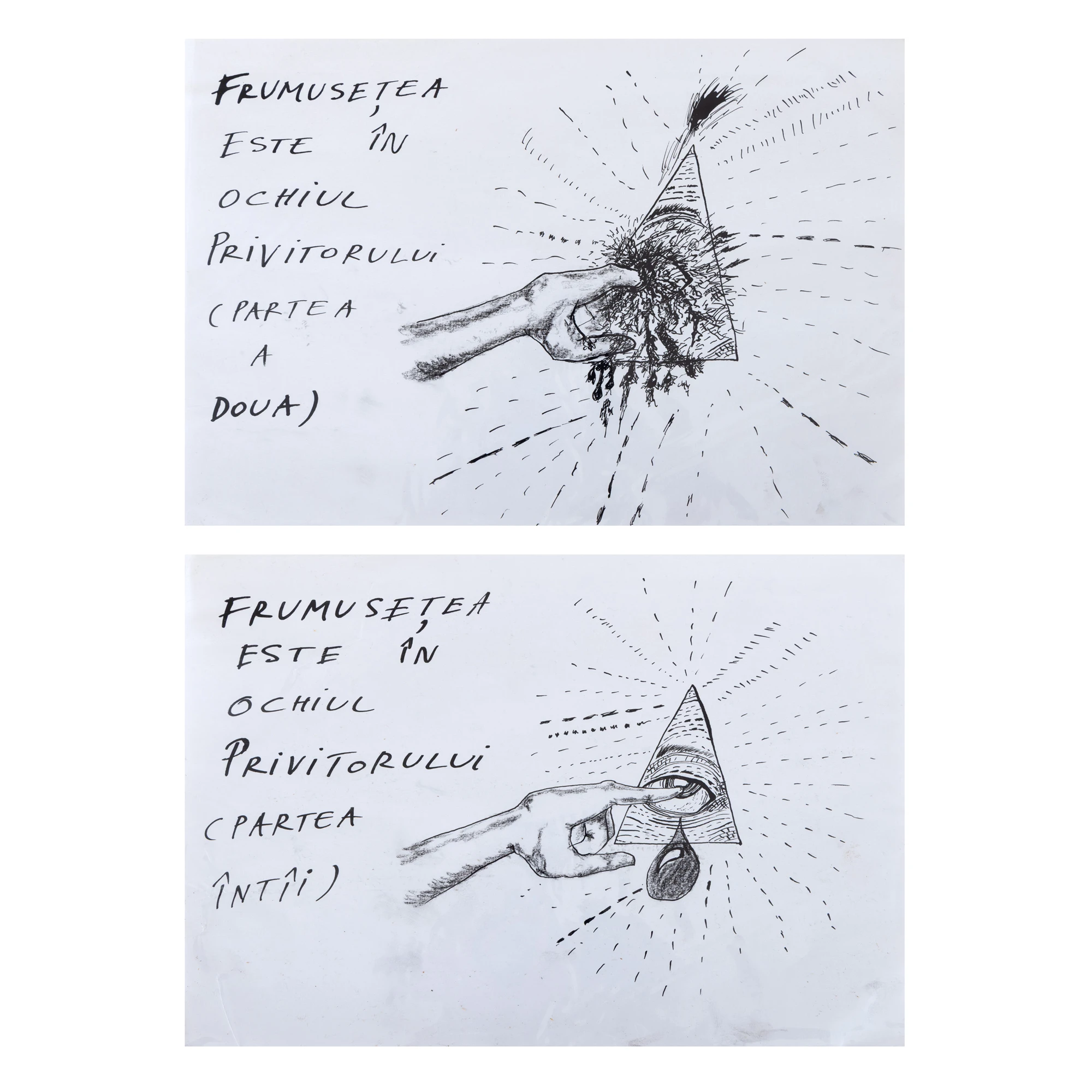
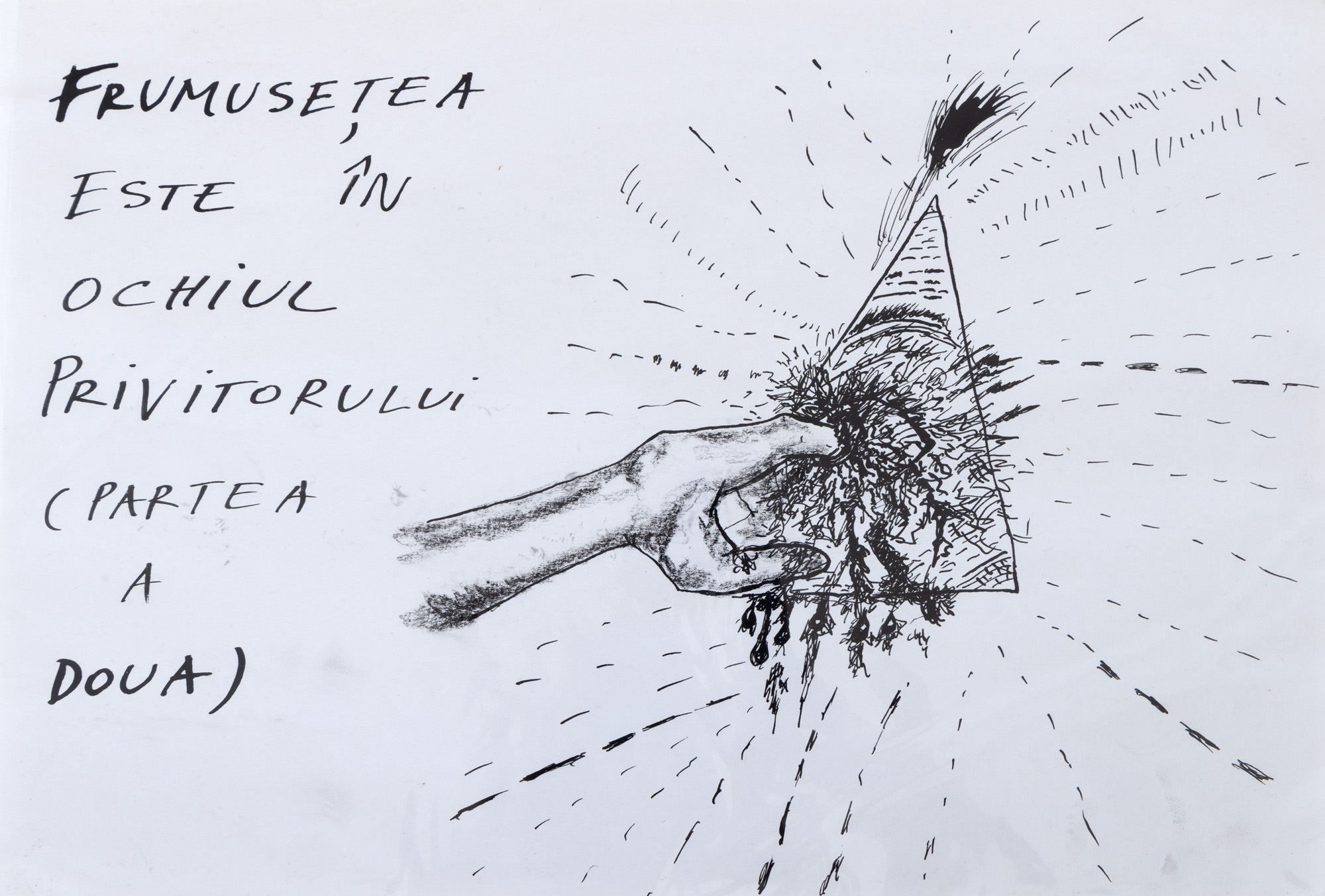
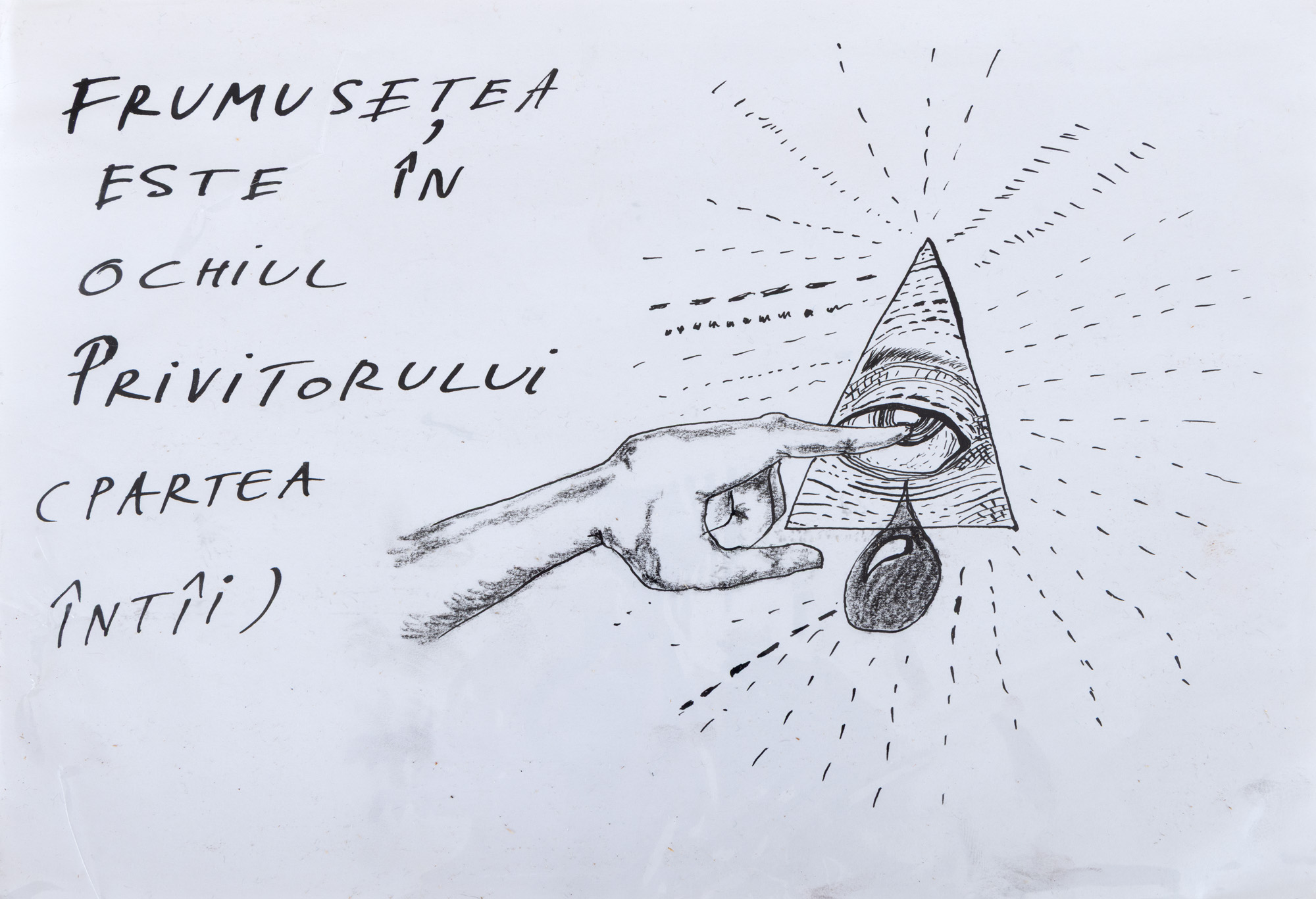
From this long, sarcastic series, the work *Beauty* presents the Doubting Thomas’s uncertainty in the face of the Cliché. Dragoș Mușat tests “Beauty” by hand. But what is Beauty? Is Beauty real? Or is Beauty manipulated—for commercial purposes? This reflects the same idea of a future totalitarianism, in which money buys real works of art and turns them into material for Artificial Intelligence, then destroys them after copying them.
With Thomas’s doubt in his mind and an eye at his fingertip, the artist’s hand tests the cliché of beauty in the eye of the beholder. But, the artist wonders, what if the “beholder’s” eye is also the “devil’s eye”? The work reveals that the so-called beholder’s eye contains the magical eye from the American banknote, in a pseudo-Masonic love triangle. But what if this is the true eye by which a work is judged? If beauty is in the eye, then the Conscious Man must verify this—and what better way to do so than to discover what truly lies “behind” the eye that “bestows” beauty upon the work of art? The artist has no choice but to touch the Unseen, see the Untouchable, and put his head inside the eye. But after the artist has “broken” the eye, does the beholder have the courage to put their “own” head inside it, to see from within what Beauty is?
This is the meaning of the work *Beauty*: the true beholder is the beholder within. The beholder who looks at themselves inside their own eye—while, ironically, the work of art is on the Outside. The artist has merely opened the eye of the eye.
The work was created for the book *100 Fundamental Prayers of Tetelu* (2020, Humanitas Publishing House). The work offered at auction is the original, which was reproduced in print.
For clarifications regarding the bidding procedure, hammer price costs, guarantee, payment, and collection terms for the winning lot, we recommend carefully reading/re-reading the Bidding Regulations.
For additional information regarding the lot and the auction, please contact the Art Consultants Department.
By choosing "Accept all cookies" you agree to the use of cookies to help us provide you with a better user experience and to analyse website usage. By clicking "Adjust your preferences" you can choose which cookies to allow. Only the essential cookies are necessary for the proper functioning of our website and cannot be refused
Cookie settings
Our website stores four types of cookies. At any time you can choose which cookies you accept and which you refuse. You can read more about what cookies are and what types of cookies we store in our Confidentiality Policy.
are necessary for technical reasons. Without them, this website may not function properly.
are necessary for specific functionality on the website. Without them, some features may be disabled.
allow us to analyse website use and to improve the visitor's experience.
allow us to personalise your experience and to send you relevant content and offers, on this website and other websites.