
Meniu

English
Gifts

Rare Books, Documents, Photography & Posters

Collectible Religious Art

Asian Art, Technical Objects, Taxidermy, Curiosities & Antiques

Jewelry & Watches

Numismatics, Medals, Maps, Arms & Decorations

Luxury, Elegance, Collectible Cars & Beverages

Collectible Folk Art

Sneakers & Toys


213. Sunflowers [1954]
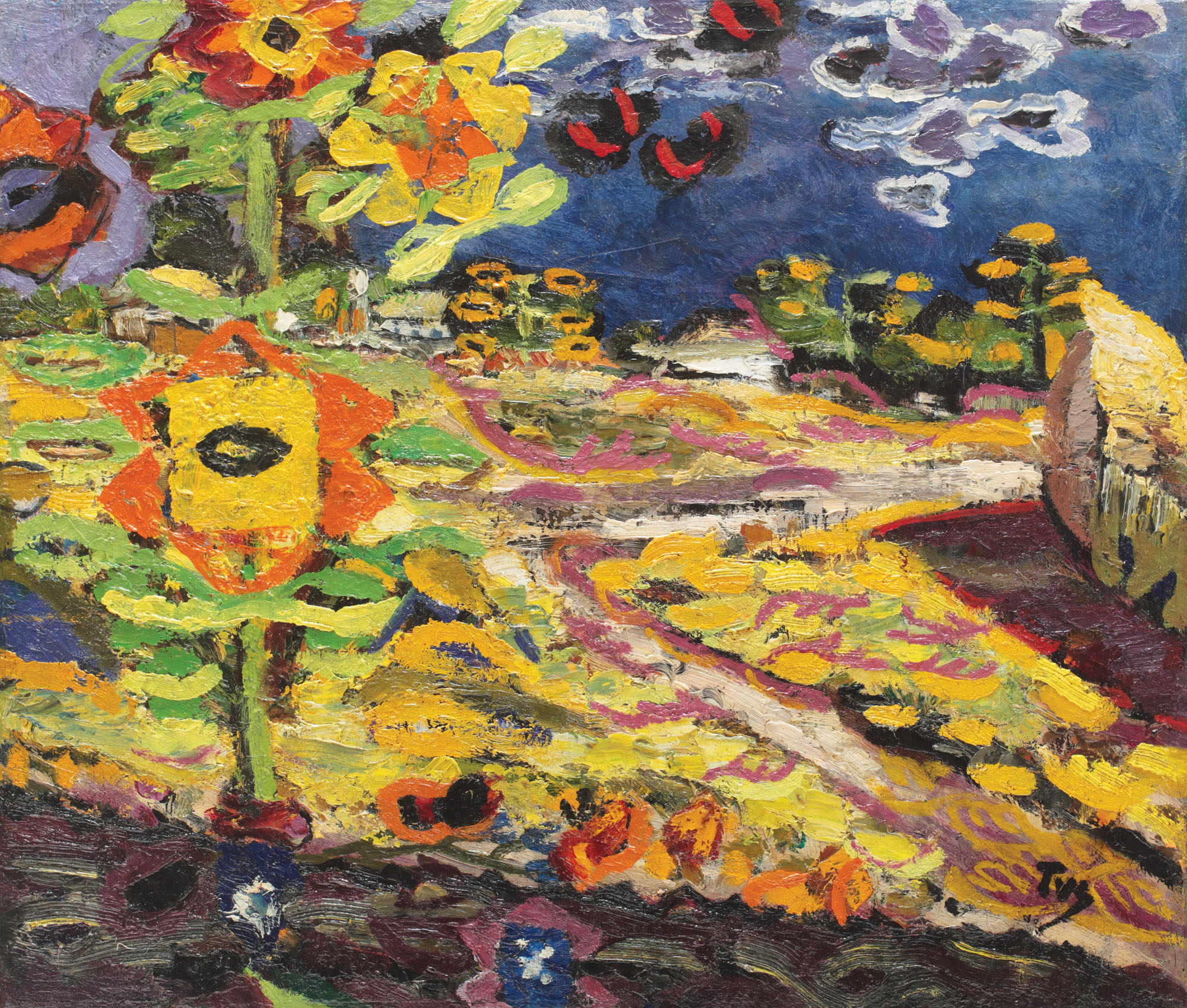
The photos of the lot are informative and indicative, and cannot provide a highly detailed view of the object from all angles. We recommend a careful physical inspection of the lot before bidding.

213. Sunflowers [1954]

1910, Craiova - 1962, Bucureşti

Estimate:
EUR 60.000 - 80.000
Not sold

References

CÂRNECI, Magda, “Ion Ţuculescu”, Meridiane, 1984 COMARNESCU, Petru, “Ion Ţuculescu”, Meridiane, 1967

oil on canvas, 46 cm, 54,5x46, signed bottom right, in black, in monogram, TUC

The presence of Ion Ţuculescu in the history of Romanian Art is unique through its significance: a short moment of synchronism with the Western fine arts. As some art critics point out, Ţuculescu is said to have forced the possible and tried the impossible. Though the equivalent of a miracle revelation, it was only just after his large retrospective exhibition that his work would obtain recognition. His creation can easily be divided into three main stages. The first, defined by pure expressionist colours and lines, is developed along with the artist’s second solo exhibition, in 1939. The second stage spans between 1947-1956 and is known as the „folklore-inspired period”. The third and last stage of his artistic work, the „totemic period”, is the most controversial and debated stage by art critics. Without any exageration, the aesthetics and the abstract tendencies from his last period are not easily assimilated by the Romanian Art due to a unique and inner algorithm of composition. “Floarea soarelui” (1954), mentioned in Petre Comarnescu’s study upon the artwork of Ion Ţuculescu, is part of the artist’s second stage of creation, the folklore inspired period. A memorable piece of work, with a willingly larger than life sunflower on the lefthand side and followed by several others coloured just as brightly as the first one in yellow, under a stormy sky,”Floarea soarelui” is closer to the aesthetics of naive art rather than to those of Van Gogh. The artworks from the folklore inspired period are a tribute to powerful colours, especially orange, yellow and red. They are created in strong variations of colours , but once the eye gets used to them, they become less striking and unusual. The artwork melts into a fusion of colours, lines and shapes, making possible the imaginary realm. With a deep lyrism consisting of colours and shapes, one can distinguish in Ţuculescu’s artwork emotions, love for life, a strong union with an eternal entity and the turn of phrase of a deeply lyrical artist. In the contemporary world of fine arts, confronted with a deep transformation of rules, let us reflect upon Ţuculescu’s artwork, defined by a high quality of balance and innovatory perspectives.

For clarifications regarding the bidding procedure, hammer price costs, guarantee, payment, and collection terms for the winning lot, we recommend carefully reading/re-reading the Bidding Regulations.

For additional information regarding the lot and the auction, please contact the Art Consultants Department.

SESSION
Tue, 28 January 2014 20:15

Similar lots

Wedding in Oaş

188. Wedding in Oaş [1972]

Mihai Lebaci

Mihai Lebaci

    Estimate: EUR 2.000 - 3.500
    Sold EUR 1.800
L'aigle

167. L'aigle

Victor Roman

Victor Roman

    Estimate: EUR 1.000 - 2.000
    Sold EUR 1.800