
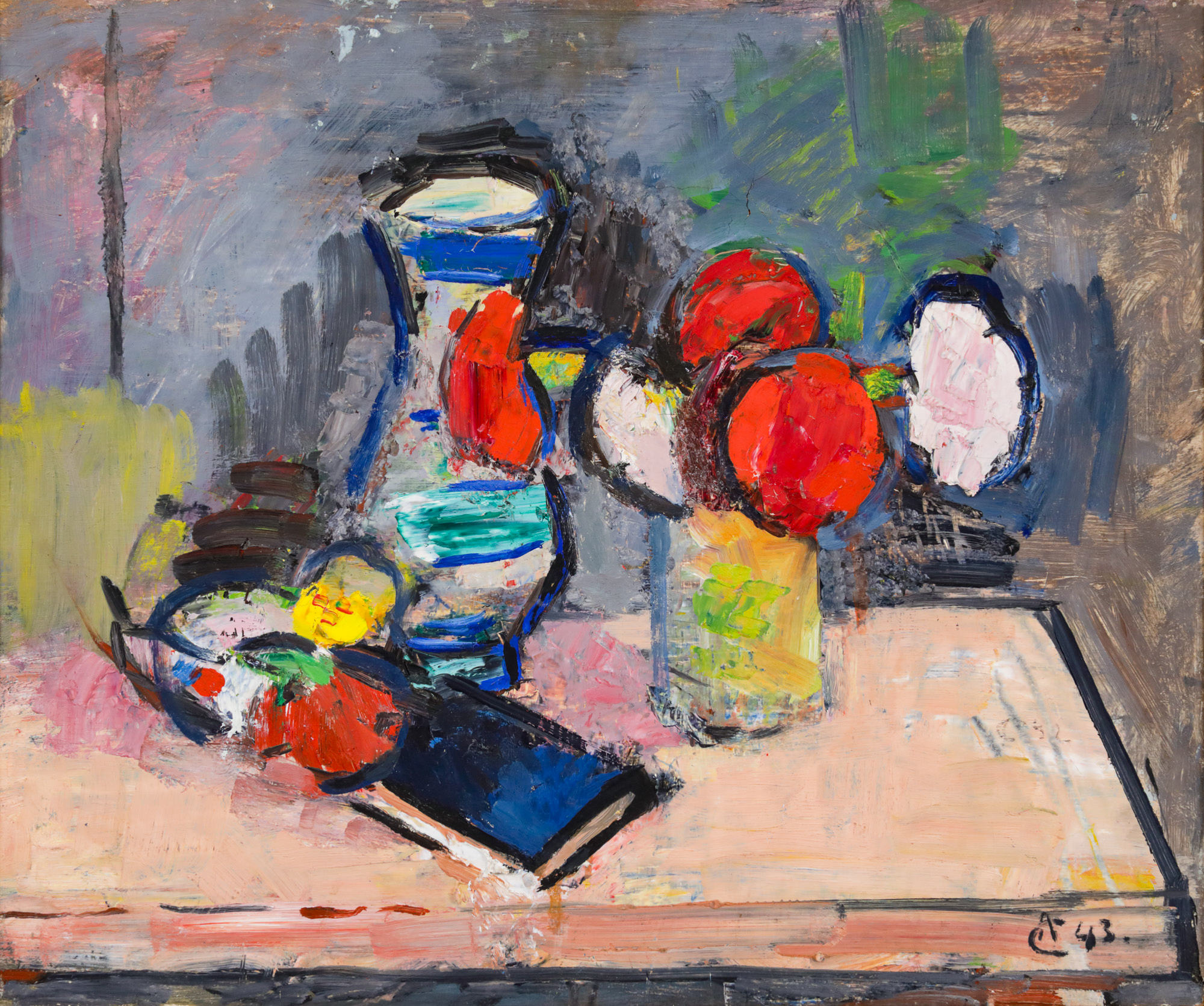
123. Still Life with Jug and Glass of Carnations [1943]
1903, Ciucurova, Tulcea - 1977, Bucureşti

Estimate

EUR 12.000 - 18.000

Sold

EUR 13.000

Session

Thu, 21 March 2024 19:00

The mature work of Alexandru Ciucurencu, renowned for its vibrant, exuberant chromatics, began as a stark contrast to his early works, deeply influenced by the brown shades promoted by his professor, G.D. Mirea. In the summers spent in Baia Mare, Ciucurencu was surprised by the expressive palette of the Maramureș painters and amazed by the chromatic juxtapositions they proposed. In 1930, the artist left his native land behind and headed towards Paris. The fervor of one of the most reputable European artistic capitals of the last century definitively broadens his imaginary horizon and offers him new possibilities for plastic expressiveness. In the French capital, Ciucurencu discovered Hieronymus Bosch, Boticelli, Matisse, Picasso, Braque or Cézanne. His contact with Paris, in addition to meeting the Romanian painter with universal art, leads to the acquisition of a much more significant pictorial refinement. His works always start from reality, regardless of the way they end up being executed. He takes, in reduced quantities, from Cézanne's cubism, and from Matisse, he will adopt the valorization of line and color in his work. As a successor of post-impressionism, he acquires some of the characteristics of this current: the autonomy of color and the use of strong, vivid shades, but he is not afraid to introduce black into his works. The draughtsman's skills are particularly revealed in the contours through which the artist defines his represented subjects. Ciucurencu masters the science of matching lines and harmonizing colors. Often presented as a "colorist", the artist considers himself a continuation of some painters who also had a special concern for color: Luchian, Ressu, Lhote or Pallady. He knows how to operate with the set of values that he acquires under the guidance of André Lhote: he gradually distributes light, following the logic of reality and masterfully distributes the chromatic effects. Ciucurencu will chiefly excel in the realization of still life. In this painterly genre, the artist will be known due to his preference for warm and intense tones, the science of melodic organization of composition and the possibility of rendering chromatic juxtapositions in lyrical rhythms. Ciucurencu admires the flowers painted by his predecessors, especially those of Luchian. He draws inspiration from the artist's work, but his flowers remain anchored in a representation where the emphasis is mainly on chromaticism, while the shape takes on secondary valences. A few accents of orange or yellow are deciphered in the flowers' realization, and the sinuous black line completes the profile of the represented objects. The constant in the present work - the blue, is declined in various shades and borrowed from the background, the ceramic vase or the book placed on the table. The flowers energetically follow in strident red and white with rosy insertions, and the background becomes a malleable, interchangeable palette, containing vigorously a plethora of tones. The obsession with color will never leave the artist, but he will focus on achieving a compositional harmony through the juxtaposition of light, shades, and contrasts.

References

IONESCU, Radu, "Ciucurencu", Semne Publishing House, Bucharest, 1994. OPRESCU, George, "Alexandru Ciucurencu", Meridiane Publishing House, Bucharest, 1962.

Dimensions

width 56 cm, height 46.5 cm

Description

oil on cardboard, signed and dated bottom right, in black, "AC, (19)43"

Research information

The work is reproduced in the monograph "Alexandru Ciucurencu", Mircea Deac, Meridiane Publishing House, Bucharest, 1978, cat. 30. The work is reproduced in the monograph "Ciucurencu", Vasile Florea, Arc 2000 Publisher, Bucharest, 1995. The work is reproduced in the monograph "Ciucurencu", Alexandru Cebuc, Arc 2000 Publisher, Bucharest, 2004, cat. 54.

Dating

1943

ADDITIONAL INFORMATION

For clarifications regarding the bidding procedure, hammer price costs, guarantee, payment, and collection terms for the winning lot, we recommend carefully reading/re-reading the Bidding Regulations.

For additional information regarding the lot and the auction, please contact the Art Consultants Department.
Similar lots