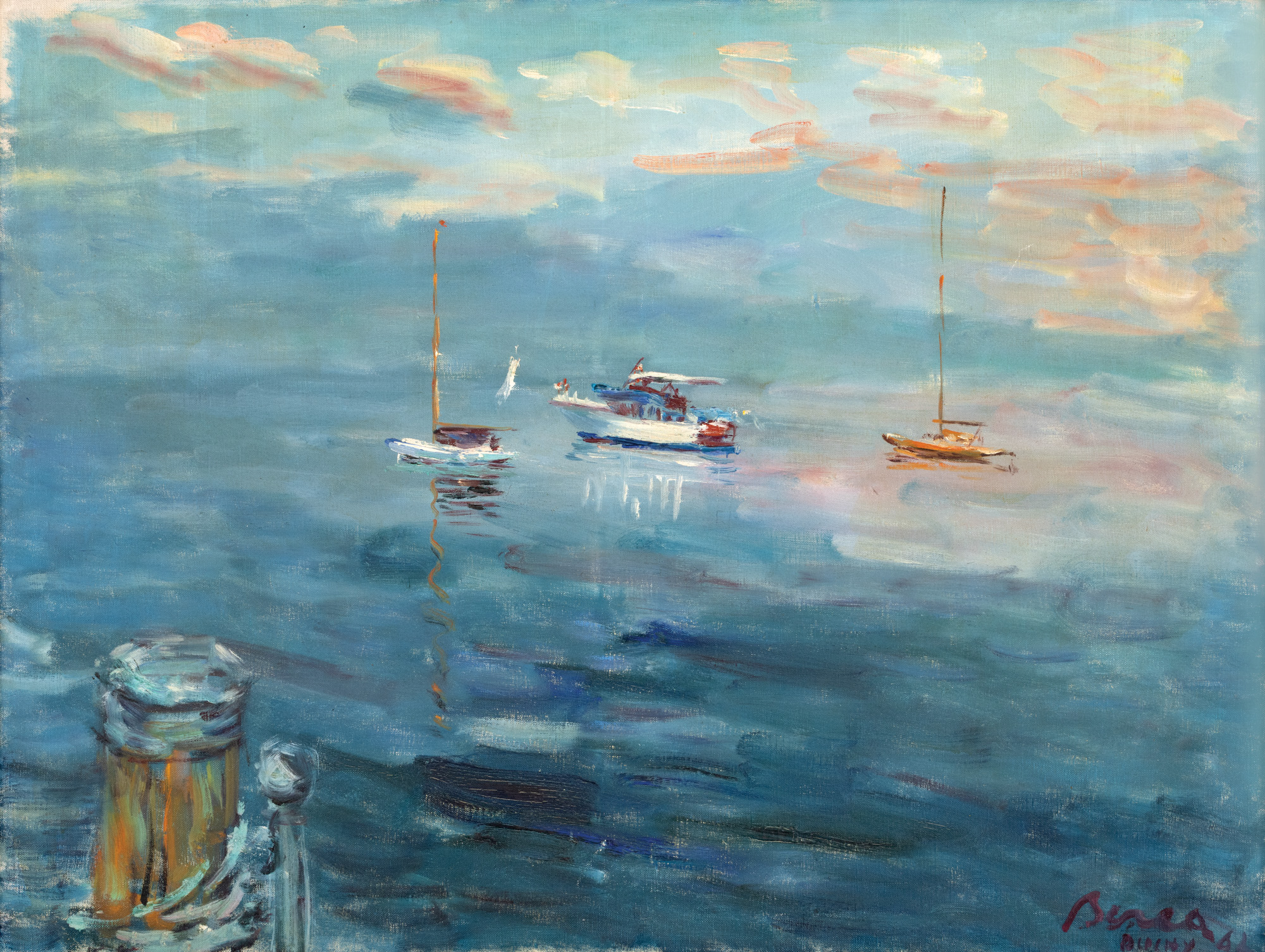
The photos of the lot are informative and indicative, and cannot provide a highly detailed view of the object from all angles. We recommend a careful physical inspection of the lot before bidding.
The photos of the lot are informative and indicative, and cannot provide a highly detailed view of the object from all angles. We recommend a careful physical inspection of the lot before bidding.
Jules Perahim's art has a smooth journey, but is constantly influenced by his ideological interests, being a notable representative of Romanian surrealism. His technique reveals a solid understanding of color and shape, most likely inherited from his teachers, Nicolae Vermont and Costin Petrescu. However, despite his classical education, Perahim quickly approached the circles of the Romanian avant-garde, where he established connections with prominent figures such as Marcel Iancu, Victor Brauner, and Max Herman Maxy. Alongside them, he developed a new artistic vision, radically different from the traditional canons he was initially formed in.
The surrealism of Perahim’s paintings is characterized by a playful component, a free play of volumes and textures, often completed with subtle narrative notes. His characters are loaded with meanings. Michel Remy sees in Perahim's art a search and exploration of lost meanings, his creatures having a primordial dimension, which seems to come from a forgotten time. What Perahim tries to convey often remains inaccessible, as if the meanings were extremely deep, but long forgotten. Remy also draws a parallel with the world of fairy tales, that archaic world speaking of an original loss, about what we no longer know, but which, once upon a time – before the Tower of Babel – united us in a common language.
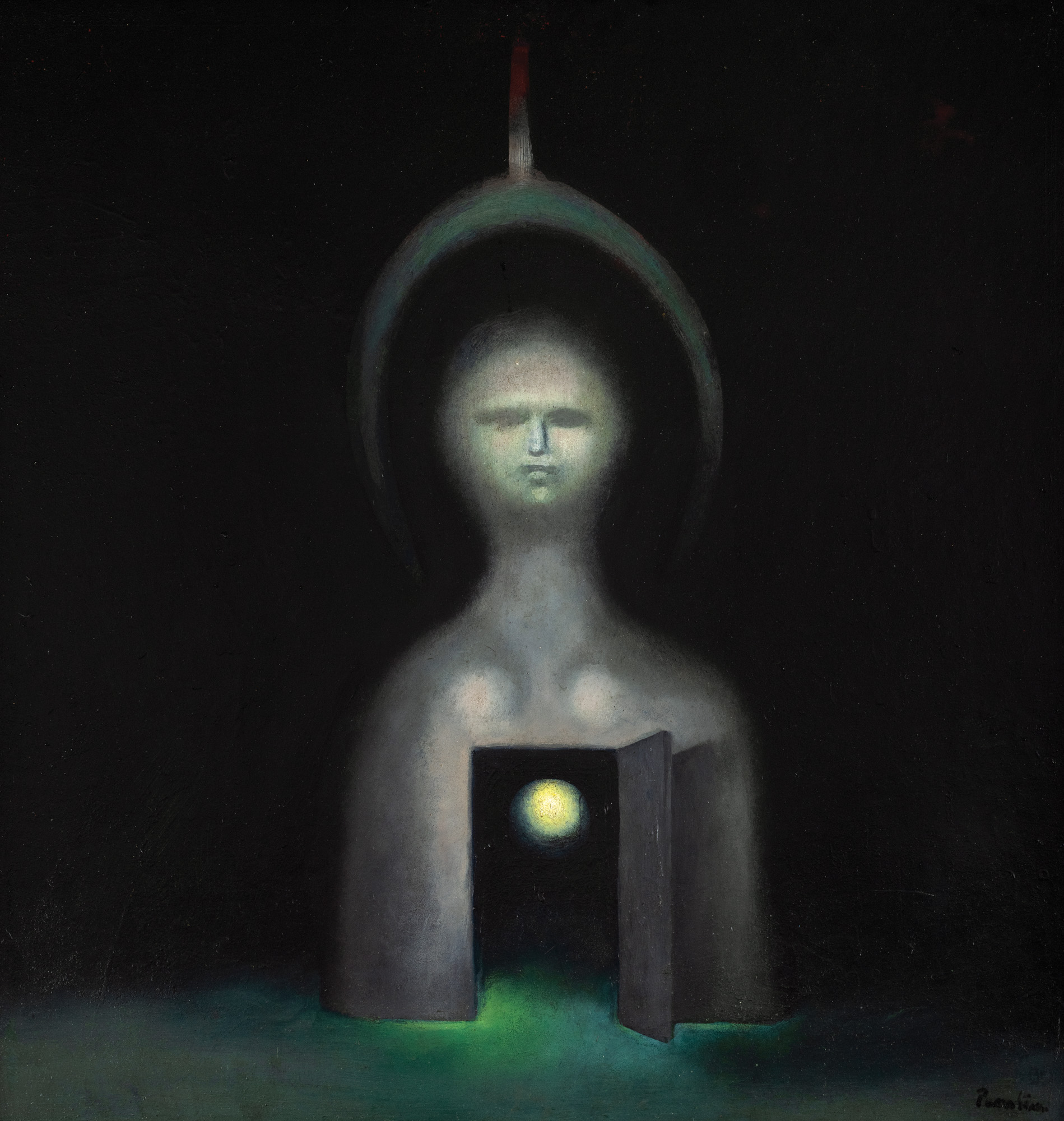
We note here how Perahim’s character, static and contemplative in posture, invites the viewer towards the knowledge of such meanings. Located in an atmosphere dominated by darkness, the character seems to be covered by a mysterious and diffuse light of his own. The perspective is frontal, with a single vanishing point, which strengthens the point of interest – the moon shining behind the door. Perahim's work stands out through a unique way of rendering a space that is simultaneously two-dimensional and three-dimensional. It's as if we are looking at an abstract painting in composition, but recognizable by subject matter, as if the artist only partially appeals to the “medium-specificity” principle spoken by his contemporary, Clement Greenberg. This approach underlines the fact that, in his art, the real world and the imaginary world coexist and complement each other, opening us the gate to a universe whose meanings await to be rediscovered.
References
"Jules Perahim. 1914-2008: From the avant-garde to flourishing, from Bucharest to Paris", Ed. LIENART, 2021.
Dimensions
width 52.5 cm, height 52 cm
Description
oil on cardboard, signed bottom right, in black, "Perahim"
Dating
anii '70
ADDITIONAL INFORMATION
For clarifications regarding the bidding procedure, hammer price costs, guarantee, payment, and collection terms for the winning lot, we recommend carefully reading/re-reading the Bidding Regulations.
For additional information regarding the lot and the auction, please contact the Art Consultants Department.
Detalii
Jules Perahim's art has a smooth journey, but is constantly influenced by his ideological interests, being a notable representative of Romanian surrealism. His technique reveals a solid understanding of color and shape, most likely inherited from his teachers, Nicolae Vermont and Costin Petrescu. However, despite his classical education, Perahim quickly approached the circles of the Romanian avant-garde, where he established connections with prominent figures such as Marcel Iancu, Victor Brauner, and Max Herman Maxy. Alongside them, he developed a new artistic vision, radically different from the traditional canons he was initially formed in.
The surrealism of Perahim’s paintings is characterized by a playful component, a free play of volumes and textures, often completed with subtle narrative notes. His characters are loaded with meanings. Michel Remy sees in Perahim's art a search and exploration of lost meanings, his creatures having a primordial dimension, which seems to come from a forgotten time. What Perahim tries to convey often remains inaccessible, as if the meanings were extremely deep, but long forgotten. Remy also draws a parallel with the world of fairy tales, that archaic world speaking of an original loss, about what we no longer know, but which, once upon a time – before the Tower of Babel – united us in a common language.
We note here how Perahim’s character, static and contemplative in posture, invites the viewer towards the knowledge of such meanings. Located in an atmosphere dominated by darkness, the character seems to be covered by a mysterious and diffuse light of his own. The perspective is frontal, with a single vanishing point, which strengthens the point of interest – the moon shining behind the door. Perahim's work stands out through a unique way of rendering a space that is simultaneously two-dimensional and three-dimensional. It's as if we are looking at an abstract painting in composition, but recognizable by subject matter, as if the artist only partially appeals to the “medium-specificity” principle spoken by his contemporary, Clement Greenberg. This approach underlines the fact that, in his art, the real world and the imaginary world coexist and complement each other, opening us the gate to a universe whose meanings await to be rediscovered.
ADDITIONAL INFORMATION
For clarifications regarding the bidding procedure, hammer price costs, guarantee, payment, and collection terms for the winning lot, we recommend carefully reading/re-reading the Bidding Regulations.
For additional information regarding the lot and the auction, please contact the Art Consultants Department.
References
"Jules Perahim. 1914-2008: From the avant-garde to flourishing, from Bucharest to Paris", Ed. LIENART, 2021.
Dimensions
width 52.5 cm, height 52 cm
Description
oil on cardboard, signed bottom right, in black, "Perahim"