The photos of the lot are informative and indicative, and cannot provide a highly detailed view of the object from all angles. We recommend a careful physical inspection of the lot before bidding.
FRUNZETTI, Ion, "Mișu Popp", State Publishing House for Literature and Art, Bucharest, 1956.
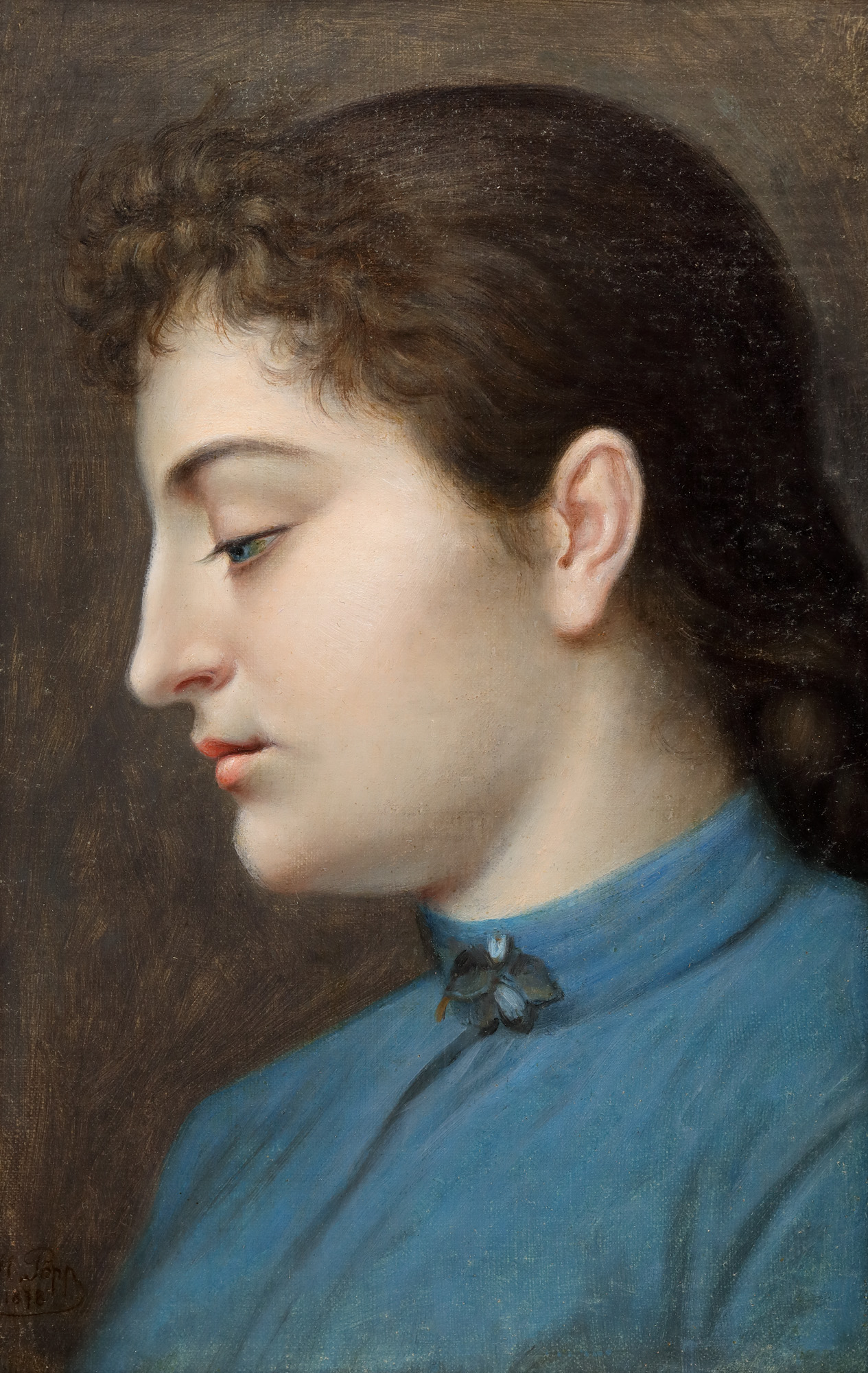
oil on canvas, 36 x 24 cm, signed and dated lower left, in brown, "M. Popp, 1878"
Material / Carats
oil on canvas
PROVENANCE
The Nicolae and Hrisanti Petresco Collection.
Mișu (Mihail) Popp was born in Brașov in 1827, the son of the church painter Ioan Popp Moldovan. He was born into a family where the parental home was transformed into a painting workshop where each member participated in the completion of the projects taken over by the father. His interest in art, therefore, is no surprise. He was the apprentice of his father and brother from elementary school; at 15 he was enrolled in the military school in Târgu Secuiesc. However, having no calling for the officer's career, he confidently turned to his real passion: art. In 1845 he entered as a student at the Art Academy in Vienna, where he arrived with his father's support. He will adopt the famous "Galerieton" of the paintings he admires in the major museums of the Habsburg Empire. Returning home from studies near the 1848 revolution, he became the apprentice of the painter Constantin Lecca. The notes of academicism will be imparted to him by both his studies abroad and by the guidance of his master from Craiova. He will paint next to this the church of St. Nicholas in Șchei and the Radu-Vodă church in Bucharest. The two will thus lay the foundation for a friendship (master-apprentice) and professional collaboration. Mișu Popp will mainly adopt the painting genres that did not represent a so-called danger to the authorities, for example the portrait, where he would not have been able to insert revolutionary ideas. He will be called to paint several churches in the country: in Vâlcea or Câmpulung Muscel, but the mural decoration and the church painting will be seconded by the easel painting. In portraiture, he will demonstrate a particular precision and minuteness in rendering the physiognomic details of his protagonists. They will pose for him the protipods of the time, the reputed personalities, and their families. With his extraordinary attention to detail, he will succeed in recreating the sheen of silks and the texture of clothing, the materiality of hair or the elegance of jewelry. In his gallery of works, there is a distinguished series of portraits of voivods, chroniclers, or writers, made after photographs or prints. However, Mișu Pop did not stop at the faces of high society, but used to transcribe on his canvases the faces of peasants from the villages where he painted churches, especially in Transylvania. Beyond the faithful transcription of the features of characters, the artist takes care of the moral component and the transposition of the human condition in his art. He thus creates a series of portraits dedicated to rural life, with representatives of places such as Țara Bârsei, Râșnov or Săcele. At the height of his artistic career, he stops in Gorj, where he befriends a local merchant - Matei Zănescu (who was then, in 1855, 70 years old). He will capture in his canvases both his face and those of his family, with which he will get very close. In the absence of founding a family of his own, Mișu Popp will direct his attention to his brothers, sisters, and nephews, but also to friends, He will spend many evenings in their homes and will transcribe in his works the faces of those who have become his family. The Biedermeier spirit and the precepts of academicism will never leave him, regardless of the subject approached. Porcelain faces, the realism of costumes, lighting, and the effects of light reflecting on fabrics, will accompany him also in the portraits of his own family.
For clarifications regarding the bidding procedure, hammer price costs, guarantee, payment, and collection terms for the winning lot, we recommend carefully reading/re-reading the Bidding Regulations.
For additional information regarding the lot and the auction, please contact the Art Consultants Department.