The photos of the lot are informative and indicative, and cannot provide a highly detailed view of the object from all angles. We recommend a careful physical inspection of the lot before bidding.
"Forgotten Transylvanian Artists. 1700-1950", Art Museum of Brasov, 2008.
"German Art from Transylvania in the collection of the Art Museum of Brasov", Art Museum of Brasov Publishing House, 2011.
Gudrun-Liane Ittu, "Ernst Honigberger (1885-1974) - A nearly forgotten artist from Brasov", in "Acta Terrae Fogorasiensis", no. IV, 2015, pp. 539-548.
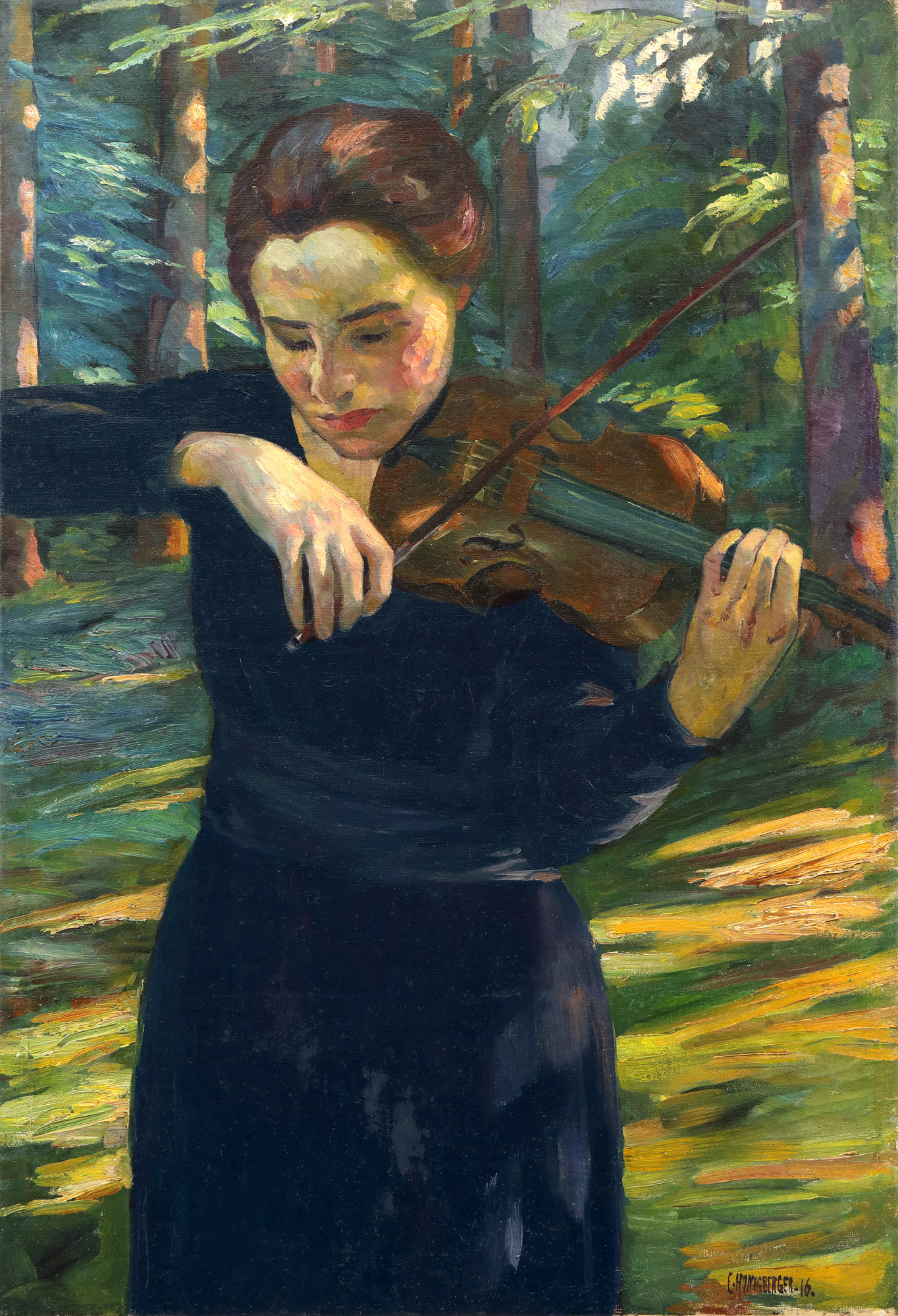
oil on canvas, 93 x 64 cm, 93x64, signed and dated lower right, in brown, "E. Honigberger, (19)16"
Born into a family of artists, Honigberger will always be surrounded by the muses of creation. His older sister, Helena, took violin and classical singing lessons, even becoming a well-known soprano, violinist, and music teacher in Germany, Budapest, and Transylvania. His younger sister, Selma, also studied the piano, eventually carrying out both a performance and teaching activity in Berlin. The affinity for the chords of music will thus also be felt in the painting of Ernst Honigberger, in the play of forces between post-impressionist and expressionist means of expression. The influence of the latter will be demonstrated by the use of lively accents and strong contrasts, broad strokes and by focusing the artist's attention on the expression of the faces represented. In the present work, the artist represented his wife, Erna (Kroder, before marriage), who was an exceptional violinist. Caught in the musician's pose, most likely in the Black Forest, near the small town where the two spouses had moved (to Wehr), the protagonist shows a distinguished posture, focused on a mental score. Placed in the middle of the natural frame, surrounded by trees and multiple shades of green, Erna demonstrates elegance and candor. With her hair tied back and dressed in a black dress, which lightly falls beside her body, the protagonist holds her violin in her left hand, while her right arm carries the bow above the strings. The harmonic heap of colors, lights, and shadows are prefigured, therefore, in a hymn dedicated to the artist's wife and main muse. Erna began her first violin lessons at the age of 14, and by the age of 16, she obtained a certificate allowing her to work as a music, violin, and piano teacher. She then attended the Music Academy in Munich, where she was awarded the Felix Mottl prize (she will be the youngest student to receive this award), and then she finished her studies in Berlin with the legendary violin teacher Carl Flesch. She will adopt the name Mottl as her stage name, most likely to decrease the chances of being recognized (during World War II, being Jewish). At the age of 24, she was teaching violin at the Conservatory in Berlin, and later she will teach at the school that she founded with her husband: "Kunst und Musikschule Honigberger". Among the students she taught at Wehr is Anne-Sophie Mutter, a famous contemporary violinist of German origin. Following the vein of the tradition proposed by the Honigberger family, the daughter of the two artists, Erda, will also stand out as a talented pianist.
For clarifications regarding the bidding procedure, hammer price costs, guarantee, payment, and collection terms for the winning lot, we recommend carefully reading/re-reading the Bidding Regulations.
For additional information regarding the lot and the auction, please contact the Art Consultants Department.
By choosing "Accept all cookies" you agree to the use of cookies to help us provide you with a better user experience and to analyse website usage. By clicking "Adjust your preferences" you can choose which cookies to allow. Only the essential cookies are necessary for the proper functioning of our website and cannot be refused
Cookie settings
Our website stores four types of cookies. At any time you can choose which cookies you accept and which you refuse. You can read more about what cookies are and what types of cookies we store in our Confidentiality Policy.
are necessary for technical reasons. Without them, this website may not function properly.
are necessary for specific functionality on the website. Without them, some features may be disabled.
allow us to analyse website use and to improve the visitor's experience.
allow us to personalise your experience and to send you relevant content and offers, on this website and other websites.