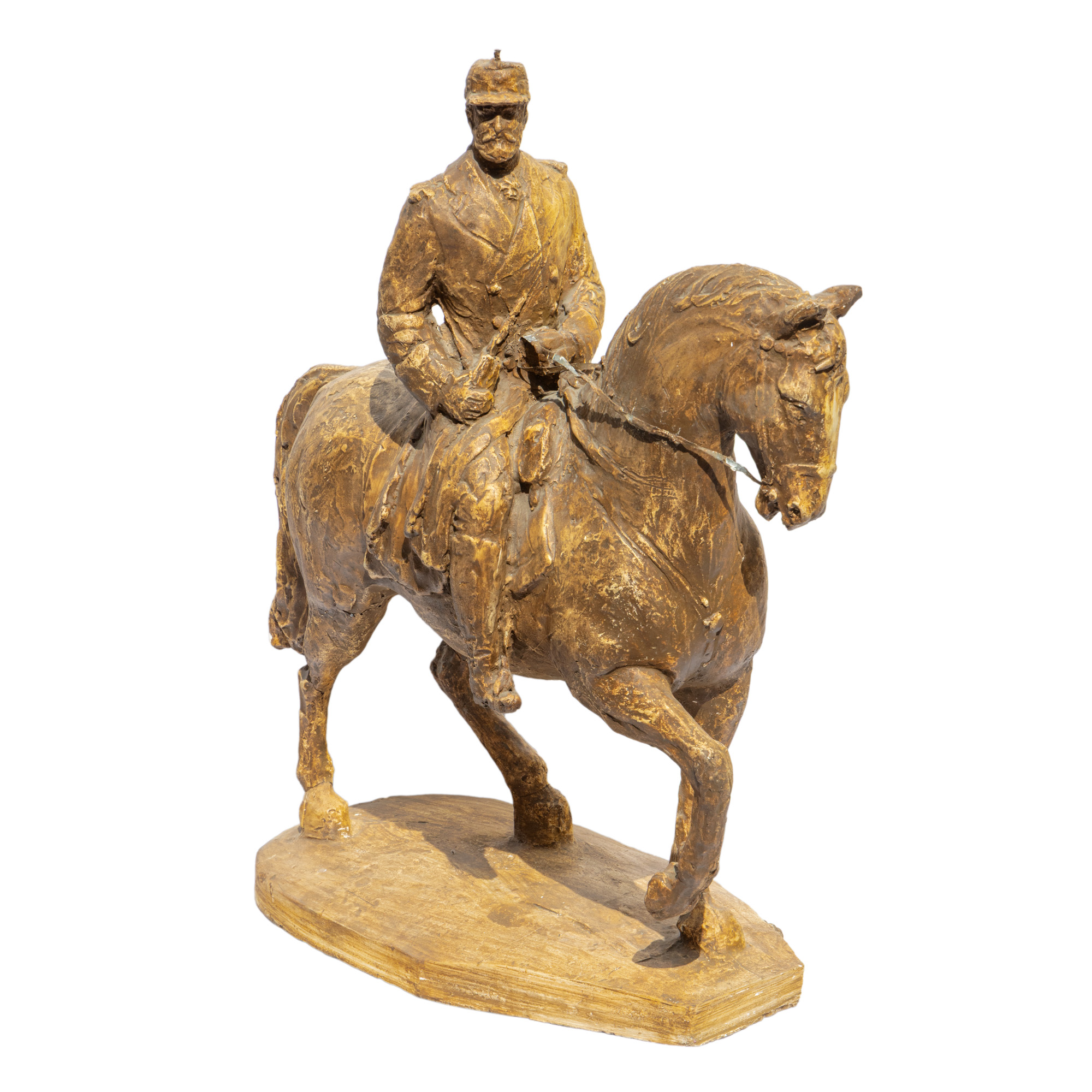
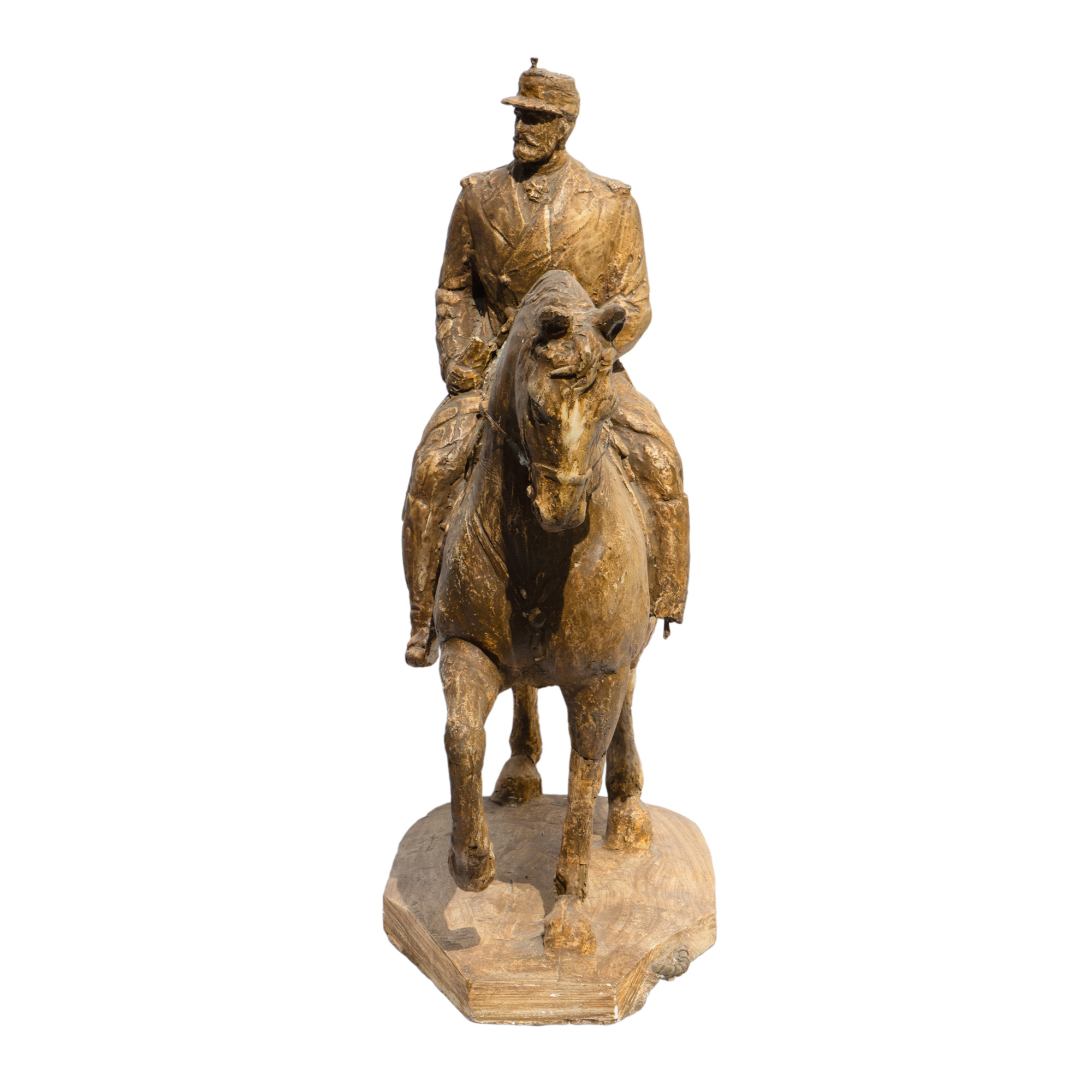
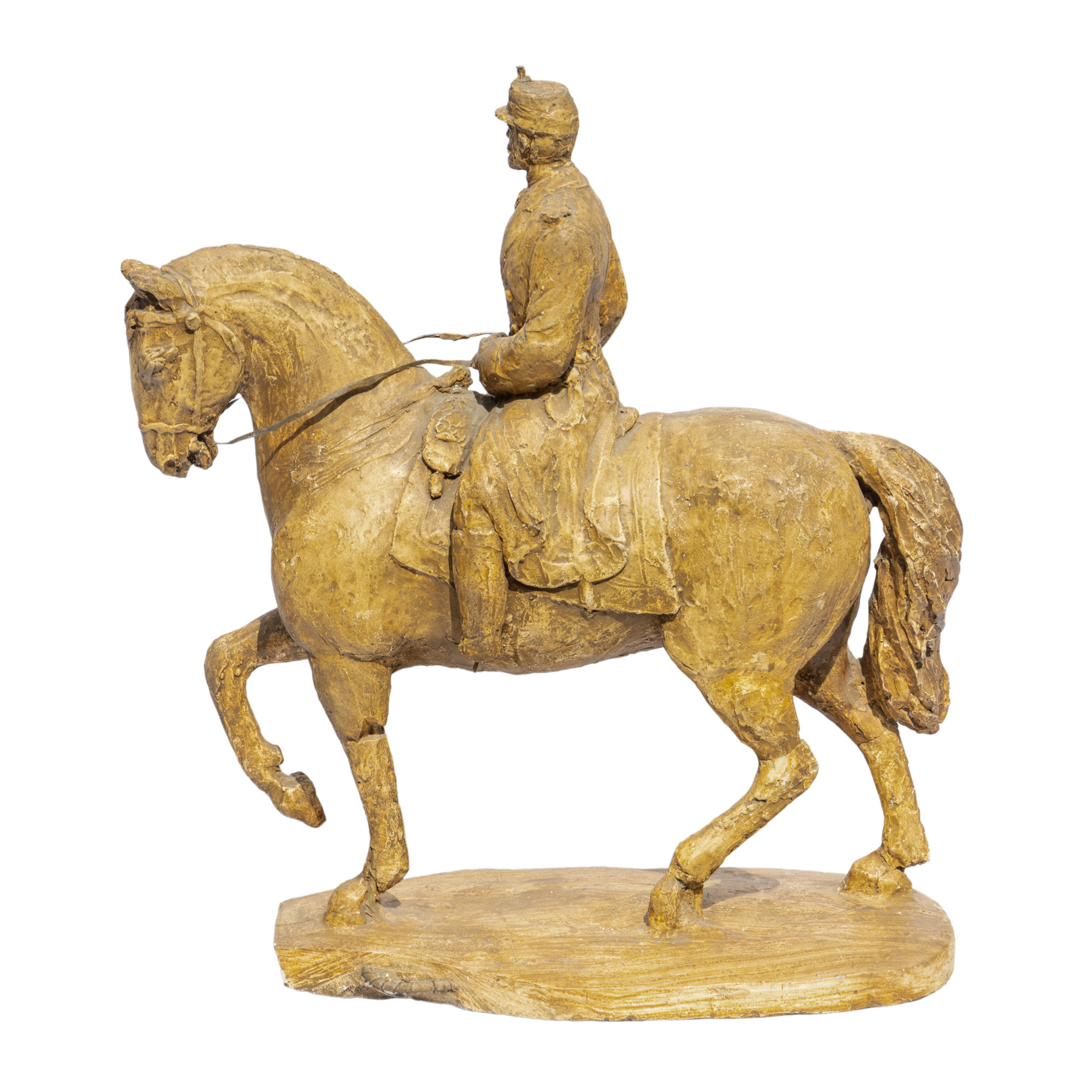
188C. Maquette for the Equestrian Statue of King Carol I
The photos of the lot are informative and indicative, and cannot provide a highly detailed view of the object from all angles. We recommend a careful physical inspection of the lot before bidding.
The Becker family and the royal family of Romania have had intersecting histories over time. Emil Wilhelm Becker's father, August Becker, was brought to Romania at King Carol I's initiative, on the occasion of the restoration of the church at Curtea de Arges. As part of this project, he took care of the reconstruction of the lead roof ornaments, being renowned as an exceptional engraver and sculptor.
His recommendation came from an older relative named August Becker, a valued landscape and portrait painter, who taught drawing to the daughters of Queen Victoria, Britain, and made numerous portraits of the British royal family. On this occasion, he also met the future king of Romania, Carol I of Hohenzollern, for whom he painted a portrait in an intimate landscape near the British royal court.
At the suggestion of the painter August von Becker, who recommended the king to hire professional artists for his projects in Romania, the engraver and sculptor August von Becker arrived in the country, later settling permanently in Bucharest. In turn, Emil Wilhelm Becker will maintain close ties with the Royal House of Romania until the end of the monarchical regime.
The model presented here is a representation of King Carol I of Romania, captured on horseback. Formed in the rigorous spirit of military schools, the king was, since his youth, an experienced officer, passed through armed conflicts, and noted for his discipline, rigor, and strategic skills. A respected soldier and a skilled diplomat, he was equally appreciated by contemporaries and the soldiers he led. These qualities were fully manifested during the Romanian War of Independence when Romania actively participated, mobilizing its entire army alongside the Russian Empire against the Ottoman Empire. Carol I was on the front for months, directly leading the military operations and consolidating his reputation as a strong and dedicated leader.
Although the attribution can not be established with certainty, it is very likely that this was Emil Becker's proposal for the competition organized in Bucharest in 1936 for the creation of the equestrian monuments of King Carol I and Ferdinand I of Romania. The competition was won by Oscar Han, but in the end, the order for the execution of both monuments was entrusted to the Croatian sculptor Ivan Meštrović.
A significant detail of the composition is the position of the horse, represented with a front leg raised. According to heraldic conventions, this posture suggests that the character died from wounds acquired in battle. In the case of Carol I, however, this symbolism does not correspond to historical reality. The king died at the beginning of October 1914, shortly after the outbreak of World War I. His death is often attributed to a profound moral suffering, generated by the dramatic situation in which Romania - his adoptive homeland - ended up in conflict with Germany, his country of origin.
For clarifications regarding the bidding procedure, hammer price costs, guarantee, payment, and collection terms for the winning lot, we recommend carefully reading/re-reading the Bidding Regulations.
For additional information regarding the lot and the auction, please contact the Art Consultants Department.
By choosing "Accept all cookies" you agree to the use of cookies to help us provide you with a better user experience and to analyse website usage. By clicking "Adjust your preferences" you can choose which cookies to allow. Only the essential cookies are necessary for the proper functioning of our website and cannot be refused
Cookie settings
Our website stores four types of cookies. At any time you can choose which cookies you accept and which you refuse. You can read more about what cookies are and what types of cookies we store in our Confidentiality Policy.
are necessary for technical reasons. Without them, this website may not function properly.
are necessary for specific functionality on the website. Without them, some features may be disabled.
allow us to analyse website use and to improve the visitor's experience.
allow us to personalise your experience and to send you relevant content and offers, on this website and other websites.