
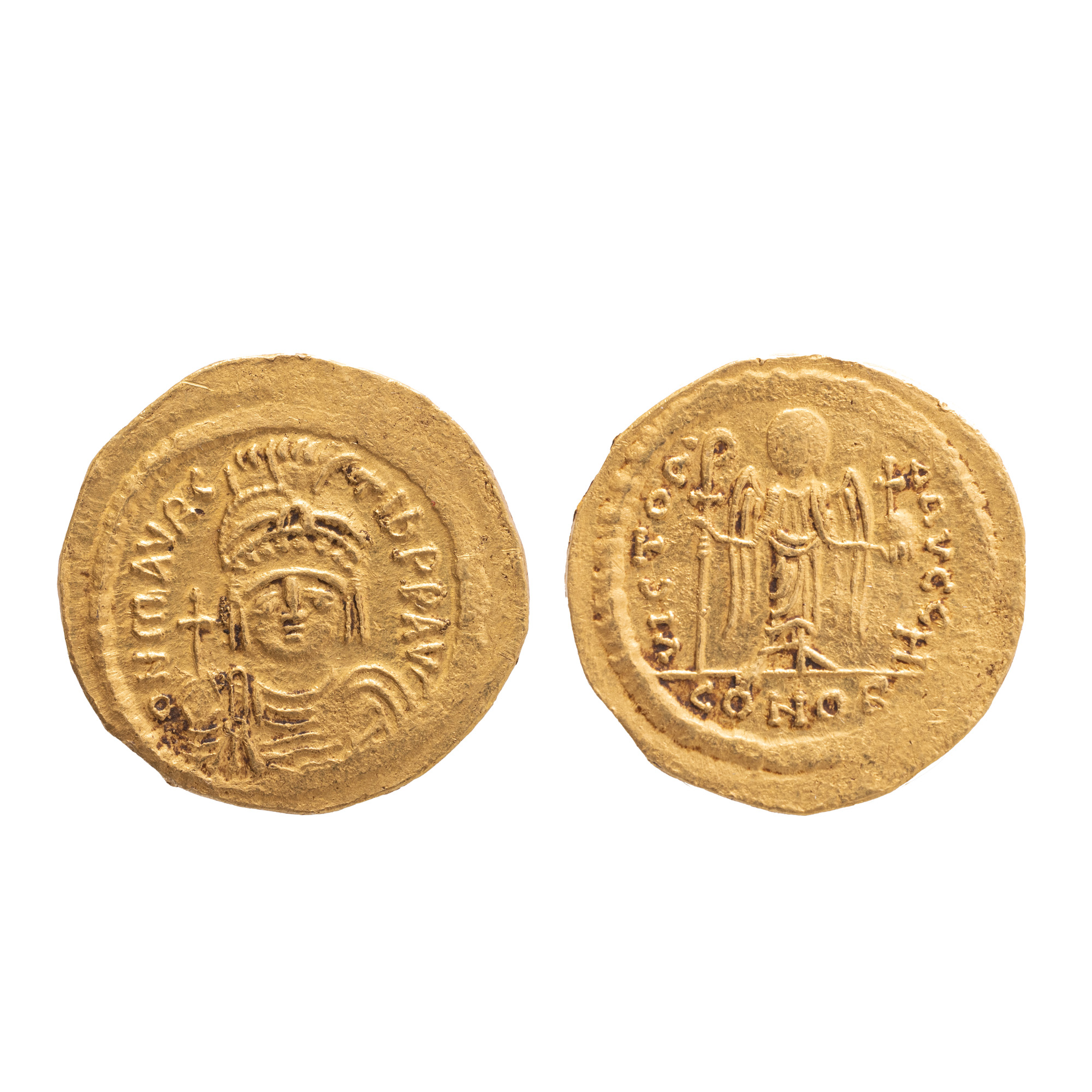
86Т. Solidus Coin, Maurice, Byzantine Empire, 582-602 A.D., Gold
The photos of the lot are informative and indicative, and cannot provide a highly detailed view of the object from all angles. We recommend a careful physical inspection of the lot before bidding.
86Т. Solidus Coin, Maurice, Byzantine Empire, 582-602 A.D., Gold
Starting price:
EUR 800
Sold
EUR 900
gold, d=21 mm
Obverse: D N mAVRC - TIb PP AVI (Our Lord Mauricius Tiberius Perpetual Augustus); Bust of Mauricius Tiberius, with helmet, diadem and cuirass, with pendants, face forward, holding a globus cruciger in his right hand. Reverse: VICTORI-A AVGGS / -|-// CONOB (Victory of the Augusti); An angel facing forward, haloed, with wings spread, holding a long cross in the right hand and a globus cruciger in the left hand.
Byzantine Emperor Mauricius Tiberius (reign: 582–602) was a key figure in Byzantine history, recognized for his efforts to stabilize and reform the empire during a period of political and military crisis. Coming from a modest background, Mauricius ascended to the throne due to his military and administrative qualities, and his reign was marked by a mix of remarkable successes and major difficulties.
One of his most significant contributions was the reorganization of the military system. He strengthened the empire's borders, especially in the Balkans and the East, where he carried out sustained campaigns against the Avars, Slavs and Sassanid Persians. Through his actions, he managed to restore some stability to key regions and delay the advance of dangerous enemies. In the East, he concluded a favorable treaty with Persia, supporting Khosrow II's ascent to the throne, which brought a temporary period of peace between the two great empires.
Domestically, Mauricius attempted to reduce state expenditures and impose better fiscal discipline. These measures, although necessary for the empire's economic health, caused discontent among the population and the army, especially when they were accompanied by salary cuts and the restriction of certain privileges. His austere policy, though well-intentioned, contributed to the decline of his popularity and, eventually, to his own overthrow.
His reign ended tragically in 602, when he was deposed by the usurper Phocas and executed along with his family. Nevertheless, historians consider Mauricius Tiberius a capable emperor, with a clear vision of the empire's needs, whose reforms and military decisions had a lasting impact on Byzantine structures.
For clarifications regarding the bidding procedure, hammer price costs, guarantee, payment, and collection terms for the winning lot, we recommend carefully reading/re-reading the Bidding Regulations.
For additional information regarding the lot and the auction, please contact the Art Consultants Department.
SESSION
Similar lots