The photos of the lot are informative and indicative, and cannot provide a highly detailed view of the object from all angles. We recommend a careful physical inspection of the lot before bidding.
BLAZIAN, H., "Pallady", State Publishing House for Literature and Art, Bucharest, 1957.
ȘORBAN, Raoul, "Theodor Pallady", Meridiane Publishing House, Bucharest, 1975.
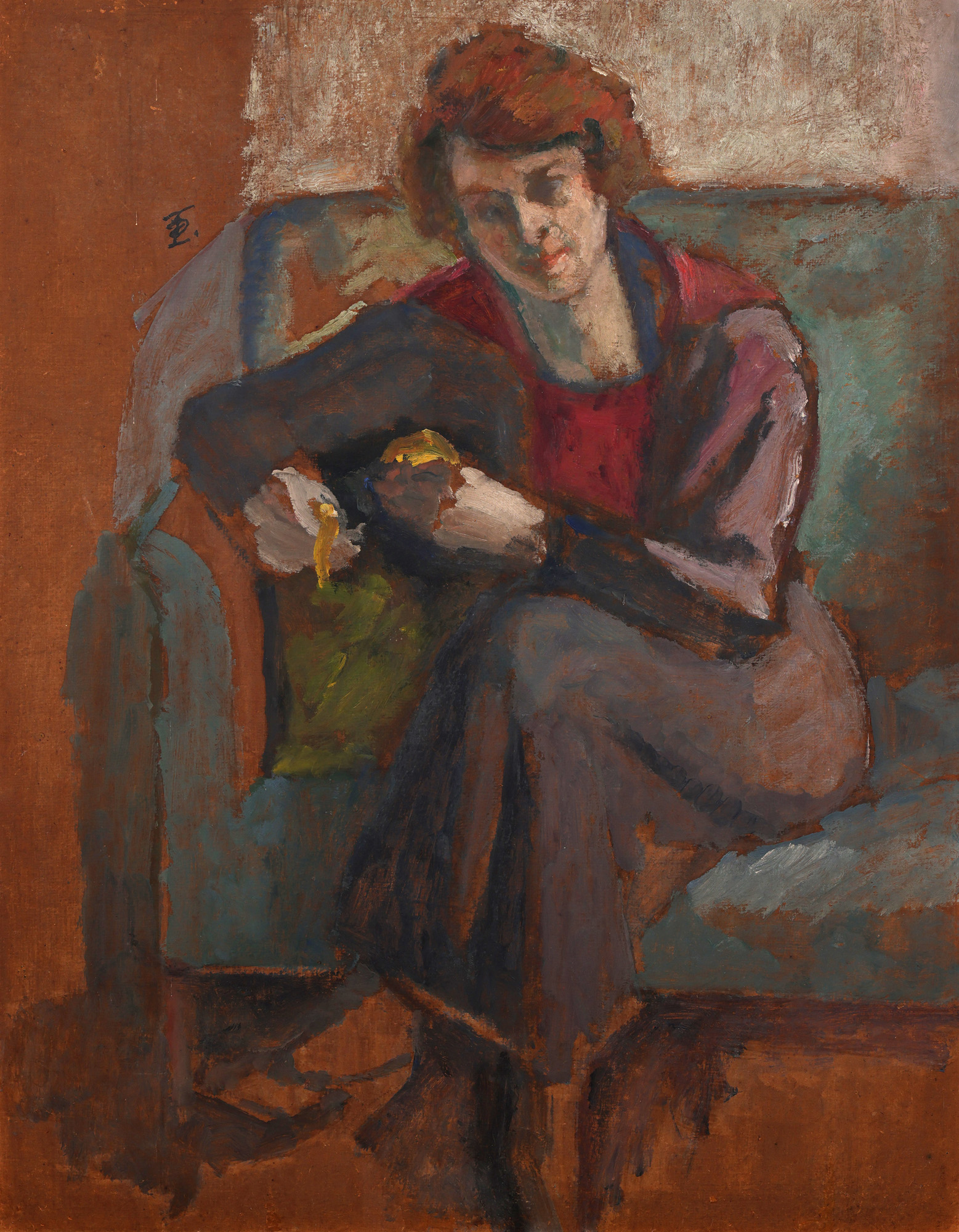
ulei pe carton, 65.5 x 51 cm, signed and dated on the left side, with black, "TP"
The end of the nineteenth century will find Theodor Pallady in the midst of Parisian frenzy, where he will often return throughout his life. Inspired by the landscapes and inhabitants of the Seine, the artist will dedicate many works to the subject. He will often stop on a deeply subjective horizon, where the characters and landscapes that are dearest to the artist predominate. Theodor Pallady will be acquainted with the French protipendada and will study alongside Matisse, Marquet or Rouault under the guidance of Gustave Moreau. The group he joins is decidedly against academicism, naturalism, and impressionism. In 1920 he affirms himself through a personal exhibition in Paris, an exhibition that will consecrate him among the critics of the time. In the intimate atmosphere of the interiors, Pallady has captured the entire essence of the female character, which has become, in his work, a muse and leitmotif. He often paints nudes, but also excels in portraits. He captures the female model seated on an armchair, lying on a bed or divan, but he is also concerned with the calculated arrangement of inorganic objects, which he groups evenly, and which often take the form of a coffee table, a desk, a newspaper or a book. The fluid course of the line, the harmonies and chromatic rhythms are not chosen randomly. The artist gives a meditative look at the interior scenes and constantly brings the female character back to the forefront of the canvas, in different variations. Pallady creates a real poetry of the interiors and attributes to his muses a hieratic symbolism. The individualization of the protagonists takes place mainly in portraits. In this work, undoubtedly included in the gallery of French portraits of the '30s, the protagonist appears seated on the sofa, elegantly dressed, styled according to the fashion of the time. The mystery of the female body, elucidated so often in the works dedicated to the nude, is encoded this time, in the long clothes, which cover the arms and lower limbs entirely. The human figure therefore appears as a pretext for line and color. The artist does not seek to reproduce in photographic detail the models who pose for him, but rather seeks to capture the atmosphere and the essence of the psychology of the character through chromatic devices, refractions of light and undulation of the line. The diffuse chromaticity, detached from reality, refines the pigment and joins the constitution of an intimate space, where the elegant forms of the muse converge beyond the profane dimension proposed by nudes, towards sacredness.
For clarifications regarding the bidding procedure, hammer price costs, guarantee, payment, and collection terms for the winning lot, we recommend carefully reading/re-reading the Bidding Regulations.
For additional information regarding the lot and the auction, please contact the Art Consultants Department.
By choosing "Accept all cookies" you agree to the use of cookies to help us provide you with a better user experience and to analyse website usage. By clicking "Adjust your preferences" you can choose which cookies to allow. Only the essential cookies are necessary for the proper functioning of our website and cannot be refused
Cookie settings
Our website stores four types of cookies. At any time you can choose which cookies you accept and which you refuse. You can read more about what cookies are and what types of cookies we store in our Confidentiality Policy.
are necessary for technical reasons. Without them, this website may not function properly.
are necessary for specific functionality on the website. Without them, some features may be disabled.
allow us to analyse website use and to improve the visitor's experience.
allow us to personalise your experience and to send you relevant content and offers, on this website and other websites.