
Meniu

English
Gifts

Rare Books, Documents, Photography & Posters

Collectible Religious Art

Asian Art, Technical Objects, Taxidermy, Curiosities & Antiques

Jewelry & Watches

Numismatics, Medals, Maps, Arms & Decorations

Luxury, Elegance, Collectible Cars & Beverages

Collectible Folk Art

Sneakers & Toys


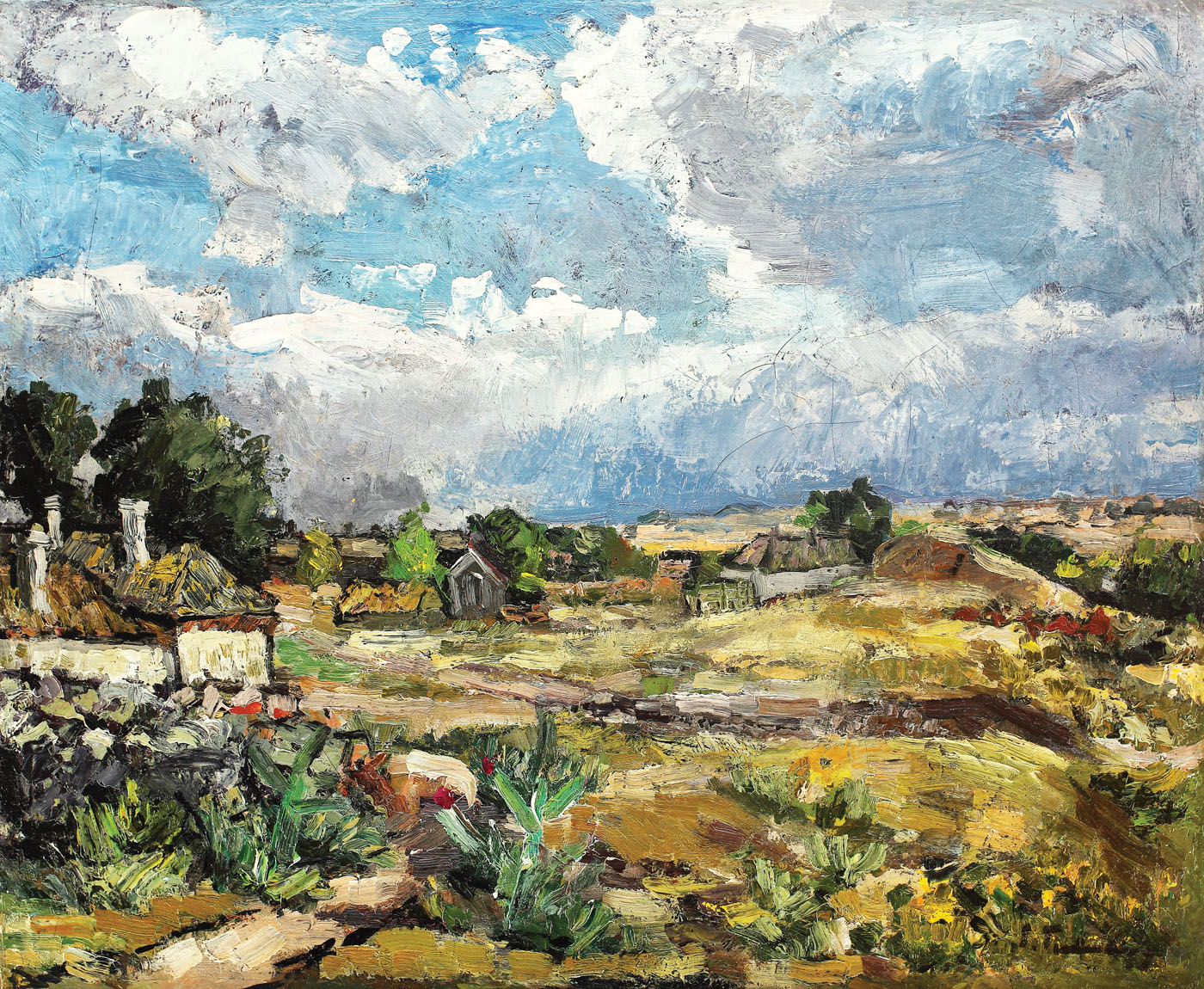
194. Landscape in Costinești

The photos of the lot are informative and indicative, and cannot provide a highly detailed view of the object from all angles. We recommend a careful physical inspection of the lot before bidding.

194. Landscape in Costinești

1910, Craiova - 1962, Bucureşti

Estimate:
EUR 25.000 - 35.000
Sold
EUR 42.500

References

CÂRNECI, Magda, "Ion Ţuculescu", Ed. Meridiane, 1984
DAVIDESCU, Cătălin, "Țuculescu", Ed. Scrisul românesc, Craiova, 1988

oil on canvas, 50.5 x 61 cm, 61x50,5, signed lower right, cu gri, "I. Țuculescu"

Material / Carats

ulei pe pânză

The 40s represent in Țuculescu's work a rich period in his evolution towards the beginning of abstraction, represented, in its turn, by the folk period. Landscapes of Bucharest or from the surroundings of Mangalia, the works painted in this period do not leave the figurative, but start from reality, so that through subtle syntheses, they can take the road of abstraction. In 1945 Ţuculescu was in Bucharest, the end of the war found him deeply troubled - from 1943 to 1945 he could not paint, being deployed and then mobilised and sent to the battle front as a doctor. The stage of creation before mobilisation was already a mature one, being coagulated around so-called "rapeseed fields". These appear at the same time with the series of night paintings by a profound Expressionist spirit and thus the period 1940-1943 is individualised coherently in the continuation of the Greek period. There is a relatively paradoxical formulation of the visual, which is now loaded with a certain narrativism of the image. The Expressionist character translates into tiny motifs that appear integrated into a realistic complex, the atmosphere being charged with a certain decorativeness. The element that tones down the period '43 -'46 is precisely the lack of emotional involvement on the part of Ţuculescu, who still cannot access the deepest levels of imagination. Of course this oneiric release will be grounded from 1947 onwards, when his well-known "folkloric" period begins. Starting from the same atmosphere that we can find in the "Rapeseed Fields", the landscape is based on the same type of backbone, the land/sky ratio being modulated by the depth of the horizon. The landscape is coordinated according to Cézanne’s principles of construction, and its visual saturation is achieved by designing a coherent pictorial register. The image is filled with vitality with a creative mobilisation of the artist, recreating a double perception of reality, through the sense of vision and its interiorised reception. Through the skilful use of black, in outlines or in matter, Ţuculescu succeeds in impressing movement and impetus to the whole composition, the eye begins to feel the materiality of the vegetation, the viewer feels the sky "moving". In a contradiction of value, our landscape is antagonistically set in the dark period, the image being loaded with optimism through a warm chromatic register. The fact that the painter focuses on the great expanse of blue gives an argument to validate the idea of a relaxed speech, but equally powerful and expressive. The overall vision is coordinated by a spiritualisation of the motif extracted from nature, thus susceptible to a subjective interpretation.

For clarifications regarding the bidding procedure, hammer price costs, guarantee, payment, and collection terms for the winning lot, we recommend carefully reading/re-reading the Bidding Regulations.

For additional information regarding the lot and the auction, please contact the Art Consultants Department.

SESSION
Tue, 19 December 2017 19:30

Similar lots