Meniu

Buying
How to sell
Contact
English
Gifts
Reduced Twice

Rare Books, Documents, Photography & Posters

Collectible Religious Art

Asian Art, Technical Objects, Taxidermy, Curiosities & Antiques

Jewelry & Watches

Numismatics, Medals, Maps, Arms & Decorations

Luxury, Elegance, Collectible Cars & Beverages

Collectible Folk Art

Sneakers & Toys

Discover


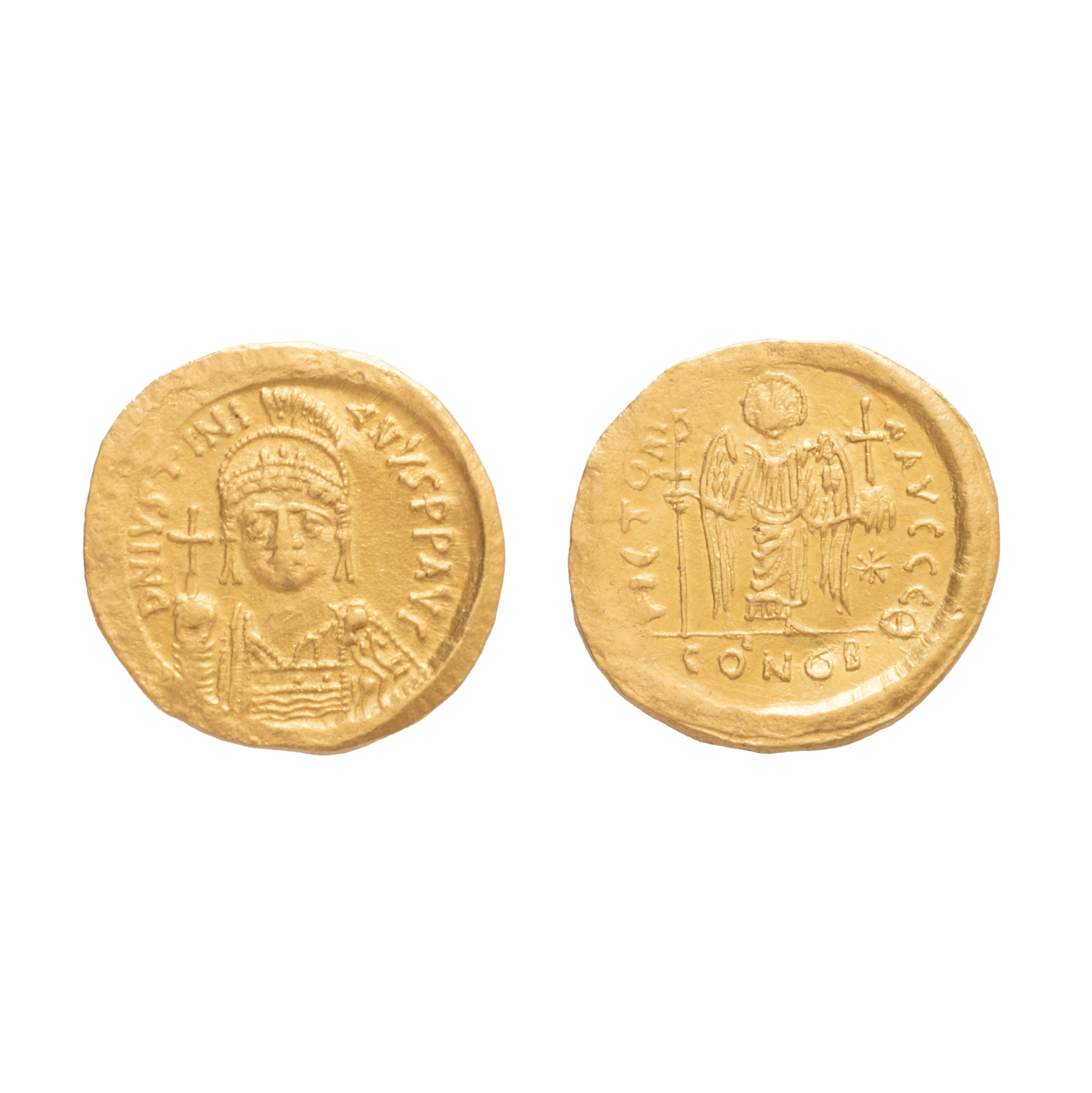
208C. Solidus Coin, Justinian I, Eastern Roman Empire, 527-565 AD, Gold

The photos of the lot are informative and indicative, and cannot provide a highly detailed view of the object from all angles. We recommend a careful physical inspection of the lot before bidding.

208C. Solidus Coin, Justinian I, Eastern Roman Empire, 527-565 AD, Gold


Starting price:
EUR 800
Sold
EUR 1.200

gold, d= 19.75 mm

Obverse legend: DN IVSTINI - ANVS PP AVC Obverse description: Marginal circular legend, interrupted at the top and bottom by the frontal bust of Emperor Justinian I. He is depicted wearing a diadem with pendilia, cuirass and paludamentum; in his right hand he holds a globus cruciger, and in his left hand a shield decorated with the schematic representation of a horseman. Reverse legend: VICTORI - AAV CCC - Θ / CONOB Reverse description: Marginal circular legend and linear legend in the exergue. In the center, angel represented frontally, standing, dressed in draped clothes, holding in the right hand a cross with staurogram at the top, and in the left hand a globus cruciger. In the right field is represented an eight-pointed linear star. The solidus issued during the reign of Emperor Justinian I represents a distinctive historiconumismatic document, relevant for understanding the economy, the monetary system and the imperial ideology in the 6th century. The Byzantine gold issues of this period stand out for the stability of the monetary standards, both from a metrological point of view, by maintaining the weight and title of the precious metal, and through the continuity of the imperial iconographic program. The piece is particularly important for documenting the subtle transformations of the monetary visual language during the transition period from late Roman tradition to Byzantine artistic and symbolic expression. The representation of the angel on the reverse, derived from the traditional type of Roman Victory, marks the adaptation of a symbol of imperial triumph to the new Christian religious context, while the introduction of the globus cruciger in the set of imperial insignia expresses the consolidation of the Christian conception of the emperor's authority and his legitimacy.

For clarifications regarding the bidding procedure, hammer price costs, guarantee, payment, and collection terms for the winning lot, we recommend carefully reading/re-reading the Bidding Regulations.

For additional information regarding the lot and the auction, please contact the Art Consultants Department.

SESSION
Tue, 29 September 2026, 12:00
Brought to you by

Similar lots