
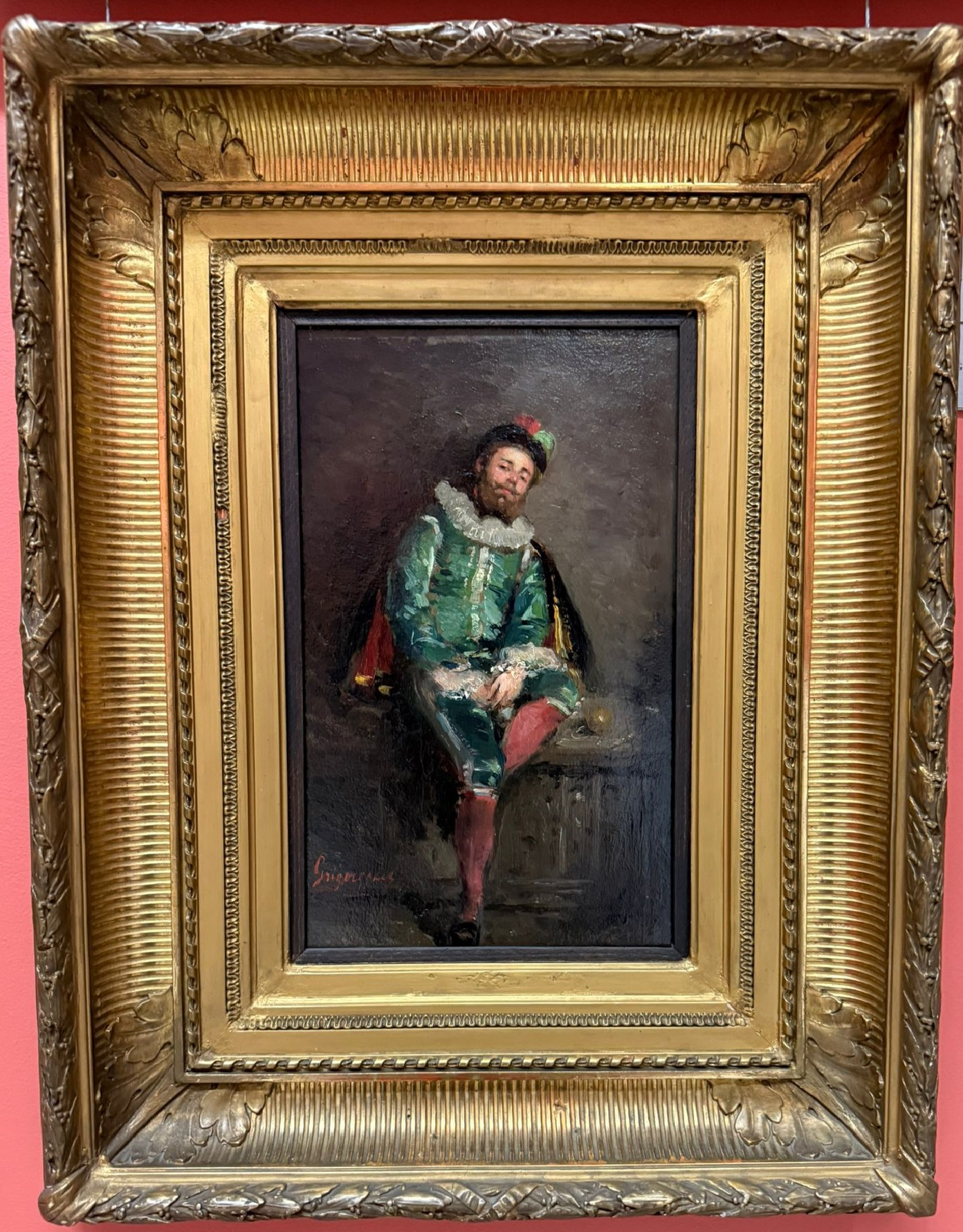
83. Green Ball Gown (Colombina in Green)
1838, Pitaru, Dâmboviţa - 1907, Câmpina

Estimate

EUR 100.000 - 200.000

Sold

EUR 175.000

Session

Tue, 16 December 2025 17:00

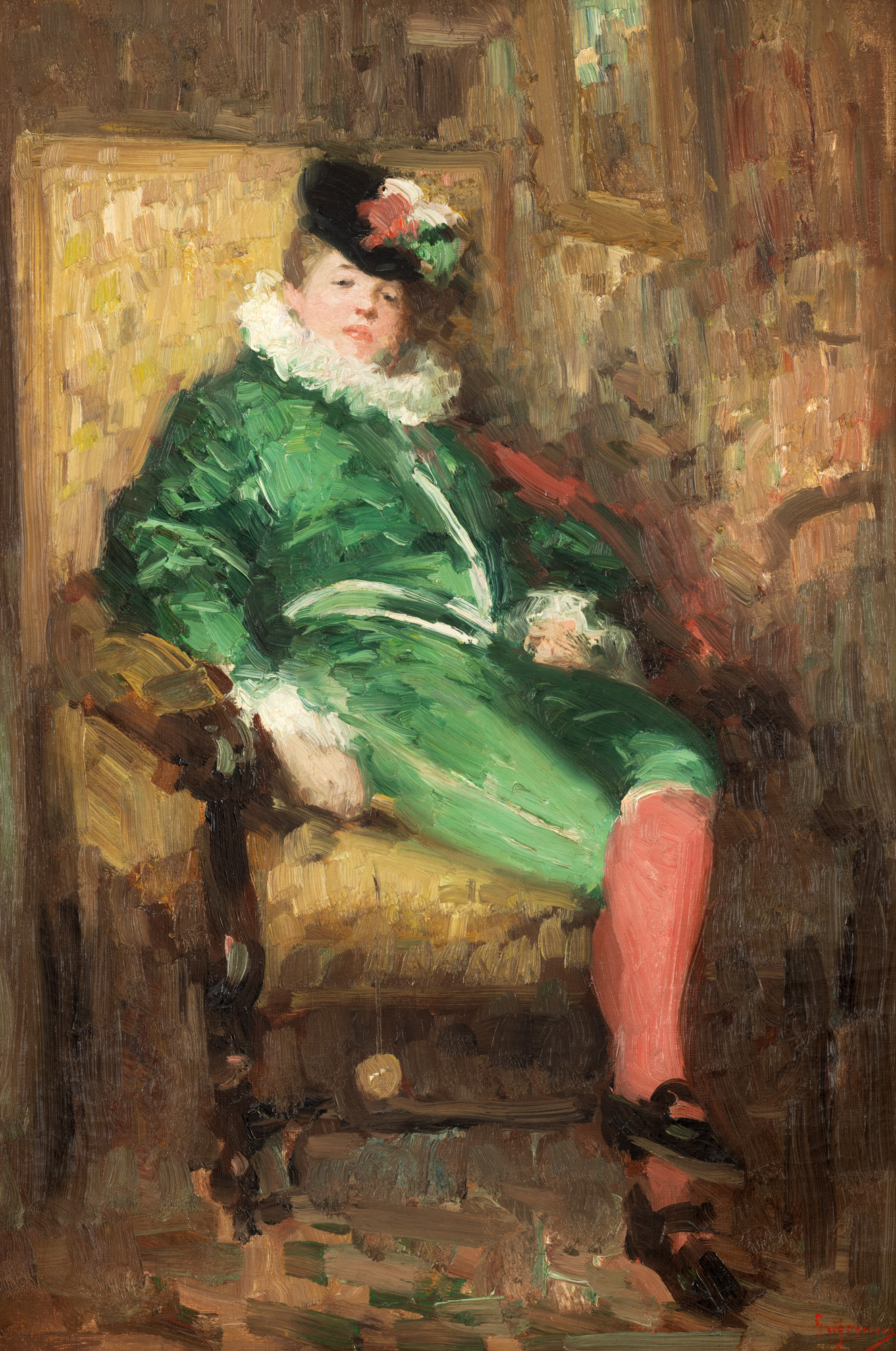
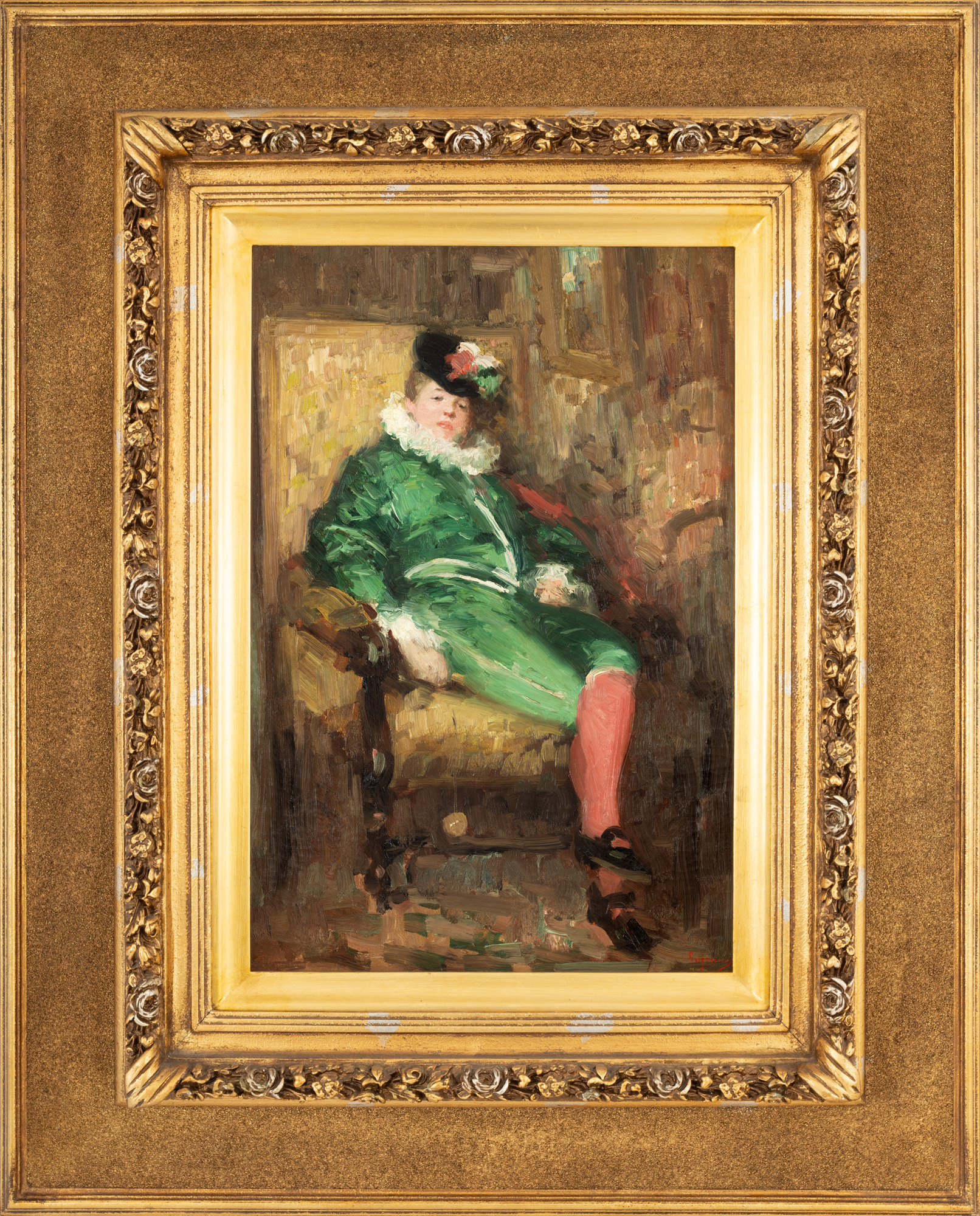
Imposing itself through an outstanding chromatic intensity, through the suggestions of pictorial tactility of the materials in which the character is dressed and through the sparkling vivacity of the strokes that make the entire surface of the image vibrate, this work is undoubtedly a masterpiece of Grigorescu's painting and is now presented to the public after three quarters of a century of absence. Its last appearance took place during Grigorescu's Centenary Exhibition, organized by Virgil Cioflec in 1938. The painting was then registered as "Green Ball Costume" (cat. no. 36), and Eug. Iliescu-Cândeşti’s collection was also mentioned as owning the piece. Its reproduction in the exhibition's catalogue remains, to our knowledge, the only image presented so far in the bibliographic context. It is worth adding that the artist listed in 1887 a very similar work, "Ball Costume" (catalogue no. 67), which could have even been this painting. In our opinion, the canvas belongs to a group of works created by Grigorescu in Rome, during the winter of 1873-1874, a moment with a peculiar outline in the artist's creation. Grigorescu worked in the Eternal City for a short period, drawing nudes and costumed models within the free academy in Via Margutta, known as Accademia di Gigi. Nicolae Grigorescu himself informed us about the identity of this workshop, signing the name (Academia Gigi) on a charcoal drawing, Male Nude (inv. 5817), kept in the Prints Cabinet of the National Art Museum of Romania. It is certain that Grigorescu spent the end of 1873 and then the carnival in February 1874, in Rome. All the carnival festivities and decorations allowed the artist to paint this inspired study of the costumed model, which seems to evoke the carnival moment, in a studio ambiance. Against a wall cluttered with paintings, the artist projects the ochre color armchair in the foreground. Seated on it is his model who appears to have stepped out of Watteau's universe, dressed in a Veronese green silk costume with pink stockings and a hat that matches the outfit. In the right hand, he holds a small ball (or a globe?), anyway, a toy-like object from the carnival props. This simple detail could be one of the keys to decoding the painting, to establishing the date and the circumstances in which it was painted. Seated on the chair with nonchalance and grace, the character whose melancholic glance, slightly tired as if after a celebration, meets that of the artist, seems to be a woman. The roundness of the face, the porcelain delicacy of the young blonde figure's features, as well as the balletic position of the right foot barely touching the floor brings us to acknowledge the artist's model as a cross-dresser. If we compare our work with another similar one, a variation on the same theme, "Costumed Man" featured in the National Gallery exhibition (MNAR, inv. 714 ), we are surprised to find the same Veronese green silk costume, but the model is undoubtedly a man, and the entire composition is placed on a more distant plane compared to our work. What evidently attracted the artist, motivating him to revisit the subject in the smaller format of "Costumed Man", was the picturality of the complementary (green-pink) dialogue and the challenge of capturing the tactile suggestion of the intensely colored silk. Grigorescu's encounter with the unique, ancient Italian celebration could have inspired him to also inscribe in "Costumed Man", through a seemingly insignificant detail, his presence during one of the carnival nights dedicated to painting: the transparent glass globe reflecting light placed to the left of the character on the chest he stands on; hence another element from the carnival props, just like the little ball in "Colombina in green". The group of Italian variations on the same pictorial themes of the evening lit studio interior, with a model in an armchair, can be completed with the study "Pifferaro in an Armchair" from George Oprescu's collection as featured in "Romanian Painting in the 19th Century", 1937 edition. The model, a child with a hat, is seated frontally in the chair, the hand making a gesture typical for his age. The same freedom of pictorial expression given by the dynamic and synthetic character of the stroke in "Colombina in Green", points towards the well-defined Italian stylistic phase that precedes the mature, recognizable formula in the well-known plein air works. "Italian Girl", also in the National Gallery exhibition (MNAR, inv.719), might have also been painted in the same studio interior. The model, a beauty, is depicted dressed in the typical peasant costume, sitting in an armchair. (I.B.)

References

CIOFLEC, Virgil, Romanian Academy and the Municipality of Bucharest, "Centennial Exhibition Nicolae Grigorescu under the high patronage of H.M. King Carol II, 1838-1938, June 12-30, 1938", Bucharest, cat. 36, ill. [pl 9] NICULESCU, Remus, "Nicolae Grigorescu Exhibition"[catalogue of], Museum of Art of the P.R.R., Bucharest, 1957 OPRESCU, G., "Romanian Painting in the XIX Century", Bucharest, Royal Foundations Ed., First Edition, 1937 OPRESCU, G. [-R. Niculescu],"N.Grigorescu", vol. I, Meridiane Ed., 1961 VLAHUTA, Al., "The Painter N.I.Grigorescu, His Life and Works", Bucharest, Socec & Co Workshops, Anonymous Society, 1910

Dimensions

width 40.5 cm, height 60 cm

Description

oil on canvas, signed lower right, in red, "Grigorescu"

Research information

The artwork was part of the "Centenary Exhibition of the Painter Nicolae Grigorescu under the High Patronage of H.M. King Carol II", 12-30 June 1938, Dalles Hall, Bucharest and it is mentioned and reproduced in the exhibition catalog at cat. 36. The artwork was part of the exhibition "Ioan Andreescu. Truth and imagination", Art Safari, Bucharest, 2025. The artwork was part of the exhibition "Nicolae Grigorescu. Treasures from private collections", Arad Museum Complex, 2024.

PROVENANCE

Gogu Iliescu collection; Eugen Iliescu-Cândești collection; Madeleine Iliescu-Cândești collection;

ADDITIONAL INFORMATION

For clarifications regarding the bidding procedure, hammer price costs, guarantee, payment, and collection terms for the winning lot, we recommend carefully reading/re-reading the Bidding Regulations.

For additional information regarding the lot and the auction, please contact the Art Consultants Department.

Similar lots
Yellow Roses

43. Yellow Roses [1971]

Rudolf Schweitzer-Cumpăna

    Estimate EUR 600 - 900
    Sold EUR 1.600
On the Terrace with Roses

97. On the Terrace with Roses [1951]

Dimitrie Berea

    Estimate EUR 2.000 - 3.500
    Sold EUR 2.750
Old Customs

158. Old Customs [1985]

Ion Pacea

    Estimate EUR 1.000 - 1.800
    Sold EUR 3.000