
72. Peasant Girl with White Kerchief [1923]
The photos of the lot are informative and indicative, and cannot provide a highly detailed view of the object from all angles. We recommend a careful physical inspection of the lot before bidding.
72. Peasant Girl with White Kerchief [1923]
1882, Ianca, Brăila - 1939, Bucureşti
Estimate:
EUR 9.000 - 15.000
Sold
EUR 15.000
oil on panel, 44.5 x 55.5 cm, signed and dated bottom left, in black, "Ion TheodorescuSion, 1923"
After 1909, the artist arrives in Sibiu to see the birthplaces of his parents, where he will begin to paint some of his relatives. The works from this period express the artist's fascination with the beauty of folk costumes.
Sion's attraction for understanding the Romanian village world intensifies between 1914-1916. In the landscapes of the 1920s, the rural motif is prevalent, where during this period, important works appear, with influences of the Sămănător peoples, which will characterize his work, becoming an important theme until the mid-1930s.
The artist will frequently return to the Argeș area, especially around the 1920s, where he will paint directly in the middle of nature.
He becomes an active observer and transcribes both the landscape and the human figures he captures through valleys, by the river or in households.
The national specifics will constitute in his work an evidence that will exceed the boundaries of time, impregnating his varied themed work. Starting from reality, he will venture into finding new forms of expressing the Romanian specifics, such as: "At plowing", "Sower", "Shepherd with goats" or "On the street", captured at Pianul de Jos or Curtea de Argeș.
The most prolific and valuable period in Ion Theodorescu-Sion's work, undoubtedly represents the time when the artist became concerned with the national ideas of traditionalism. The portrait will be a constant concern of Sion's work, from the moments of searching at the beginning of his studies, until the end of his activity, materializing either in the portraits of peasants from his native Pianul de Jos area, or those of his close ones.
He is concerned with the rural world seen as the point of origin, being interested in finding his Transylvanian roots on his father's side, these approaches being the first take on the subject, in the period of 1909-1912.
The main sources of inspiration will be folk legends, ballads, but especially the popular beliefs and customs, always searching for the national sentiment, imprinting his works a purely Romanian character.
Theodorescu-Sion looks for new forms of expressing national sentiments and the Romanian specifics, trying a modern interpretation, always motivated by the same personal sentiment of perfection.
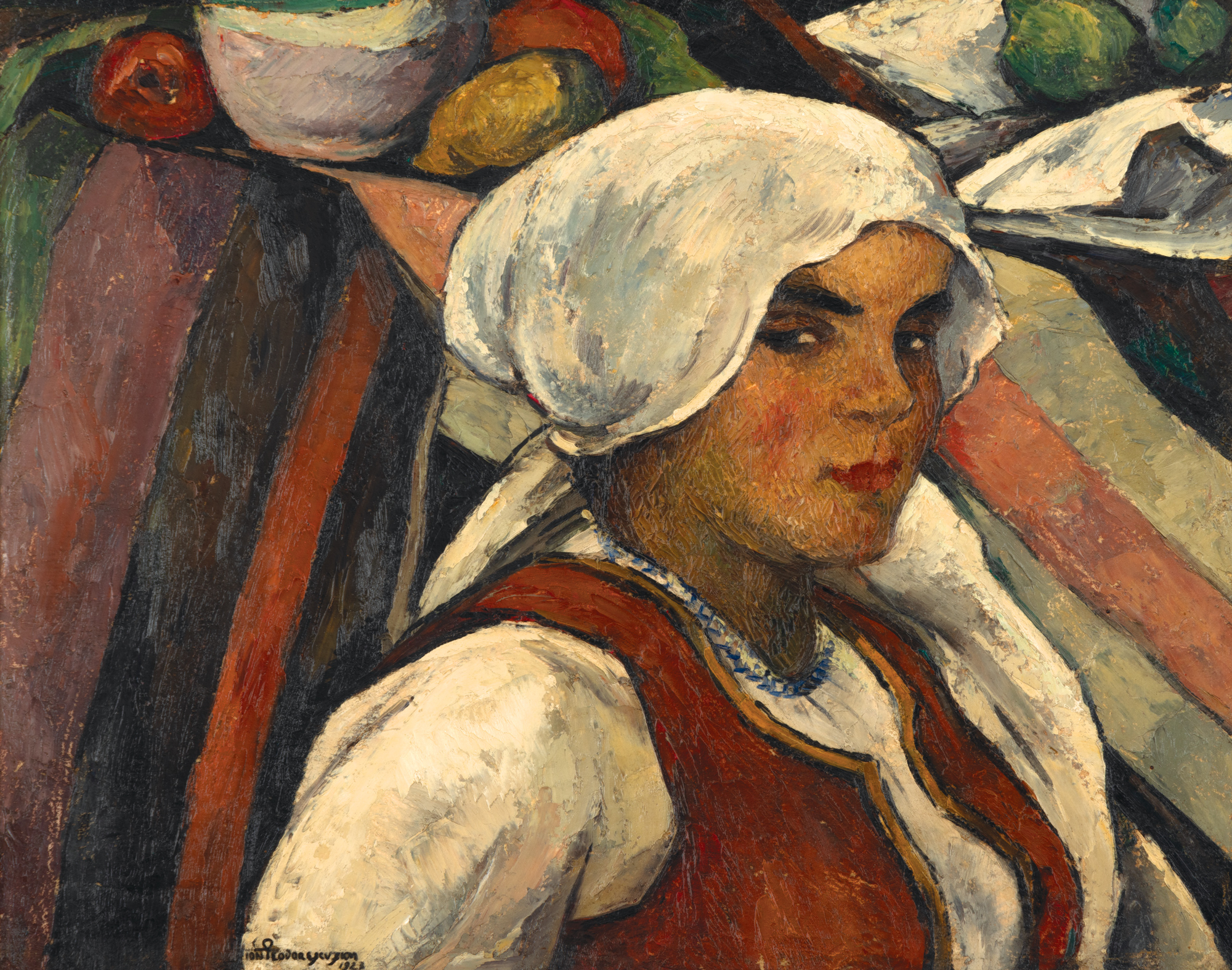
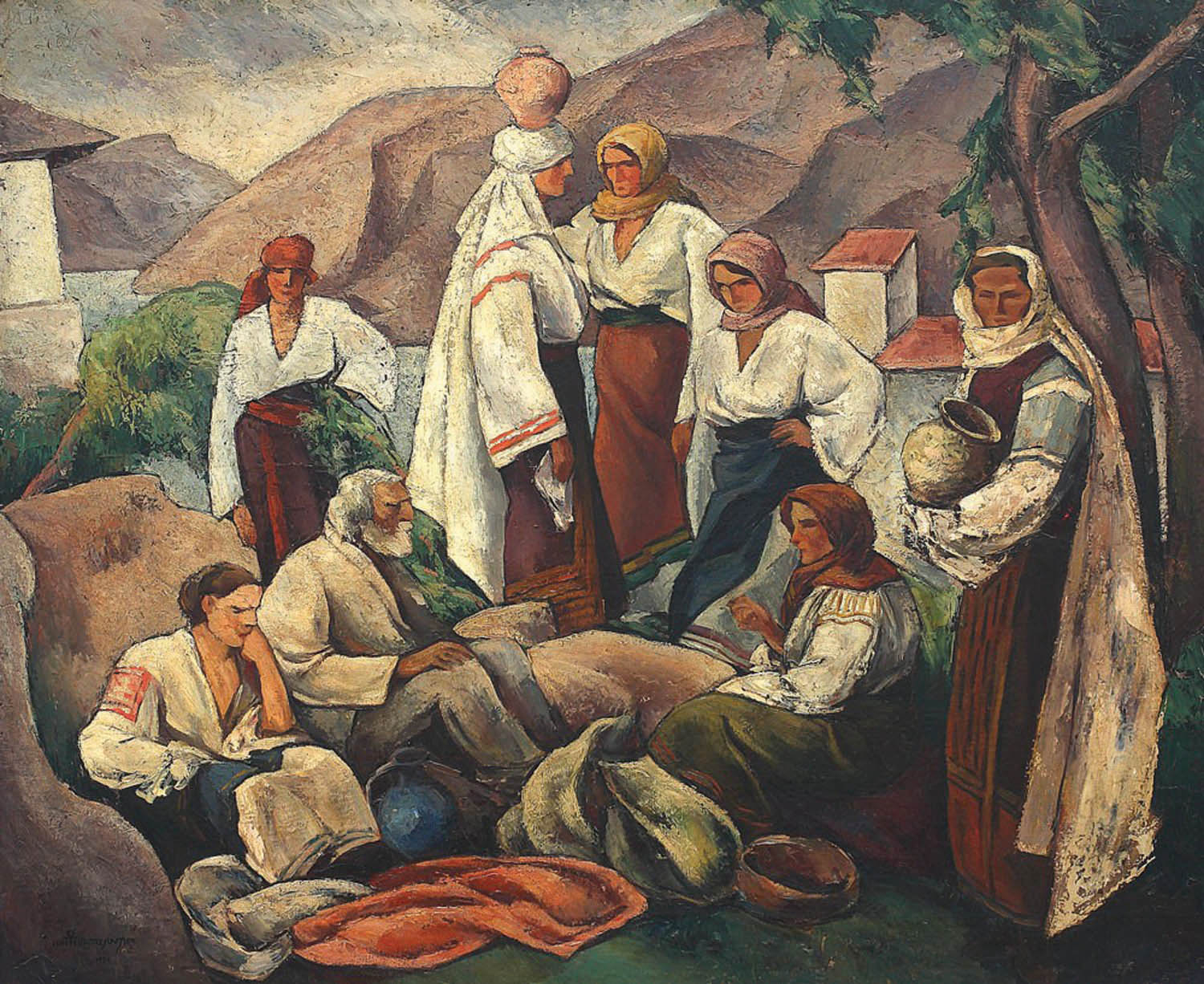
The work dated 1923 presents a composition with peasant themes, centered around a figure of a young woman dressed in Romanian traditional clothes, with a white headscarf placed on her head.
The character is captured with her gaze slightly turned to the left, suggesting a moment of introspection. Arched eyebrows, luminous eyes, and forehead partially covered by the headscarf highlight fine, expressive features.
Through these details, the artist does not only look for a realistic portrayal, but aims to capture the essence of a peasant woman, an ideal of beauty and simplicity, in which one finds dignity, inner strength, and spiritual balance.
The refinement of the chromatic palette, the harmony of the tones, and the diffused light that models the face create a subtly visual effect, but profound, turning this scene into an emblematic representation of the traditional Romanian universe, filtered through modern artistic sensitivity.
Overall, the work stands out not only for the represented model but especially for its ability to transcend the everyday frame and give the character a symbolic dimension. The young peasant woman thus becomes an archetypal figure, embodying the purity, balance, and discrete nobility of the Romanian rural world. (S.S)
For clarifications regarding the bidding procedure, hammer price costs, guarantee, payment, and collection terms for the winning lot, we recommend carefully reading/re-reading the Bidding Regulations.
For additional information regarding the lot and the auction, please contact the Art Consultants Department.
SESSION
Similar lots