The photos of the lot are informative and indicative, and cannot provide a highly detailed view of the object from all angles. We recommend a careful physical inspection of the lot before bidding.
ȘUȘARĂ, Paul, “Corneliu Baba”, Official Monitor R.A., 2013
BOTAR, Remus, “Interview with Corneliu Baba”, December 1982
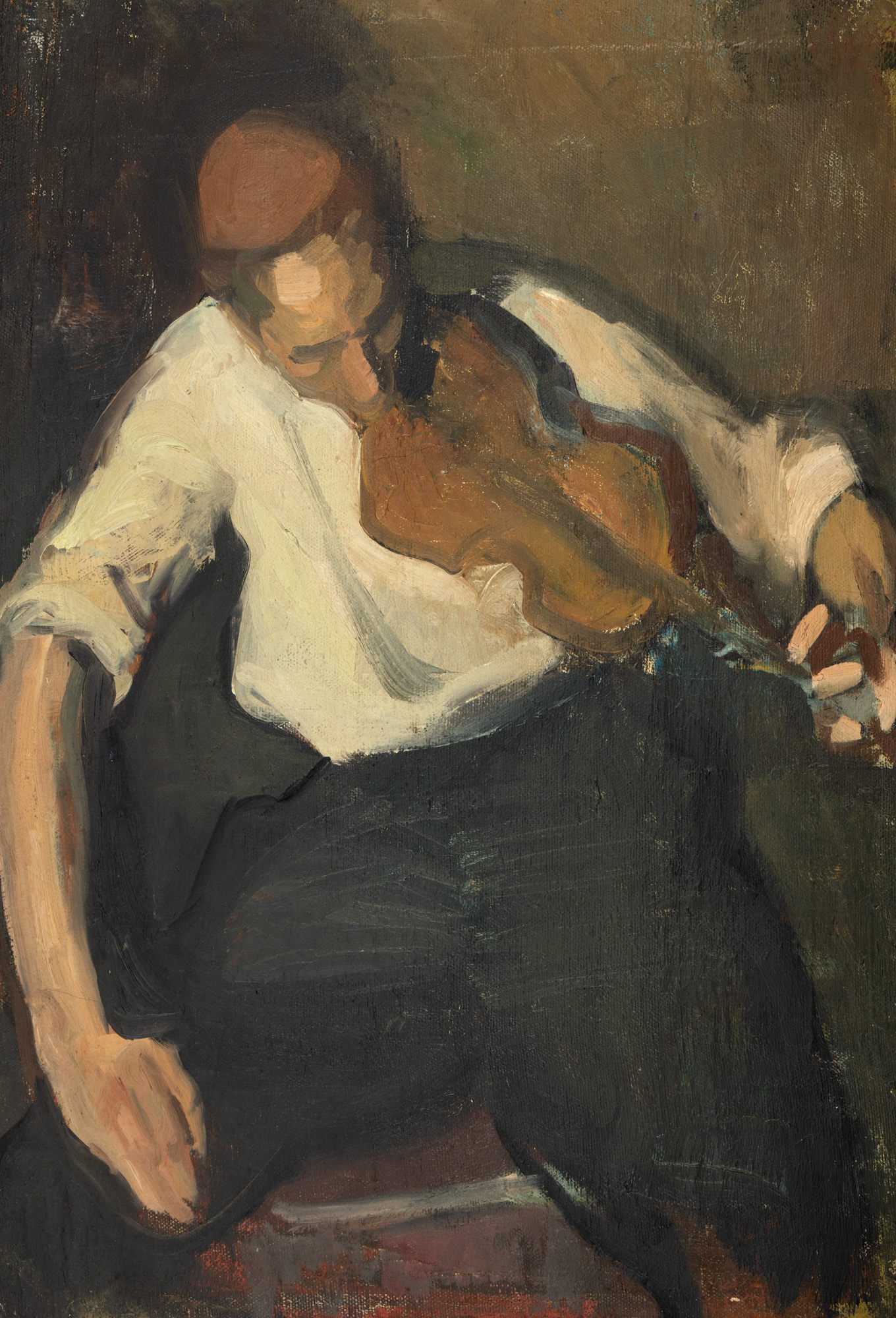
oil on canvas, 80 x 60 cm
PROVENANCE
sculptor Vladimir Sulschi's collection.
An outstanding artistic personality of the early 20th century, Corneliu Baba distinguishes himself from his contemporaries by returning to the chiaroscuro technique reminiscent of Velazquez and Manet. His robust realism is founded on an expressive drawing and a restrained and sober color palette. As the artist recalled, "I prefer to paint people. What interests me is the quality of the painting I do and the feelings I want to convey. The portrait is a summum".
A remarkable subdivision of Baba's portraiture is the portrait with a precise identity, in most cases of great cultural personalities or public figures. Among these are the portraits depicting Mihail Sadoveanu, Tudor Arghezi, George Enescu, and Maria Tănase. Far from conventional norms (socialist realism), they sought to capture the human condition, the artist masterfully handling light, colors, and shadow. Thus, Baba immortalizes the psychological portrait of the subject.
In the years of youthful solitude marked by provincial solitude and the oppressive presence of war, experiences were gathered that will build defining elements of Baba's artistic life. Impressed by Enescu's concert in Craiova, he adds to his interest in painting another great passion that will never leave him, that of music. About this event, Baba wrote: "I had not heard a professional concert at that age (...) but on a memorable evening, when my old professor gave me a ticket to a special recital that George Enescu was giving at the National Theater in the city, a miracle occurred".
His appreciation for the Romanian composer and musician materialized in a series of portraits dedicated to the artist. However, George Enescu is not the only violinist portrayed by Corneliu Baba on his canvases. The profile and kippa of the artist appearing in the work reveal the identity of the violinist and conductor Yehudi Menuhin, who also appears in some of Baba's drawings, included in the collection of the Romanian Academy's Cabinet of Prints. Born in New York, Menuhin arrives in Romania in 1927, where he begins to study violin alongside George Enescu, who would strongly influence his artistic evolution. Through his works, Baba draws a parallel between the two musicians, revealing his preference in a 1982 interview: "Yehudi Menuhin cannot be Enescu with all his genius. The student has genius, the master is unique."
Beyond their artistic value, their plastic qualities, and their ability to capture and define the inner physiognomy of the subjects, these portraits have a direct, epic value, a faithful image of an unmistakable and exemplary model. (L.M.)
For clarifications regarding the bidding procedure, hammer price costs, guarantee, payment, and collection terms for the winning lot, we recommend carefully reading/re-reading the Bidding Regulations.
For additional information regarding the lot and the auction, please contact the Art Consultants Department.
By choosing "Accept all cookies" you agree to the use of cookies to help us provide you with a better user experience and to analyse website usage. By clicking "Adjust your preferences" you can choose which cookies to allow. Only the essential cookies are necessary for the proper functioning of our website and cannot be refused
Cookie settings
Our website stores four types of cookies. At any time you can choose which cookies you accept and which you refuse. You can read more about what cookies are and what types of cookies we store in our Confidentiality Policy.
are necessary for technical reasons. Without them, this website may not function properly.
are necessary for specific functionality on the website. Without them, some features may be disabled.
allow us to analyse website use and to improve the visitor's experience.
allow us to personalise your experience and to send you relevant content and offers, on this website and other websites.