


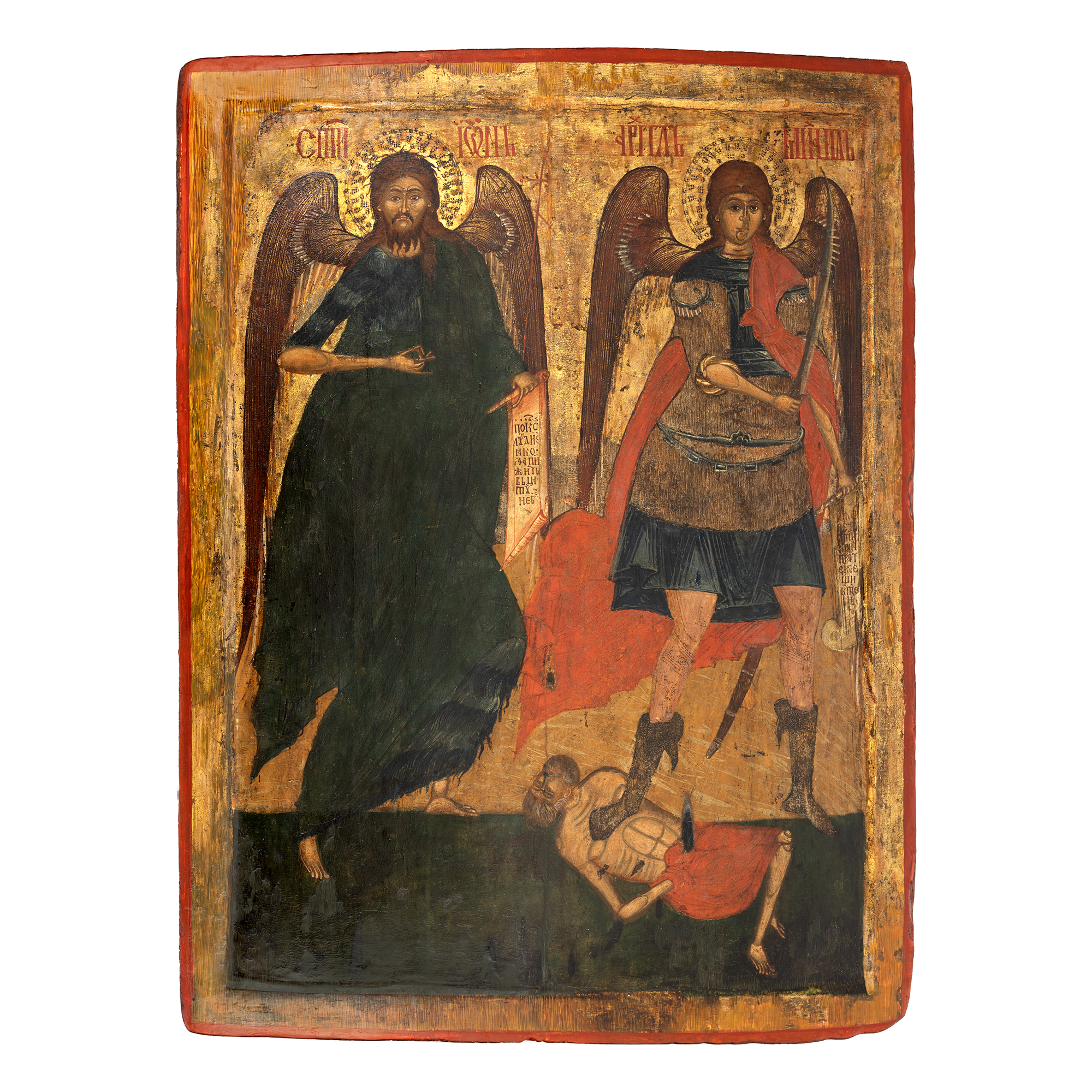
22Т. "Imperial Icon on wood, 'Saint John the Baptist - Angel of the Desert and Saint Archangel Michael - Psychopomp', attributed to Costandin the painter, Wallachia, Brâncovenesc school, Era of Constantin Brâncoveanu, last decade of the 17th century, very rare museum piece"
The photos of the lot are informative and indicative, and cannot provide a highly detailed view of the object from all angles. We recommend a careful physical inspection of the lot before bidding.
22Т. "Imperial Icon on wood, 'Saint John the Baptist - Angel of the Desert and Saint Archangel Michael - Psychopomp', attributed to Costandin the painter, Wallachia, Brâncovenesc school, Era of Constantin Brâncoveanu, last decade of the 17th century, very rare museum piece"
Starting price:
EUR 20.000
Sold
EUR 32.500
tempera and gold leaf on wood, 102 x 78 cm
Research information
Of high artistic value, the painting of the icon fits within the stylistic coordinates of the Brancovenian painting, and through its entire demeanor, which expresses wealth, splendor and opulence, it can be considered as a princely order. Constantinos, a painter of Greek origin active in Wallachia between 1658 and 1720, played a crucial role in the development of the Brâncovenian art. Brought by Şerban Voda Cantacuzino to paint The Lady's Church in Bucharest in 1683, his talent was quickly recognized, which determined Constantin Brâncoveanu to appoint him "head of painters" at Hurezi Monastery in 1692, where he created one of the most successful mural ensembles in entire Romanian medieval art. Among his most important works are the frescoes from the Royal Court Church in Târgovişte (the first monument painted by the painters of the "Hurezi School" outside the Hurezi Monastery ensemble, in 1698), Dintr-un Lemn Monastery (founded by Preda Brâncoveanu in 1635), Ostrov Hermitage in Călimănești (1701), Polovragi Monastery (1703) and the Church within the Brâncovenian ensemble of Mogoşoaia (1705). Regarding the icon painting, so far only six icons belonging to Constantinos are known, of which only one is signed, the rest being attributed to him. His distinctive style represents a synthesis between Byzantine tradition art and echoes of the Late Renaissance and Baroque. Thus, Constantinos significantly contributed to shaping the visual identity of the Brâncovenian epoch, which gives birth to the first national style. There are specialists who discuss the hypothesis that the painter Constantinos, towards the end of his career, appreciating Russian icon art, shows interest for their painting style and also creates icons close to the Russian spirit and stylistics of the period.
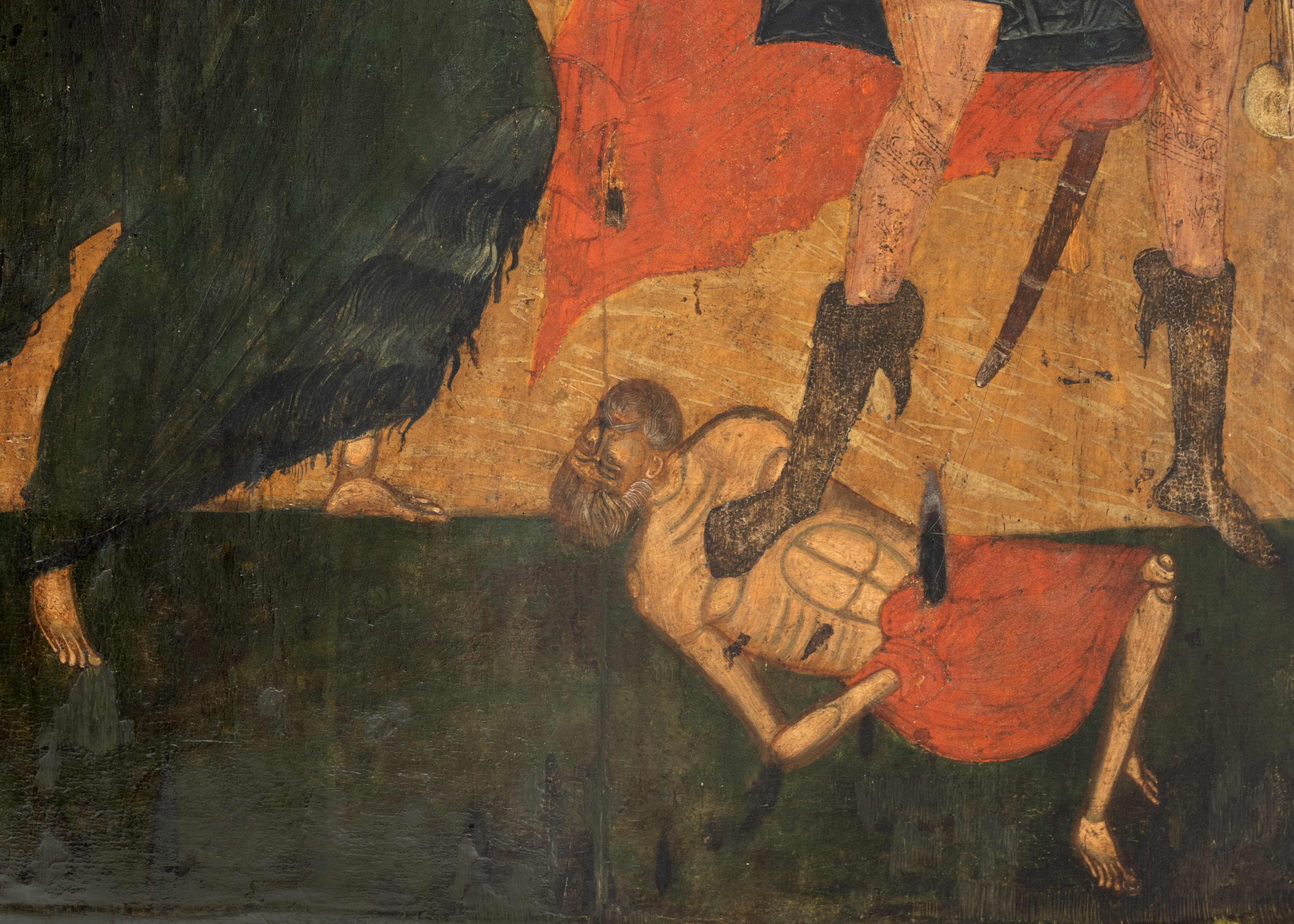
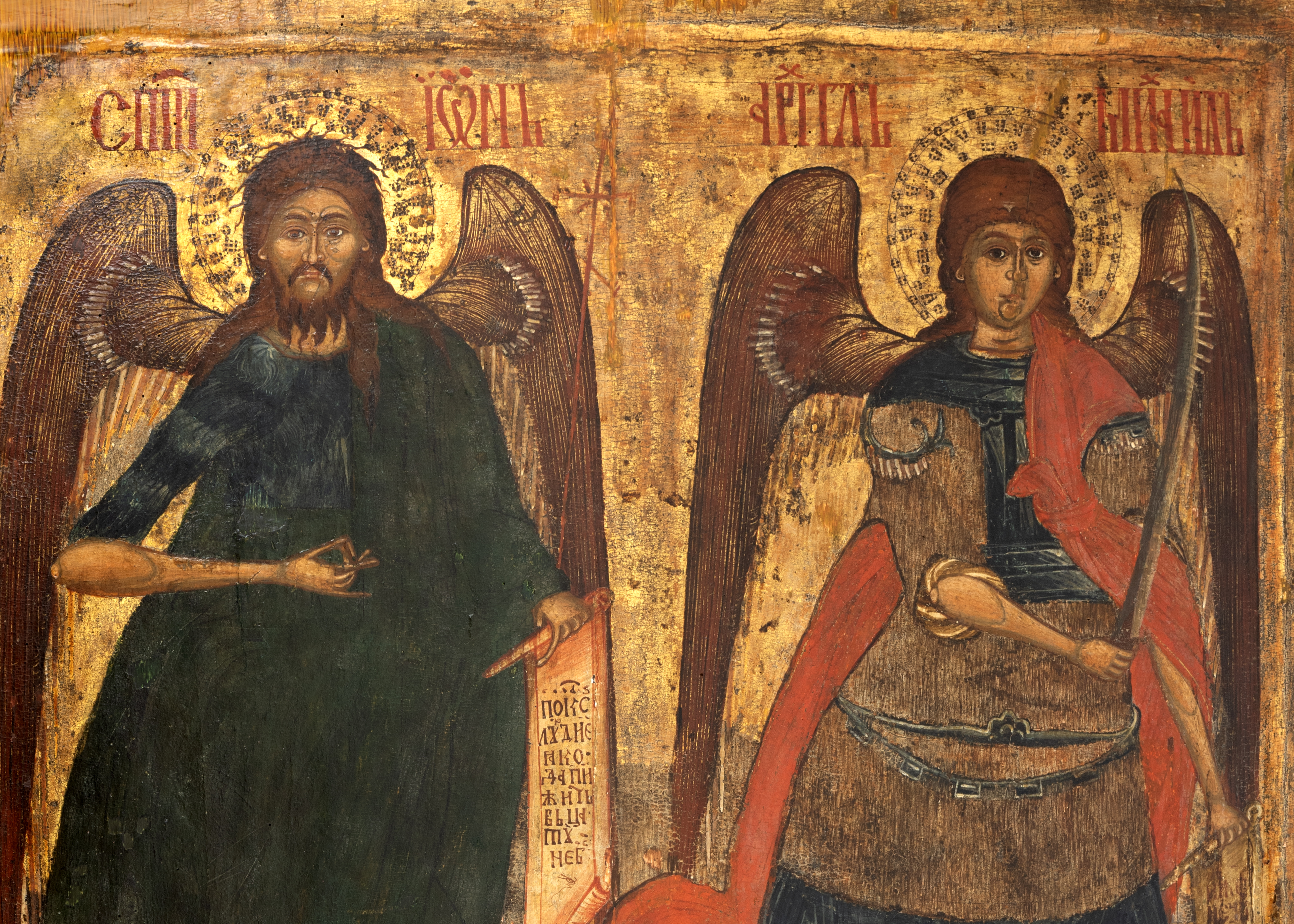
Iconographic and stylistic identification elements: On the golden background of the icon, painted at the bottom with green, a dynamic composition shows, standing on the left, Saint John the Baptist and, on the right, the Archangel Michael. Saint John the Baptist wears the traditional camel-hair dress, rendered by the painter in blue, over which he wears a green mantle. He blesses with his right hand, and in his left hand he carries a scroll with the Slavonic inscription: "Repent, brothers." He is depicted with wings, in his capacity as Angel of the desert. Around his head he carries a decorated halo with a wheel, through an incision in the ground of the icon, and he is depicted in a motion pose. Next to him, the Archangel Michael, standing, slightly twisted to the left, holds the raised sword in his right hand, and in his left hand a scroll with a difficult to read inscription while treading the chest of the "unbeliever" fallen to the ground. According to tradition, he wears a Roman soldier's costume - a short blue tunic, a golden breastplate over it, tight pants on his leg, and over his shoulders a fluttering red mantle, suggesting his movement. The typology and modeling of the faces, the way the folds of the clothes are made and the chromatics are characteristic of the Brâncovenesc style.
Technical identification elements: The icon's panel, made of linden wood, is reinforced at the back with two semi-buried crosspieces, and on the front the wood is planed. A ground covers the uniform surface of the icon, over which gold leaf was applied, then it was painted in tempera and varnished.
Conclusions: Moreover, the stylistic features and technical realization of the icon are similar to the other three imperial icons (The Mother of God with the Child, Jesus Christ, and Saint Nicholas), which allows us to frame them in the “classical” Brâncovenesc style and, according to some common particularities of the four imperial icons, to credit them to the painter Costandin (A.D.).
For clarifications regarding the bidding procedure, hammer price costs, guarantee, payment, and collection terms for the winning lot, we recommend carefully reading/re-reading the Bidding Regulations.
For additional information regarding the lot and the auction, please contact the Art Consultants Department.
SESSION
Brought to you by
Similar lots
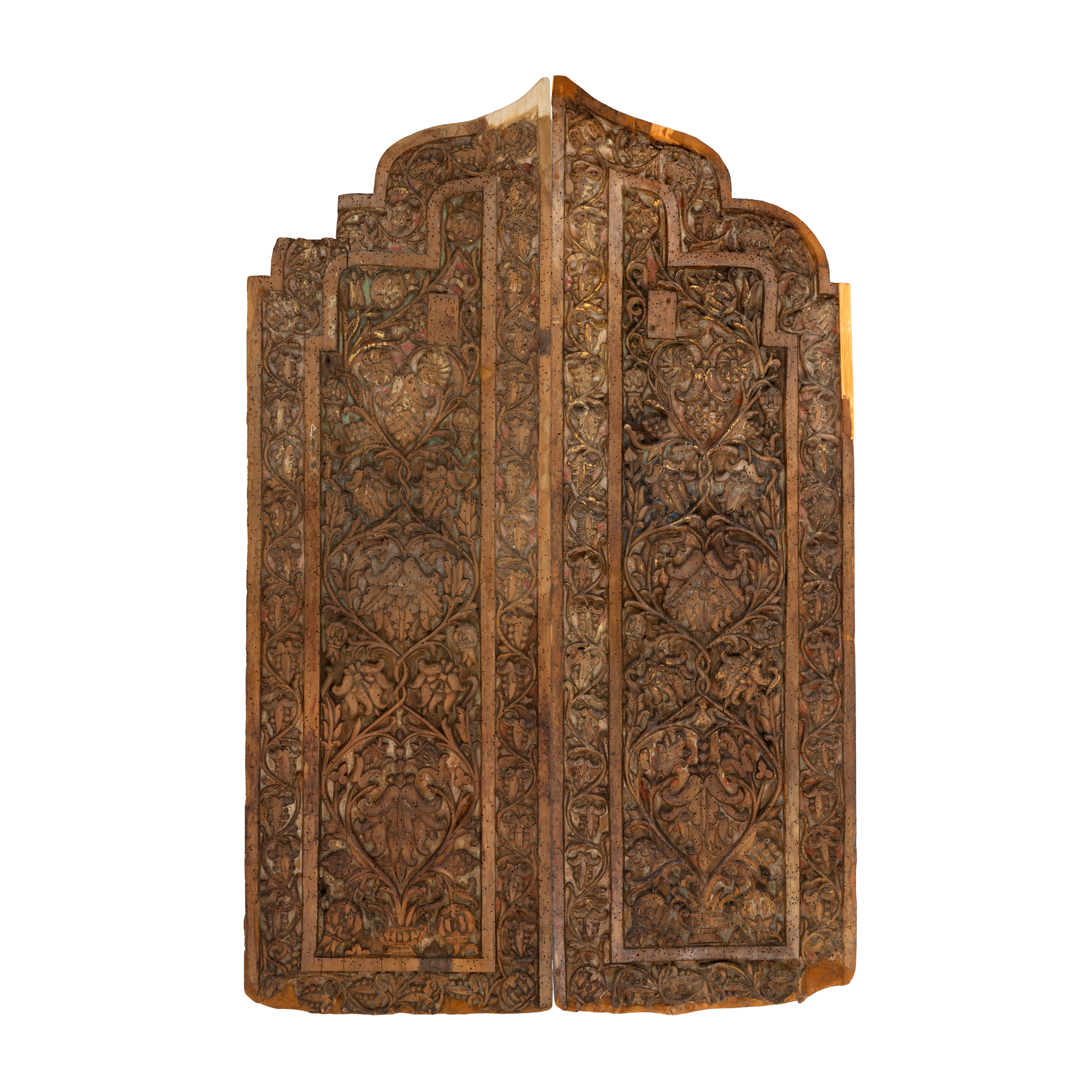
5Т. Imperial Doors, Moldovan workshop, era of Michael the Brave, towards the end of the 16th century, absolute rarity
Starting price:
EUR 20.000
Not sold
56. Icon on wood, "Meeting of the Lord", Romanian school, first half of the 19th century
Starting price:
EUR 1.000
Not sold