


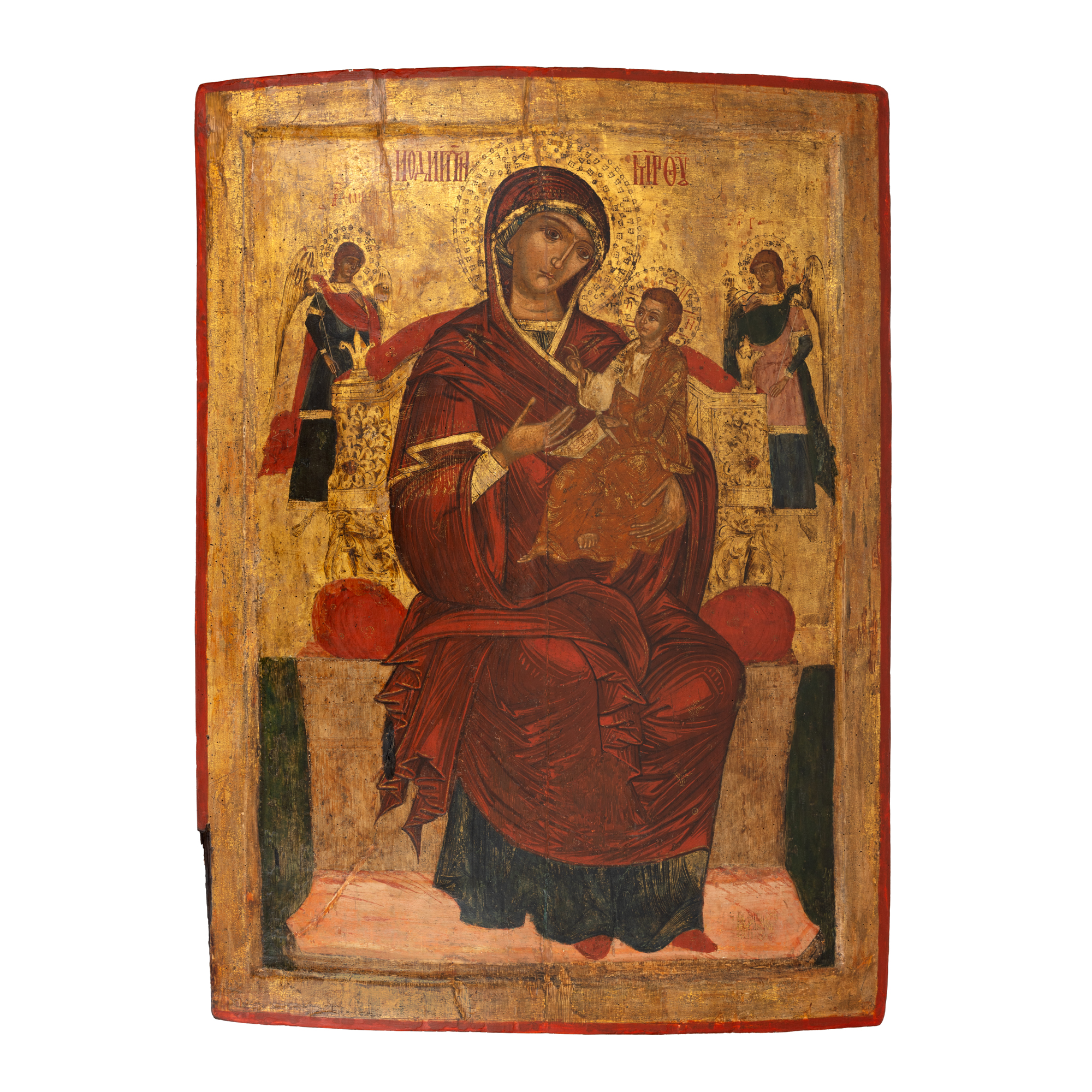
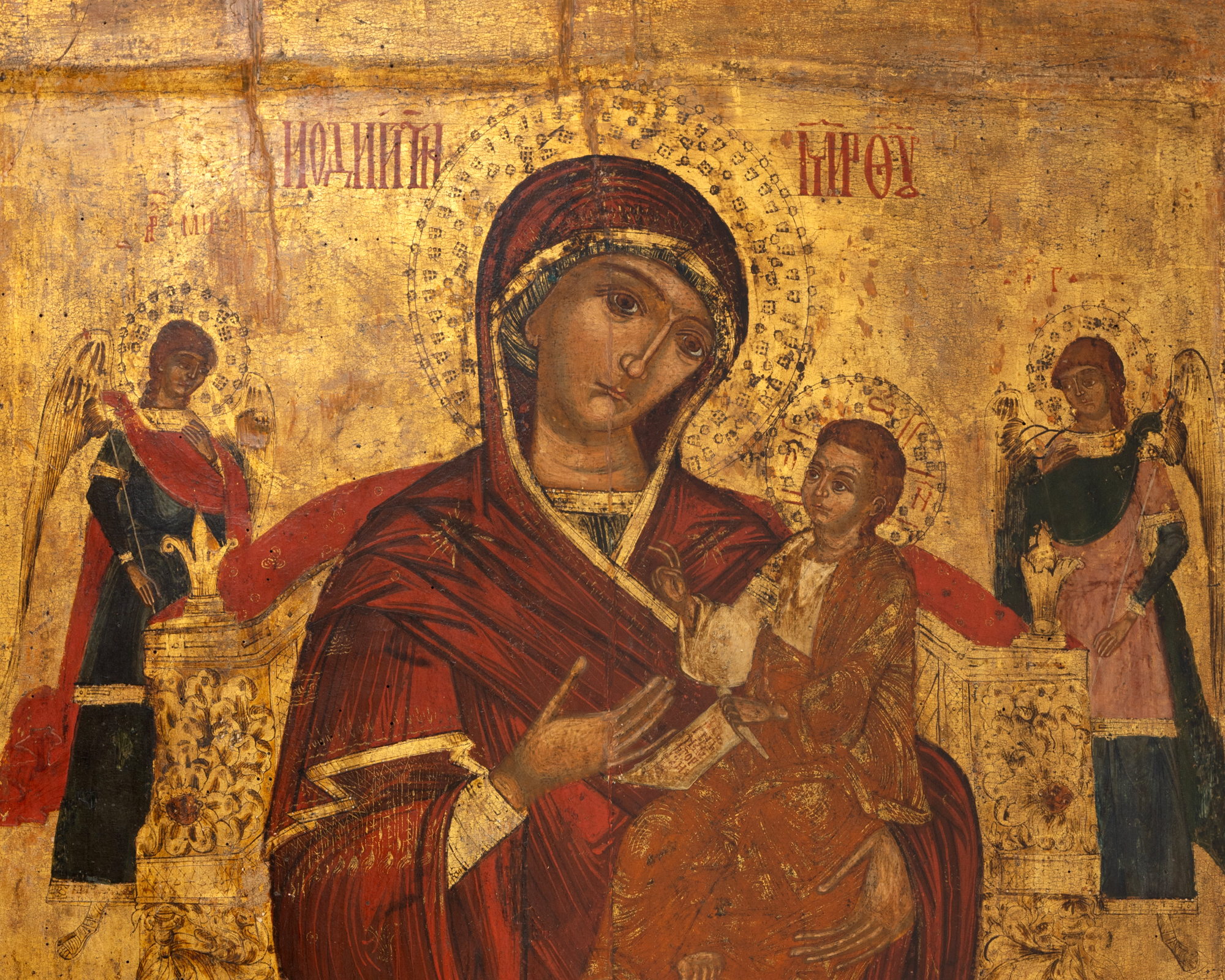
23Т. Imperial Icon on Wood, "The Mother of God with the Infant - The Lady of Angels", by Costandin Zugravul, Wallachia, Brâncovenesc school, during the era of Constantin Brâncoveanu, last decade of the 17th century, museum piece
The photos of the lot are informative and indicative, and cannot provide a highly detailed view of the object from all angles. We recommend a careful physical inspection of the lot before bidding.
23Т. Imperial Icon on Wood, "The Mother of God with the Infant - The Lady of Angels", by Costandin Zugravul, Wallachia, Brâncovenesc school, during the era of Constantin Brâncoveanu, last decade of the 17th century, museum piece
Starting price:
EUR 20.000
Sold
EUR 40.000
tempera and gold foil on wood, 102 x 74.5 cm
Research information
Of high artistic value, the icon painting fits within the stylistic coordinates of the Brâncovan painting, and through its entire demeanor, which expresses wealth, luxury, and opulence, it can be considered a princely command. Constantinos, a painter of Greek origin active in Wallachia between 1658 and 1720, played an essential role in the development of the Brâncovan art. Brought by Șerban Vodă Cantacuzino to paint the Lady's Church in Bucharest in 1683, his talent was quickly recognized, which led Constantin Brâncoveanu to appoint him "master of painters" at Hurezi Monastery in 1692, where he created one of the most accomplished pictorial ensembles in all Romanian medieval art. Among his most important works are the frescoes at the Court Church of Târgoviște (the first monument painted by the painters of the "Hurezi School" outside the Hurezi Monastery ensemble, in 1698), the Wood-in-one Monastery (founded by Preda Brâncoveanu in 1635), the Ostrov Hermitage from Călimănești (1701), Polovragi Monastery (1703) and the Church within the Brâncovan ensemble of Mogoșoaia (1705). Regarding icon painting, so far only six icons belonging to Constantinos are known, of which only one is signed, the rest being attributed to him. His distinctive style represents a synthesis between Byzantine tradition art and late Renaissance and Baroque echoes. Thus, Constantinos significantly contributed to shaping the visual identity of the Brâncovan period, which gave birth to the first national style. There are specialists who discuss the hypothesis that the painter Constantinos, towards the end of his career, appreciating the art of Russian iconographers, shows interest in their painting style and also creates icons close to the Russian spirit and stylistics of the period.
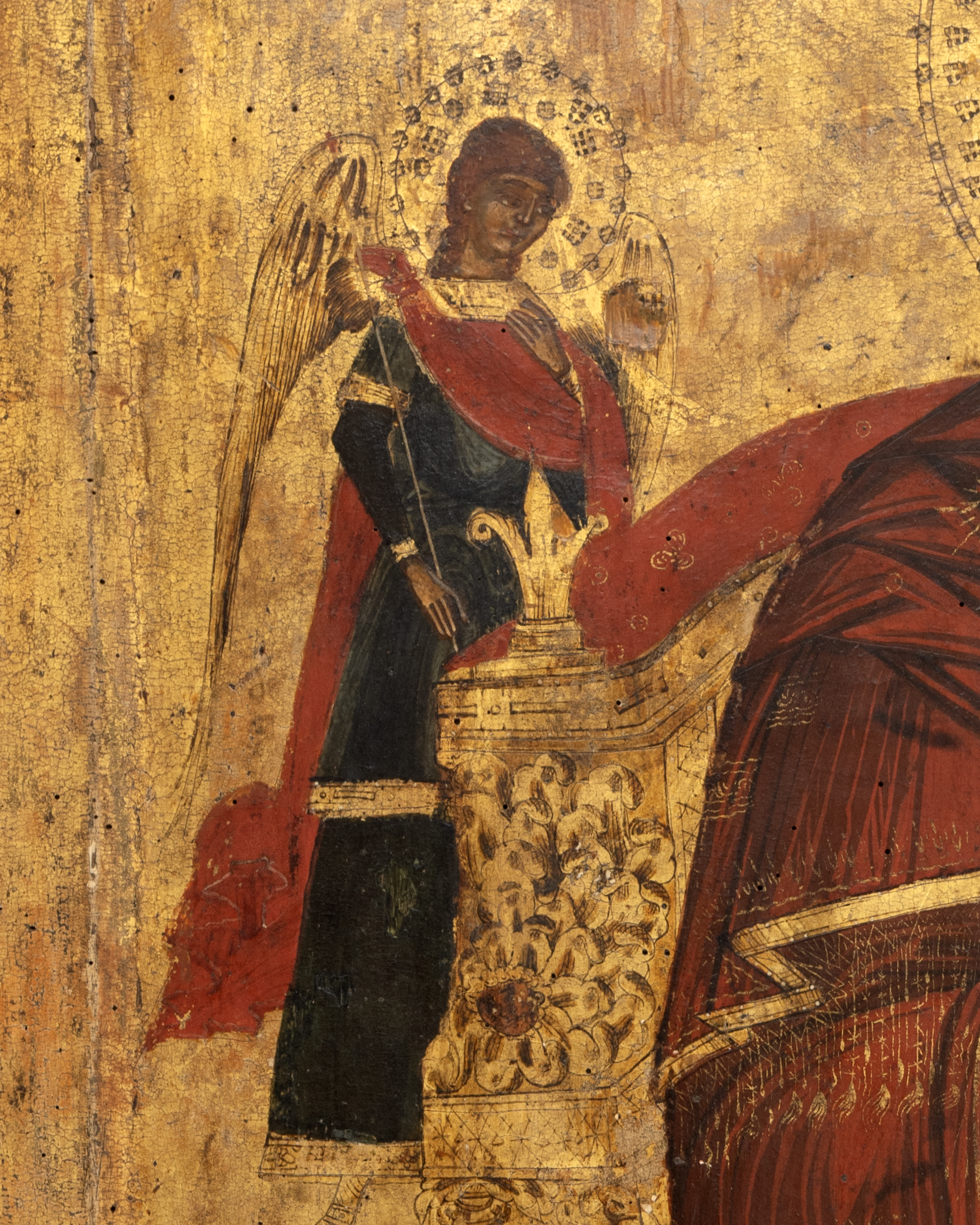
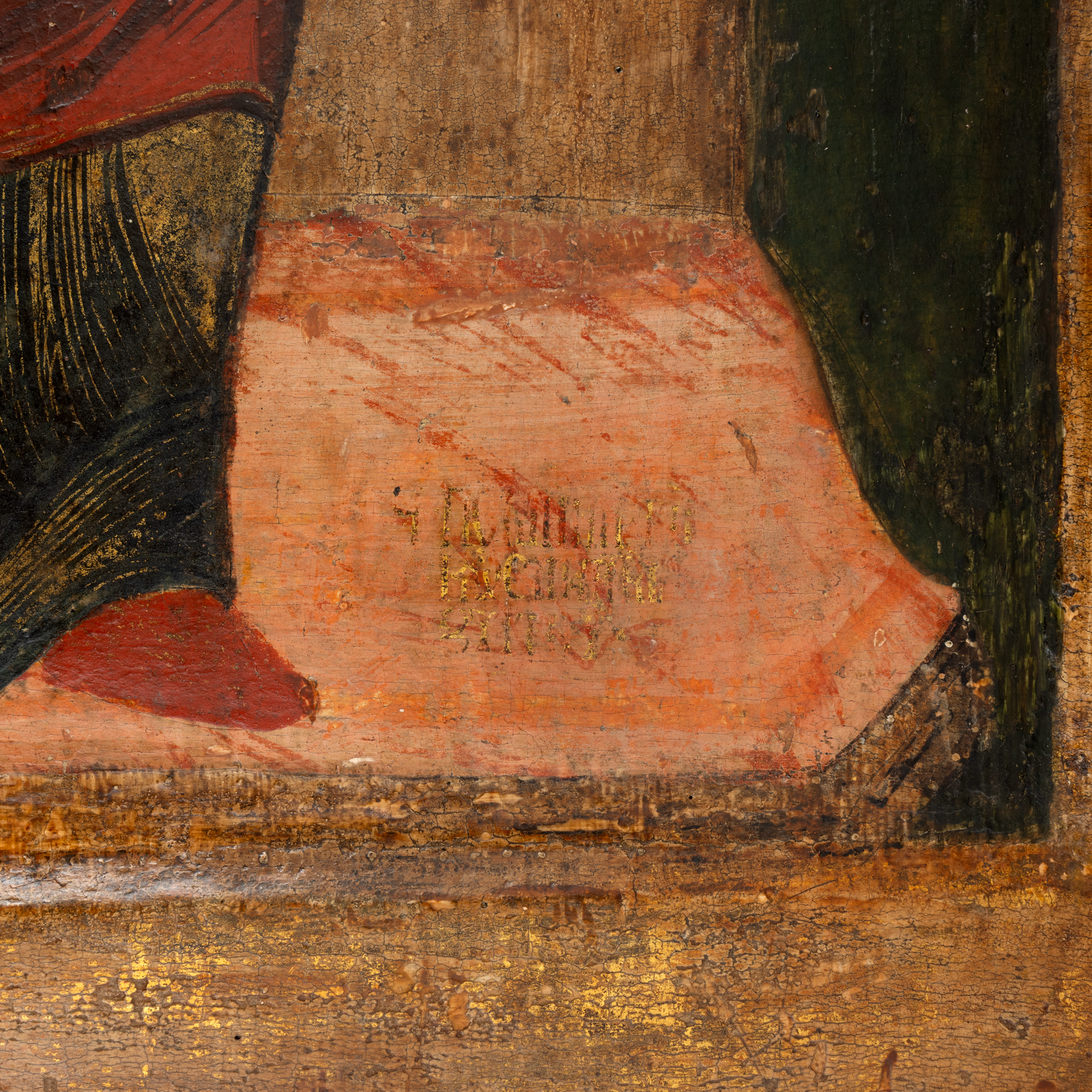
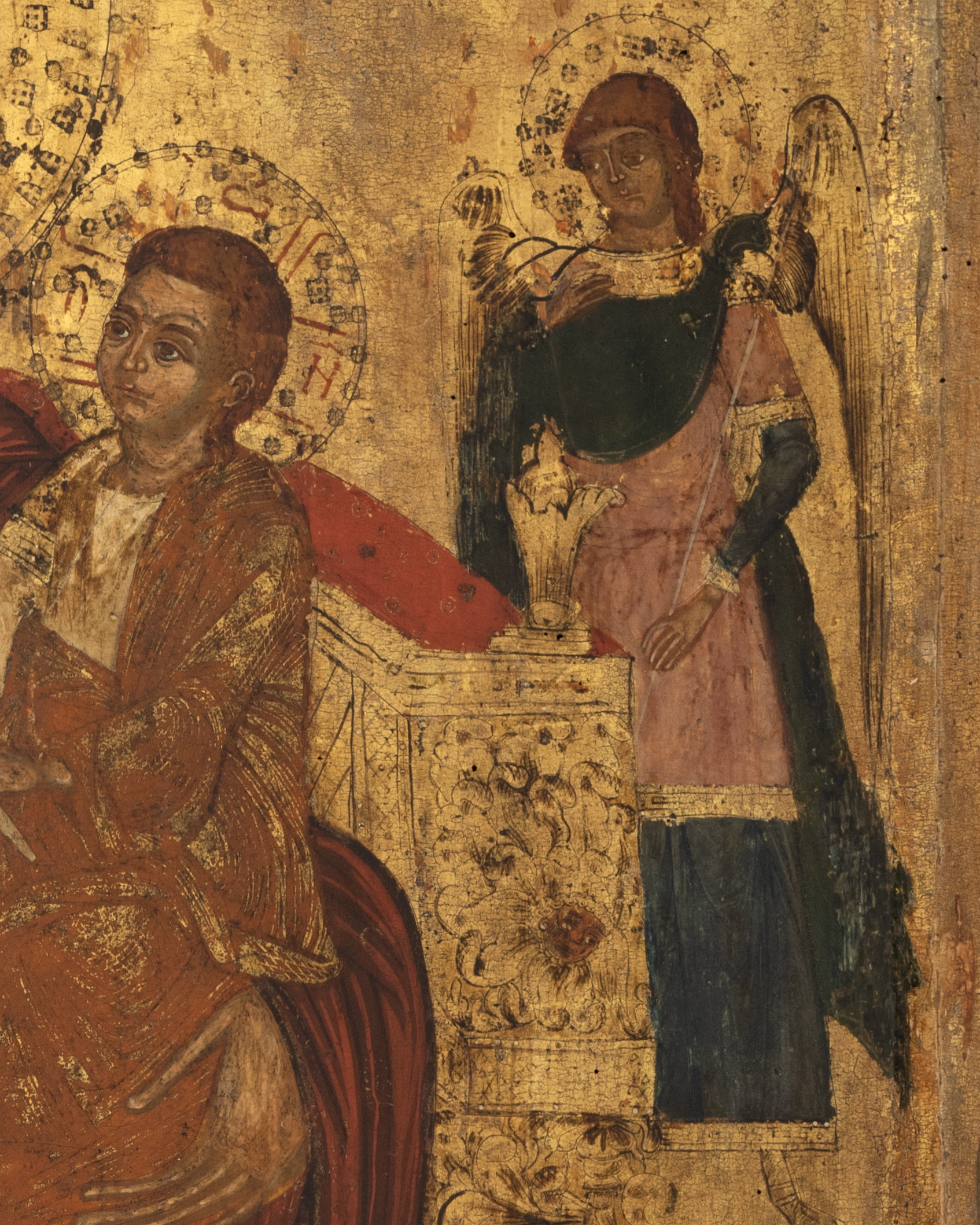
Identifying elements of an iconographic and stylistic order: The Icon of the Mother of God with the Child, of the Hodegetria type, is a series with the icons of Saint Nicholas, Saint John the Baptist and the Archangel Michael, being part of the imperial icons of an iconostasis. The painting of the icon is executed in Brâncovenesc style, a style established in the last decade of the 17th century in Wallachia. In the deep nave of the icon, on the golden background, the Mother of God is seated on a golden throne with a curved backrest, decorated on the side with golden Brâncovenesc motifs. The Virgin Mary holds the Child on her left arm and points to him with her right hand, according to the Hodegetria type. The baby Jesus holds a rotulus with his left hand, and with his right hand he blesses. The Archangels Michael and Gabriel, present behind the throne, refer to the type "Lady of the Angels". The Mother of God is dressed in the traditional red maphorion, over the blue palla (dress). Jesus wears a white chiton and a brick-colored himation chrysographed. All characters wear halos around their heads decorated by incision with a wheel. Their faces are inscribed in the specific typology of Brâncovenesc painting, the modeling being executed by successive overlays of ochre shades, and the shadows are rendered with green-brown and red. On the right side, at the bottom, there is a remaining fragment of an inscription in golden Cyrillic letters, in transliteration "Pomeni Gospodi Costandini Zugraf"?, possibly the name of the icon's painter. The dominant chromatics of gold, red, ochre and blue, through splendor and riches, the icon fits into the "classical" period of the Brâncovenesc style.
Technical order identification items: Shaped wooden panel, buried crossbeams, uniform primer on the entire surface, gold leaf, wheel decoration, tempera on wood, varnish.
Conclusions: The large-sized icon was certainly a princely order for an important foundation. It stands out for its artistic qualities and for the aspect of splendor and wealth that it exudes, specific to the Brâncovenesc style (A.D.).
For clarifications regarding the bidding procedure, hammer price costs, guarantee, payment, and collection terms for the winning lot, we recommend carefully reading/re-reading the Bidding Regulations.
For additional information regarding the lot and the auction, please contact the Art Consultants Department.
SESSION
Brought to you by
Similar lots
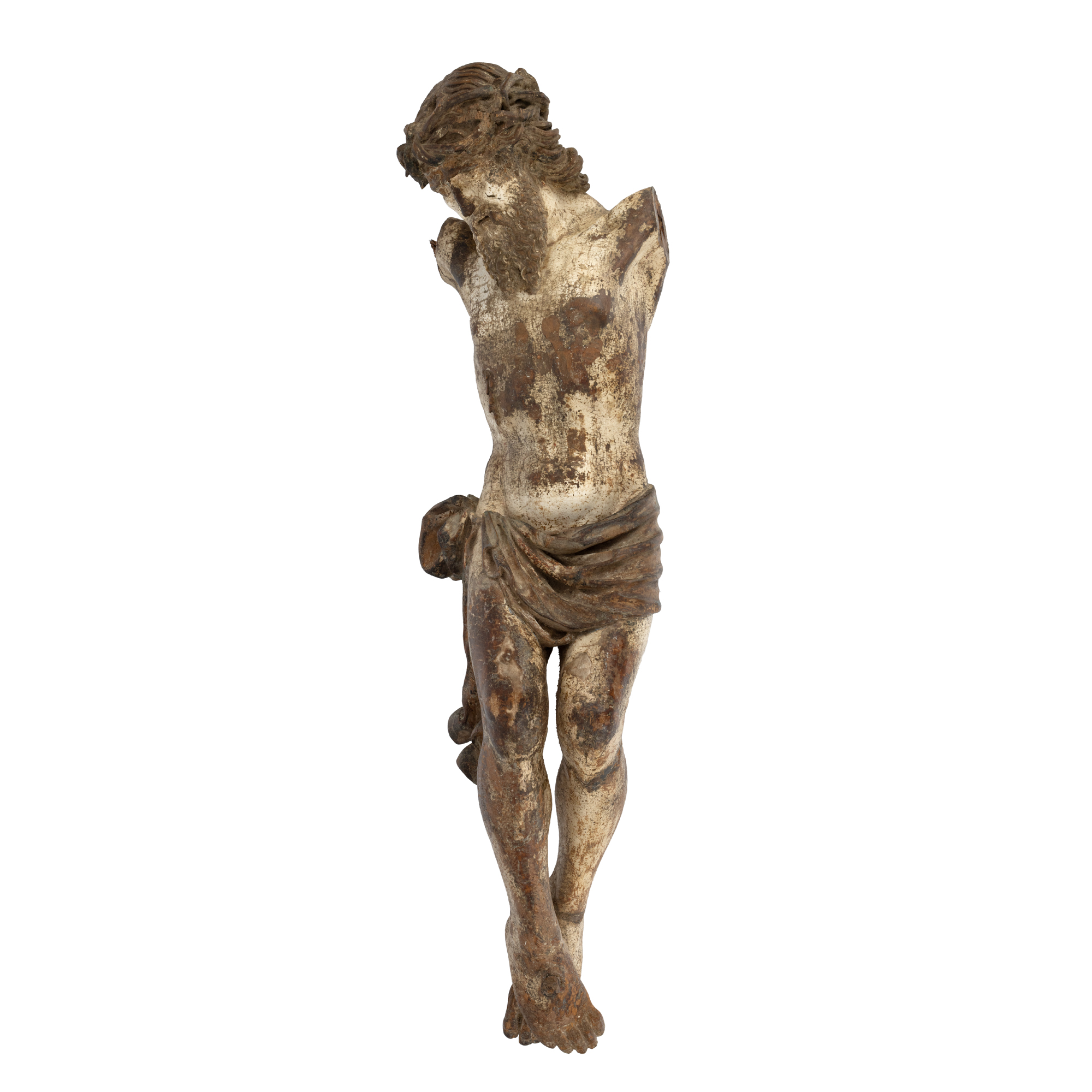
60. Wooden statuette, "Corpus Christi", Transylvanian school, first half of the 16th century, very rare collection piece
Starting price:
EUR 1.000
Sold
EUR 1.600
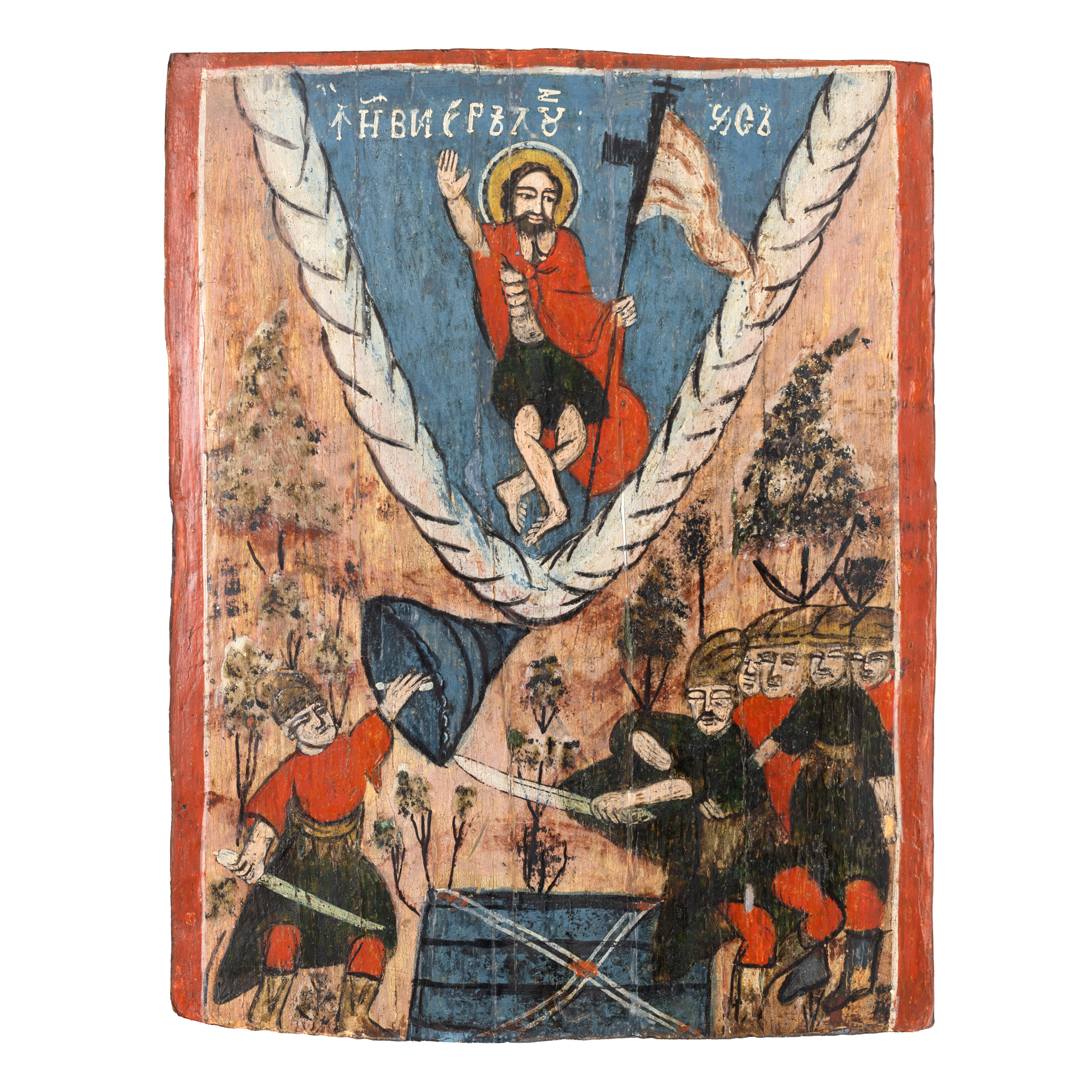
50. Icon on wood, "Resurrection of the Lord", Romanian school, first half of the 19th century
Starting price:
EUR 1.000
Not sold