The photos of the lot are informative and indicative, and cannot provide a highly detailed view of the object from all angles. We recommend a careful physical inspection of the lot before bidding.
''Nicolae Tonitza'', exhibition catalog, text by Georgeta Peleanu, Bucharest, 1964
BABA, Corneliu, ''Tonitza'', Ed. Meridiane, Bucharest, 1965
BREZIANU, Barbu,"Nicolae Tonitza", Ed. Arta Grafică, Bucharest, 1967
BREZIANU, Barbu, "Nicoale Tonitza", Ed. Meridiane, Bucharest, 1986
CIUCĂ, Valentin, "Following Nicolae Tonitza", Ed. Sport-Turism, Bucharest, 1984
COMARNESCU, Petru,"N.N.Tonitza", Ed. Tineretului, Bucharest, 1962
ŞORBAN, Raul, ''Tonitza'', Ed. Meridiane, Bucharest, 1973
ŞORBAN, Raul, ''Nicolae Tonitza'', Ed. Meridiane, Bucharest, 1965
ZAMBACCIAN, Krikor, ''N. Tonitza'', State Ed. for Literature and Art, without location, without year.
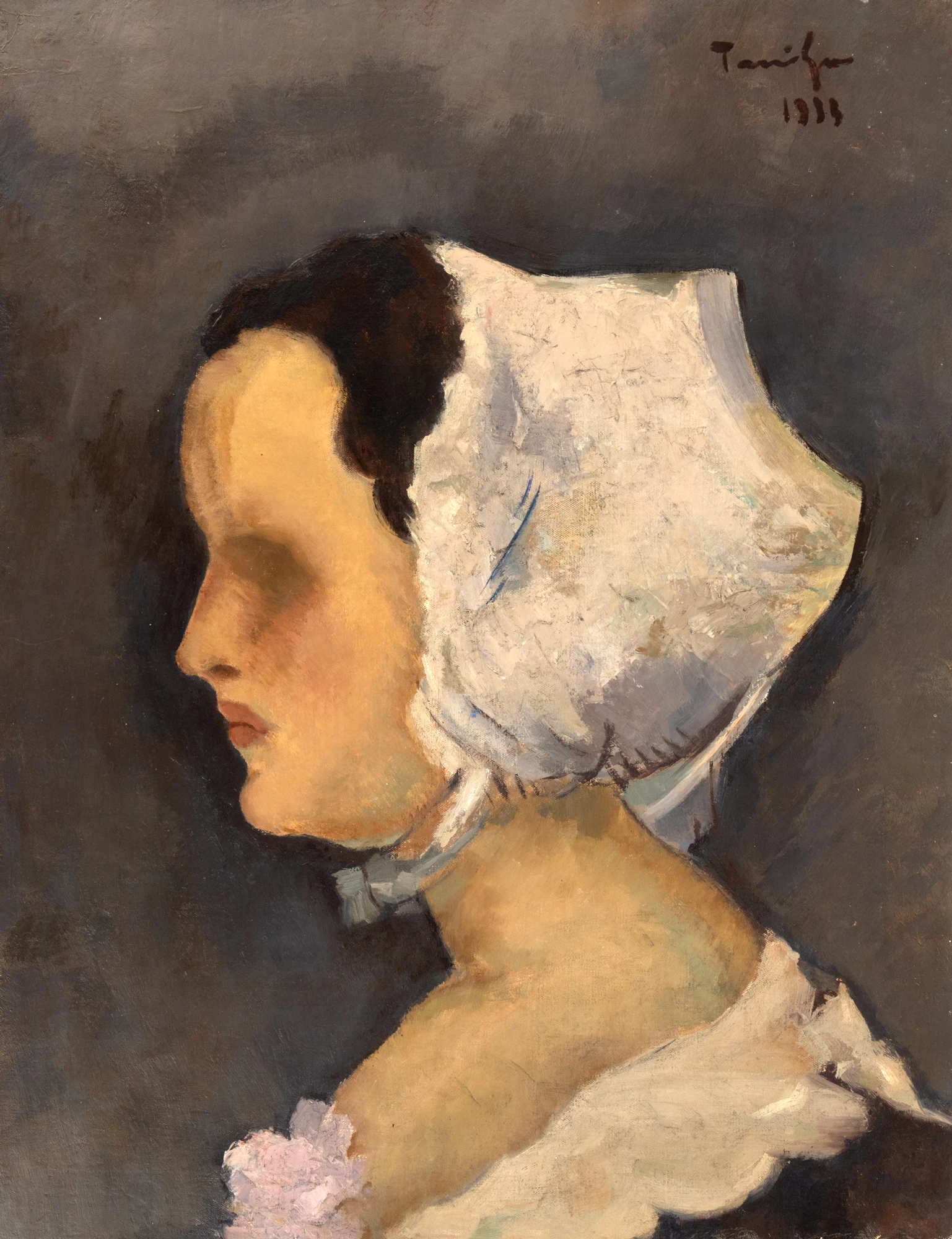
oil on canvas, 50.5 x 40 cm, signed and dated top right, in brown, "Tonitza, 1933"
Research information
A version of the work participated in the sixth exhibition of the Group of Four, March 5 - 31, 1933, Dalles Foundation Halls, Bucharest and is mentioned in the exhibition catalog at cat. 144, under the title "Woman's Head".
A version of the work participated in the "Nicolae N. Tonitza" painting and graphic art exhibition, R.S.R. Art Museum, June-July 1979.
A version of the work participated in the exhibition "Tonitza and the genius of childhood", Art Safari, Bucharest, 2019 and is reproduced in the exhibition catalog on page 191.
The portrait, practiced since his time at the School of Fine Arts in Iasi, represented perhaps one of the most applauded pictorial categories that Tonitza ventured into (especially due to child faces – “children's painter”). Documentary resources provide a relative image of the works from the end of the first decade of the 20th century, up to the period after the discovery of Balchik, towards the end of his life. Some portraits of the elderly made in Munich, during the Bavarian period - and probably the oldest portrait known to us today, the portrait of his master's mother, the Baroness von Habermann - are certain dates of a clear trend towards a scrutinizing investigation of human nature, from the beginning of his career. For an individual like Nicolae Tonitza, the emergence of such a pictorial genre is clearly regulated by psychological aspirations nurtured in the soul of a true life researcher, especially as we know today that he did not make a “career” out of selling portraits. Very few are the works that had a clear direction, such as a commission or a gift to close ones. Here we identify an almost unique series made during the same period as the current oil – 1933-1935 – years from which works such as “Portretul d-soarei Trembiski”, “Portretul lui A. Lehrmann” or the portraits of Paul Gotcu’s spouses – collector and doctor of the royal court – presented to the public at the “Șirato-Tonitza” exhibition in 1935. Very likely the work from the auction, was in position 144 in the catalogue of the Grupului celor Patru exhibition in 1933, under the modest title of “Cap de femee - studiu”, “Bretonă ”. It was an extremely crucial year in the artist's career, being practically a moment of unshackling, after a relatively unprosperous period of his career. The years spent in Constanta, where he eventually failed to finish the painting of St. George's cathedral, one of the reasons the Group did not exhibit between 1931 and 1932, were rewarded by both the exhibition of the Grupului celor Patru (March 1933), and by the “discovery” of Balchik, which would materialize over the summer months of the same year. In the exhibition, he displayed an impressive number of works, around 70, oils, tempera, watercolors and drawings that offered the public and art critics an eclectic, yet valuable palette. “The corner of the exhibition dressed in Tonitza's paintings, makes in the Dalles hall a fragment of a museum. This admirable painter of Moldovan sensitivity – as he’s the most representative painter of Moldova – has delimited his plastic research field in a constant concern for full light, which brought him straight and fully prepared towards the painted white. From here, Tonitza links all the finer and more refined made in Romanian art, going beyond a racial boundary and placing himself at a level only reached by Ștefan Luchian”. This is how the chronicler of the important literary and artistic criticism magazine “Gândirea” saw Nicolae Tonitza. In the eyes of the same Victor Ion Popa, dramatist and significant representative of the “gândirism”, “the exhibitor at work Mar has today reached the intersection with the Luchian palette. But if Luchian means the highest point reached in art – or more exactly, in the Romanian palette – Tonitza has overtaken him in the development of whites, tailoring from the beginning a special disregard, a special stamp, which clearly testifies the lack of influence and shows through the similarities reached, only the inner commandment that would be called the plastic expression of the Romanian soul”. (“Plastic Chronicle”, Gândirea, no.4, April 1933, p. 157-159) “Bretonă” gives us precisely the occasion to understand what the chronicler expressed, especially with regard to the prevalence and quality of the whites used by the painter. In a composition like this, where the surface is exclusively coordinated by a single motif – the portrait – Tonitza uses the typical ascetic palette, the colors being few in number but strongly nuanced. The use of the palette knife, especially in the molding of the prop (the cap) is connected precisely to the need to reach the texture that white can capitalize on. Among the nude studies and winter landscapes that abounded in the 1933 exhibition, our painting easily stands alone, marking an important evolutionary threshold in terms of the portrait. Not only the picturesque texture that the theme offers us is decisive– the head of the model being covered with a hat typical of the Breton-Flemish area - but also the pictorial manner, coordinated by the plastic homogeneity between the brushwork and the saturation of tones. Tonitza chooses the profile here, but loses nothing from that expression of the eyes, managing to charge the portrait with depth in the expressionist nuances characteristic of the works from the 1925-1935 period. In addition, by fixing this slightly decorative background of the secondary plan, Tonitza manages to “throw“ in the foreground the face, this work being defined by this portraiture cut-out, modeled also with the help of a certain materiality of the paste. Between the paleness of the ochres used for flesh color and the monochrome background - but nuanced in shades – the feminine profile “floats” in this small composition that enriches the portraitistic work of the most reputed modernist of the genre.
For clarifications regarding the bidding procedure, hammer price costs, guarantee, payment, and collection terms for the winning lot, we recommend carefully reading/re-reading the Bidding Regulations.
For additional information regarding the lot and the auction, please contact the Art Consultants Department.
By choosing "Accept all cookies" you agree to the use of cookies to help us provide you with a better user experience and to analyse website usage. By clicking "Adjust your preferences" you can choose which cookies to allow. Only the essential cookies are necessary for the proper functioning of our website and cannot be refused
Cookie settings
Our website stores four types of cookies. At any time you can choose which cookies you accept and which you refuse. You can read more about what cookies are and what types of cookies we store in our Confidentiality Policy.
are necessary for technical reasons. Without them, this website may not function properly.
are necessary for specific functionality on the website. Without them, some features may be disabled.
allow us to analyse website use and to improve the visitor's experience.
allow us to personalise your experience and to send you relevant content and offers, on this website and other websites.