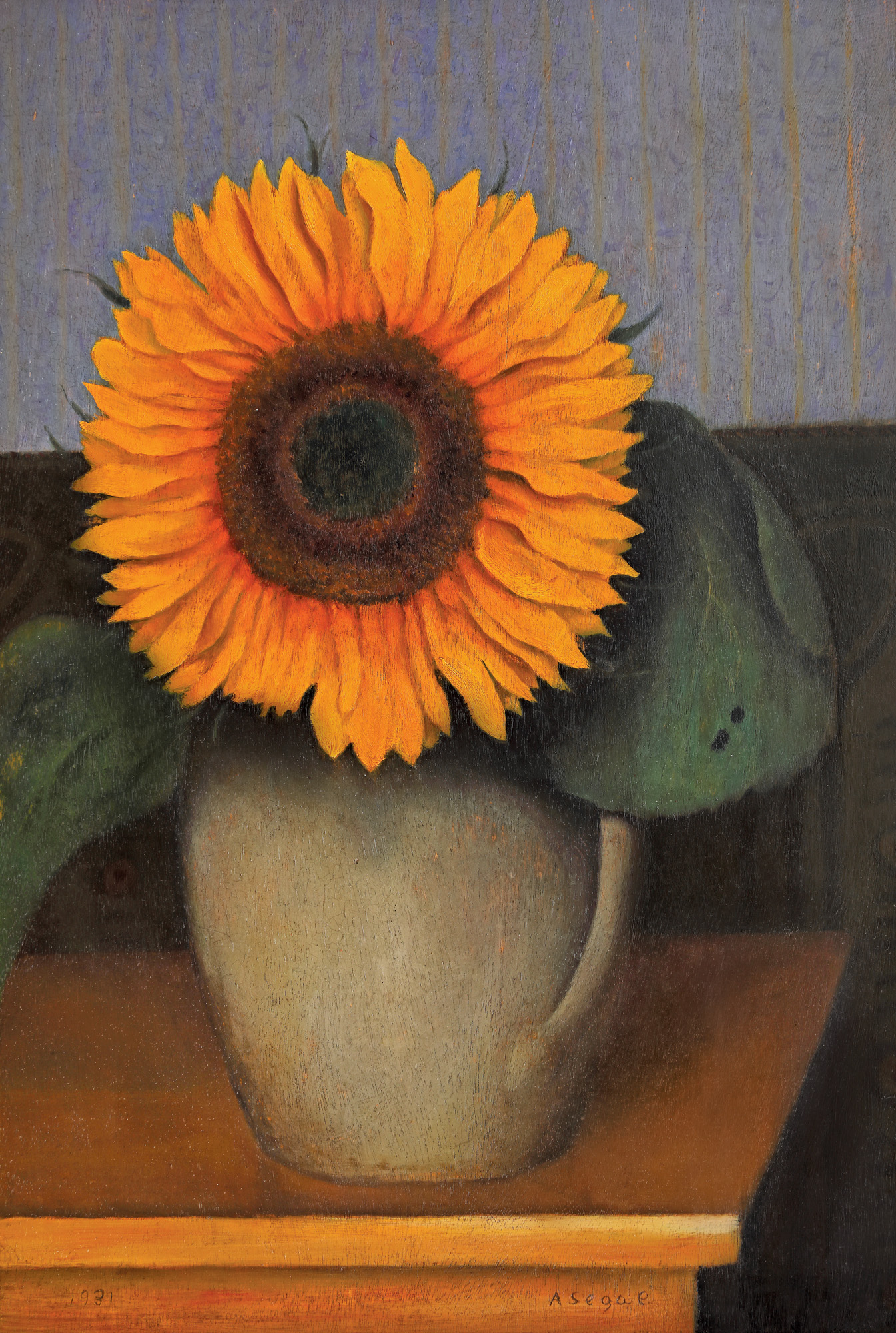

59. Sunflower [1931]

1875, Iaşi - 1944, Londra

Estimate

EUR 3.000 - 5.000

Sold

EUR 13.000

Session

Thu, 19 October 2023 19:00

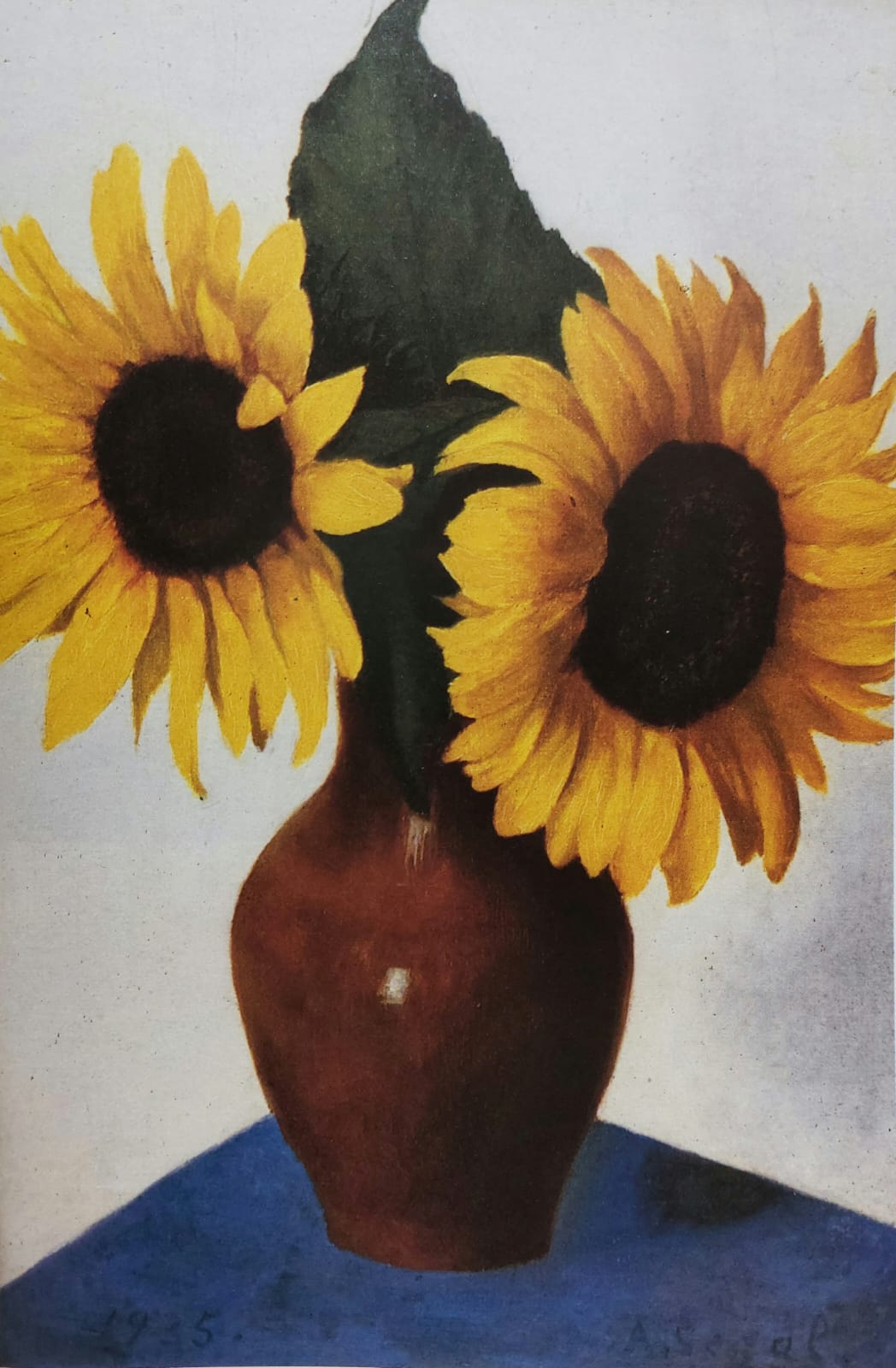
Arthur Segal is rather an adept of modern movements, of international repute; thus, his image oftentimes fails, in the collective memory, to be associated with our vernacular. After a brief journey through the art education institutes in Munich, Paris, or Italy, Segal’s creation was also subject to style changes, visibly influenced by the spaces and trends encountered by the artist in his travels. We thus see visible leaps from Impressionism and Neo-Impressionism to Expressionism and Dadaism and, in the end, the artist came to define his own, modern style. After completing his studies, he went to Berlin, where he contributed to the establishment of the Neue Secession group. In 1914 he went to Zürich, the avant-garde nucleus of the time, and he met artists Jawlensky and Arp, with whom he created under the auspices of the Dadaist movement, and exhibited within the Voltaire Cabaret. In 1920 he returned to Berlin, where he opened a personal exhibition and joined the management board of the Novembergruppe movement, with which he exhibited until 1932. He lived in Mallorca, in Spain, for a while; however, in 1936, he settled in London, where he remained until his death. The first period of his creation was under the influence of Segantini, Van Gogh, or Matisse (until 1916). His move to Ascona, in Switzerland, brought with it a discovery of the Expressionist manner, which led the artist to the desire to conceive art based on harmony and balance. In 1923, Segal learned about the colour theory proposed by Goethe, and he returned to some of his works created in his Neo-Impressionist period, before 1916. In Romania, Arthur Segal is perceived as the parent of the Israeli avant-garde scene. Through his religious affiliation, he took part in an exhibition dedicated to "The Jewish Artists of Our Times", together with Marc Chagall, Erlich, Kisling, Lipschitz, or Modigliani. And, as a representative of abstract art, he displayed along with artists such as Braque, Kandisnky, Klee, Mondrian, or Picasso, at Mannheim. he tackled most genres and subjects which we find in the works of the great artists, so it is no wonder that he successively stopped, at various moments of his journey, on a theme that had become a leitmotif in his creation: the sunflower. A symbol of optimism and wellbeing, the plant was not chosen accidentally; instead, it can be seen as a symbol of resistance, an answer to an alternative to the anxiety-laden time which the artist of Jewish origin experienced in the interwar period, as well as at the start of the Second World War. Having had an ambiguous genesis in Segal’s work, but with resounding insertions (1931 - the year of this work, 1935, or 1940), the sunflower, a symbol of long and abundant life, became a subject favoured by the artist. (D.C.)

References

The catalogue of the exhibition "Arthur Segal. 1875-1944. A Selection of Paintings", April 2-14, 1973, The Alpine Club, London.

Dimensions

width 40 cm, height 59.5 cm, custom 59,5 × 40 cm

Description

oil on plywood, signed bottom right, with pencil, "A Segal", dated bottom left, with pencil "1931"

Research information

The work probably participated in the exhibition hosted by Verein d. Künstlerinnen, Berlin, 1933. The work probably participated in the exhibition hosted by Jüdische Kunst, London, 1934. The work participated in the exhibition hosted by Cooling Galleries, London, 1947, under cat. 8. The work participated in the "Arthus Segal. 1875-1944. A Selection of Paintings" Exhibition, 2 - 14 April 1973, The Alpine Club, London, and it was reproduced in the exhibition catalogue under cat. 23. The work was reproduced in the monography "Arthur Segal 1875-1944", Aragon Publishing House, 1988, on page 354.

Dating

1931

PROVENANCE

Barry Mason collection.

ADDITIONAL INFORMATION

For clarifications regarding the bidding procedure, hammer price costs, guarantee, payment, and collection terms for the winning lot, we recommend carefully reading/re-reading the Bidding Regulations.

For additional information regarding the lot and the auction, please contact the Art Consultants Department.
Similar lots

Jug with Roses

31. Jug with Roses [1972]

Rudolf Schweitzer-Cumpăna

    Estimate EUR 1.000 - 1.800
    Sold EUR 1.600
Tinker Woman with Pipe

14. Tinker Woman with Pipe [cca. 1915]

Octav Băncilă

    Estimate EUR 3.500 - 5.500
    Sold EUR 4.250
Waves at Constanța

48. Waves at Constanța

Marius Bunescu

    Estimate EUR 3.000 - 5.000
    Sold EUR 5.000