
The photos of the lot are informative and indicative, and cannot provide a highly detailed view of the object from all angles. We recommend a careful physical inspection of the lot before bidding.
Theodor Aman, considered the first modern artist from our country and the one who managed to capture aspects of the era in which he lived, from the evolution of fashion to the mores of the bourgeois society from the second half of the 19th century. Still life is a genre that Aman approaches throughout his artistic course, mainly standing out in compositions with flowers and fruits. The first still lifes with flowers appear in the first years after returning to Bucharest from his studies in Paris, when Aman performs a few chromatic exercises, still under the influence of French academicism.
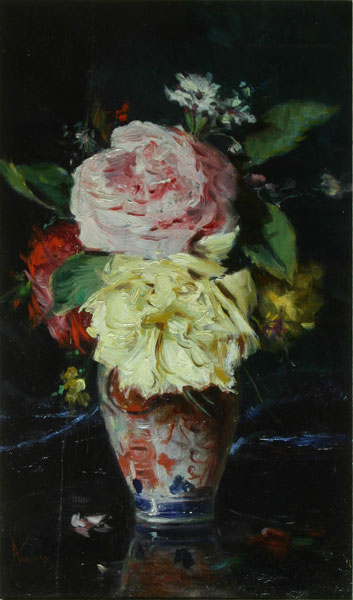
After 1875, the first truly important works appear, works in which a greater inclination towards these compositions can be observed. Fascinated by reflections, effects and lighting work, he tries to capture as much of these elements where an important example in this sense is: ("Lilac bouquet"), in which the glass surface reflects the composition, doubling the image and allowing the artist to perform an anamorphosis exercise. Other examples are: ("Bouquet of flowers"), ("Lilac bouquet") or ("Pot with flowers- Roses in a glass").
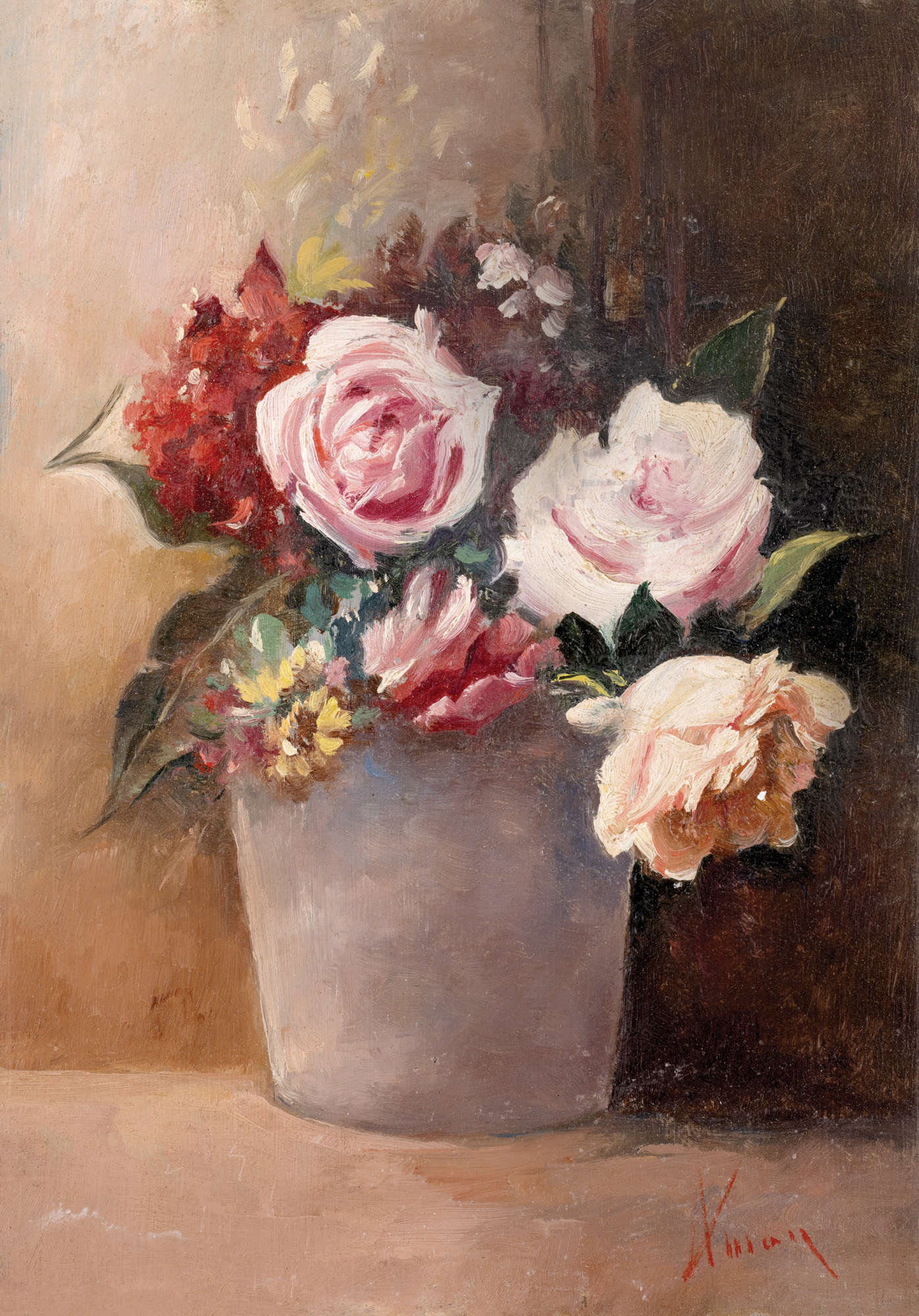
Regarding this work, which we can frame in the period around 1875 after his return from his studies in Paris, he focuses on capturing the still nature of a vase with roses. The vase is placed on a table, in a room, the bouquet consists of several roses of different shades of pink and yellow with their green leaves. The roses create a play of light and shadow that is projected on the wall behind the vase, more visible on the right side and behind the vase. This shadow projected on the wall is given by a thinner rose stem, its trunk and its leaves that give a vibrant balance to the work.
Despite the floral composition being part of the first stage in which Aman acquaints himself with the reproduced object, trying to get as close to it as possible and without standing out through a notable plastic expression, the work is only important in as much as it marks a moment of inception of still life as a new genre in Romanian painting. Even if the work is in its initial period, Aman managed to capture the composition quite well, a composition that is carefully made and focuses on reflections and the study of light. The brushwork is broad, with accents on transparency effects; the chromatic range is harmonious and pleasant and made of warm colors.
All of his still lifes are largely characterized by a very rigorous and confident design, the balanced composition also follows the appropriate chromatic formula and the correct placement of light and shadow within the paintings.
Beyond the conceptual evolution, which marks various stages, Aman's still lifes stand out with the precision of execution, the finesse and meticulousness of visual perception, the sensitivity with which it harmonizes chromatic and luminous values.
References
Greta ȘUTEU "Aman the Painter, the painting repertoire of the Theodor Aman Museum", Bucharest City Museum Publishing House, 2017.
Dimensions
width 11 cm, height 16 cm
Description
oil on wood, signed bottom right, in red, "Aman"
Dating
1875-1880
PROVENANCE
Tiberiu Puica's historical collection.
ADDITIONAL INFORMATION
For clarifications regarding the bidding procedure, hammer price costs, guarantee, payment, and collection terms for the winning lot, we recommend carefully reading/re-reading the Bidding Regulations.
For additional information regarding the lot and the auction, please contact the Art Consultants Department.
Detalii
Theodor Aman, considered the first modern artist from our country and the one who managed to capture aspects of the era in which he lived, from the evolution of fashion to the mores of the bourgeois society from the second half of the 19th century. Still life is a genre that Aman approaches throughout his artistic course, mainly standing out in compositions with flowers and fruits. The first still lifes with flowers appear in the first years after returning to Bucharest from his studies in Paris, when Aman performs a few chromatic exercises, still under the influence of French academicism.
After 1875, the first truly important works appear, works in which a greater inclination towards these compositions can be observed. Fascinated by reflections, effects and lighting work, he tries to capture as much of these elements where an important example in this sense is: ("Lilac bouquet"), in which the glass surface reflects the composition, doubling the image and allowing the artist to perform an anamorphosis exercise. Other examples are: ("Bouquet of flowers"), ("Lilac bouquet") or ("Pot with flowers- Roses in a glass").
Regarding this work, which we can frame in the period around 1875 after his return from his studies in Paris, he focuses on capturing the still nature of a vase with roses. The vase is placed on a table, in a room, the bouquet consists of several roses of different shades of pink and yellow with their green leaves. The roses create a play of light and shadow that is projected on the wall behind the vase, more visible on the right side and behind the vase. This shadow projected on the wall is given by a thinner rose stem, its trunk and its leaves that give a vibrant balance to the work.
Despite the floral composition being part of the first stage in which Aman acquaints himself with the reproduced object, trying to get as close to it as possible and without standing out through a notable plastic expression, the work is only important in as much as it marks a moment of inception of still life as a new genre in Romanian painting. Even if the work is in its initial period, Aman managed to capture the composition quite well, a composition that is carefully made and focuses on reflections and the study of light. The brushwork is broad, with accents on transparency effects; the chromatic range is harmonious and pleasant and made of warm colors.
All of his still lifes are largely characterized by a very rigorous and confident design, the balanced composition also follows the appropriate chromatic formula and the correct placement of light and shadow within the paintings.
Beyond the conceptual evolution, which marks various stages, Aman's still lifes stand out with the precision of execution, the finesse and meticulousness of visual perception, the sensitivity with which it harmonizes chromatic and luminous values.
ADDITIONAL INFORMATION
For clarifications regarding the bidding procedure, hammer price costs, guarantee, payment, and collection terms for the winning lot, we recommend carefully reading/re-reading the Bidding Regulations.
For additional information regarding the lot and the auction, please contact the Art Consultants Department.
References
Greta ȘUTEU "Aman the Painter, the painting repertoire of the Theodor Aman Museum", Bucharest City Museum Publishing House, 2017.