The photos of the lot are informative and indicative, and cannot provide a highly detailed view of the object from all angles. We recommend a careful physical inspection of the lot before bidding.
Deac, Mircea, "Magdalena Rădulescu", Meridiane Publishing House, Bucharest, 1980.
Beu, Lilian, "The Story of a Forgotten Artist: Magdalena Rădulescu" in "Buridava - Studies and Materials", XII, 12.02.2015, pp. 162-176.
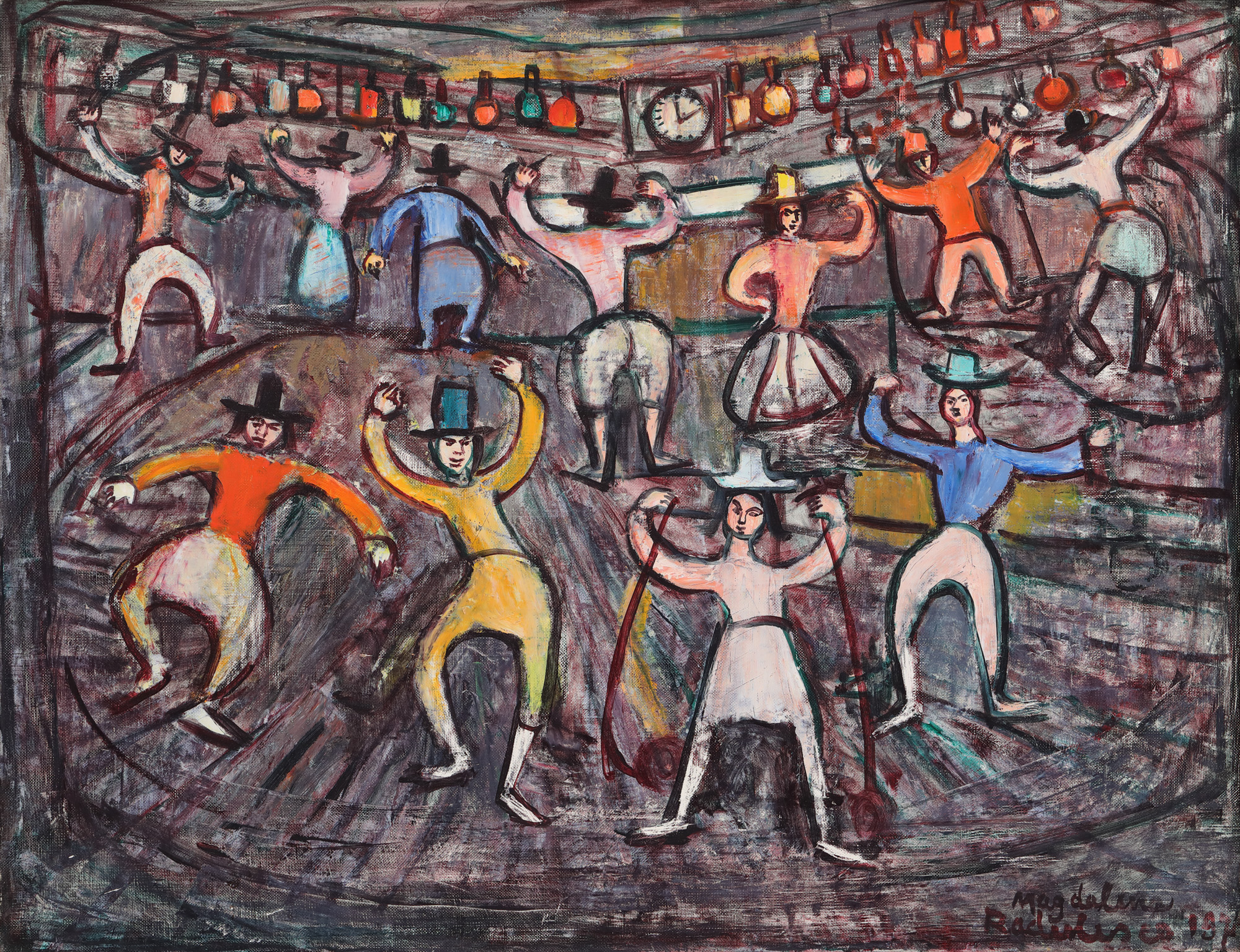
oil on canvas, 50.5 x 64.5 cm, signed and dated lower right, in brown, "Magdalena Rădulescu, 1977"
Absorbing the aspirations of her parents (her father – a railway engineer, her mother – possessing a remarkable musical talent), Magdalena Rădulescu will compose her own artistic rhythm, skillfully combining the mathematical precision of her father with her mother's artistic nature. After completing her studies, many of them abroad, the artist will immerse herself in the world of theater, resulting in a series of portraits dedicated to esteemed actors of her time, and also in creating stage designs (such as the monumental curtain introduced by director Ion Sava in the staging of W.B. Yeats' drama "The Unicorn"). Frequently navigating the world of spectacle, Magdalena Rădulescu adopts other motifs as the epicenter of her works. Notably, dance is one of her favorite subjects, which she draws upon from native tradition, resulting from wandering through Romanian villages, or from folk festivals she attends in Nice. She closely studies the movements of the dancers, their expressions, and costumes, often finding similarities and differences between East and West. Dance becomes a metaphysical element, akin to magic, laden with messages and symbols; music also serves as a connecting element between peoples and traditions, with the artist often highlighting subtle influences from one part of the world to another. Although she places her characters in uncertain settings, mostly against richly colored backgrounds, Magdalena Rădulescu's dancers seem to gently lift from the ground, thus constantly ascending and aspiring towards apotheosis. The thematic cycle proves revelatory for exuberant color rhythms and the choreography of strokes that support the hushed melody of the dancer paintings. Not infrequently, we note a collective dance in an endless circle. Whether we speak of Romanian circle dances or calusari, dance ensembles proposed by the artist become examples through the depth of meanings and messages encoded in their frozen-in-time movements. Hence, we distinguish the recurrence of traditional dancers, costumes, and hats distinctive of certain dance genres, as well as details referring to traditions and spirituality. With arms raised towards the asceticism they dream to achieve, Magdalena Rădulescu's characters receive distinctive strokes and various postures, thus emphasizing their individuality. The artist will place her models, on canvas or paper, with the skill of a scholar, or the apparent chaos of a contemplative bohemian. Most often, starting from one of her favorite subjects: horses, the artist will attach bells worn by calusari dancers to the ankles of her dancers, transferring a pictorial motif from one cycle of artwork to another.
For clarifications regarding the bidding procedure, hammer price costs, guarantee, payment, and collection terms for the winning lot, we recommend carefully reading/re-reading the Bidding Regulations.
For additional information regarding the lot and the auction, please contact the Art Consultants Department.
By choosing "Accept all cookies" you agree to the use of cookies to help us provide you with a better user experience and to analyse website usage. By clicking "Adjust your preferences" you can choose which cookies to allow. Only the essential cookies are necessary for the proper functioning of our website and cannot be refused
Cookie settings
Our website stores four types of cookies. At any time you can choose which cookies you accept and which you refuse. You can read more about what cookies are and what types of cookies we store in our Confidentiality Policy.
are necessary for technical reasons. Without them, this website may not function properly.
are necessary for specific functionality on the website. Without them, some features may be disabled.
allow us to analyse website use and to improve the visitor's experience.
allow us to personalise your experience and to send you relevant content and offers, on this website and other websites.