
157. The Bay [anii '30]

1880, Galaţi - 1962, Bucureşti

Estimate

EUR 10.000 - 16.000

Sold post auction

EUR 10.000

Session

Tue, 22 October 2024 19:00

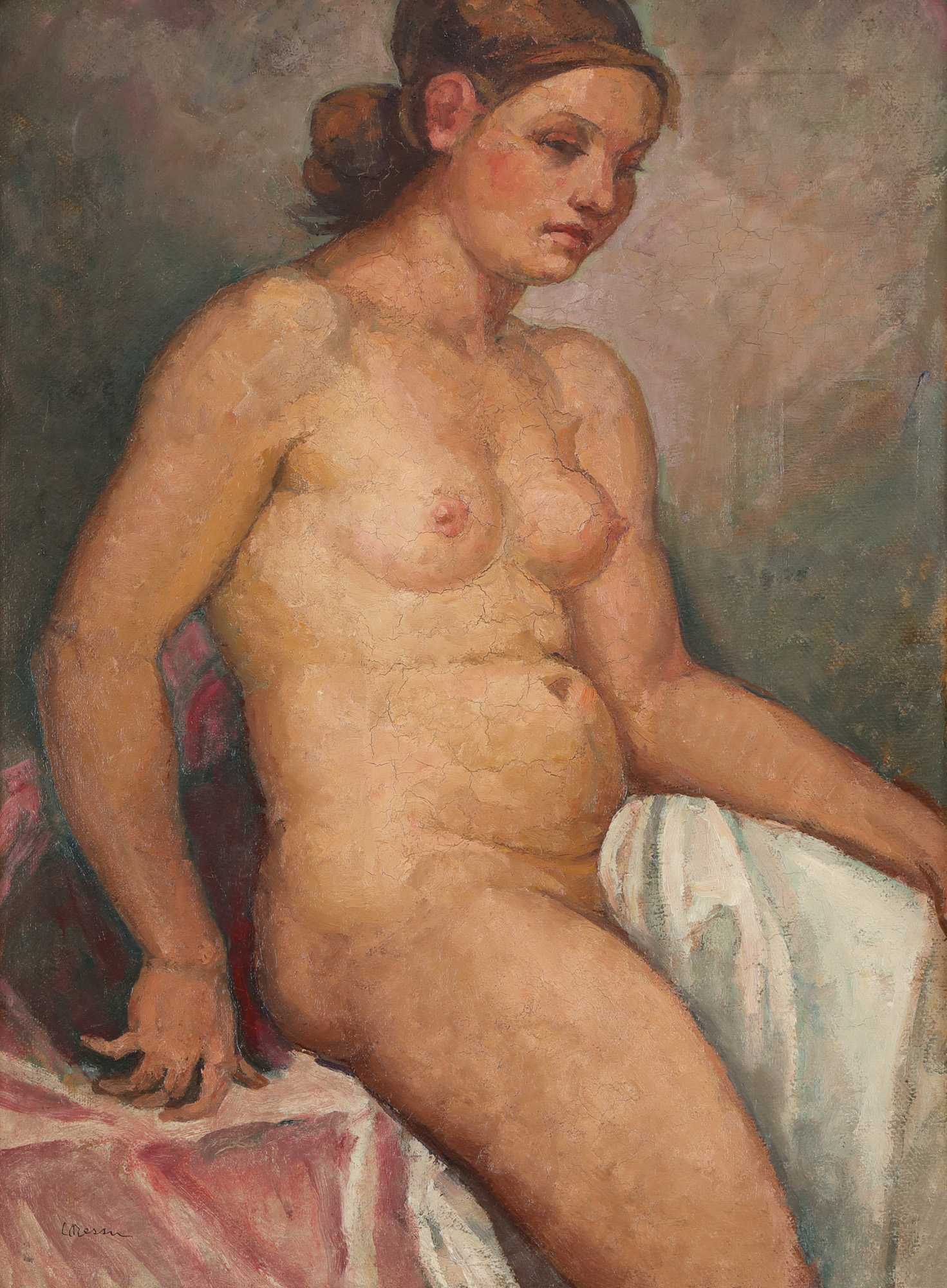
A symbol of liberation and the assumption of freedom in art, the nude has been distinguished throughout history as a special genre of painting. In Antiquity and the Renaissance, the representatives of art movements would remove the clothing of Eros, revealing his human nature to viewers. Eros would then take the shape of little cupids, which would later transform into angels and cherubs. Presented with bare bodies, the heroes of ancient works would pave the way for both artists and the public to familiarize themselves with a new type of art. From the early modern Romanian painters, who returned to their country after studying abroad, to the present day, the nude has been integrated into painting and elevated to the rank of art. Unlike sculptors, who turned their attention to both male and female forms, painters focussed mostly on idealizing female proportions. Camil Ressu is among the painters who "dominated the first half of the 20th century and who produced nude paintings as an independent genre”, as Mircea Deac claims, along with Theodor Pallady, Gheorghe Petrascu, and Nicolae Tonitza. In their works we will identify the figure of a loved one, a model or a reputable personality. Typically, the model merges with characters from the artists' biography, thus being allowed both in the studio and the painter's home. They spent a long time studying anatomy and the transposition of the image in oil would consequently take place at the end of an ample period devoted to research and experimentation. For Camil Ressu's art, immediate contact with reality is vital in order to convey emotion. The painter focuses on depicting the reality of volumes and constructive rhythms. This success is most evident in his portraits, where he evokes the inner life of his models through the tranquillity and purity of lines. He is also interested in precise contouring. He uses a predominantly linear rhythm and a bright colour scheme in an attempt to highlight the silhouettes of the characters in his works. The period 1920-1950 - therefore a generous stage of his creation - overlaps with the artist's interest in nude painting. Michelangelo stated that "an artist's perfection is shown by the perfect drawing of a nude". However, Camil Ressu focuses on surpassing academicism and anatomical knowledge, and rather strives for the perfection of his own beauty ideal. He thus uses the nude as a means of expression, combining Renaissance muscular vigor and Baroque carnality. The female characters in the artist's nudes are predominantly depicted in a robust manner, brimming with vital energy and fertility, as is the case with the present model, depicted in semi-profile. We notice the full and well-defined shapes: the bust and belly area, as well as the arms or thighs. However, the composition is harmonized not only by brush strokes and shapes, but also by well-argued color choices.

References

ENESCU, T., "Camil Ressu", "Academy Publishing House of the People's Republic of Romania", Bucharest, 1958. ENESCU, Theodor, "C. Ressu", Meridiane Publishing House, Bucharest, 1984.

Dimensions

width 49 cm, height 68 cm

Description

ulei pe carton, signed lower left, in pencil, ''C. Ressu''

Dating

anii '30

ADDITIONAL INFORMATION

For clarifications regarding the bidding procedure, hammer price costs, guarantee, payment, and collection terms for the winning lot, we recommend carefully reading/re-reading the Bidding Regulations.

For additional information regarding the lot and the auction, please contact the Art Consultants Department.

Similar lots