The photos of the lot are informative and indicative, and cannot provide a highly detailed view of the object from all angles. We recommend a careful physical inspection of the lot before bidding.
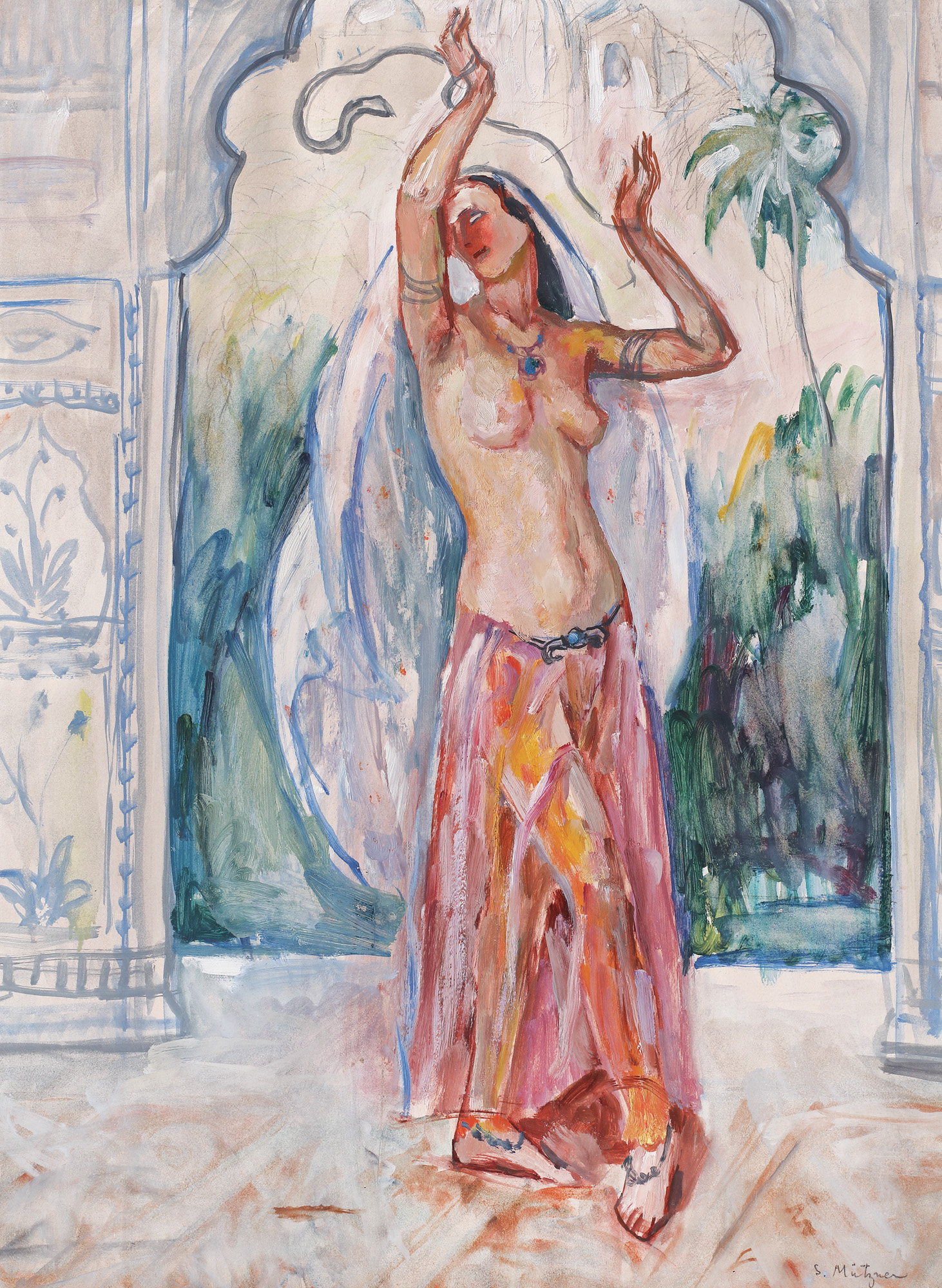
oil, gouache on paper pasted on cardboard, 69 x 50 cm, 69 Ã 50 cm, signed bottom right, with pencil, "S. Mützner"
One of the most important explorers of foreign cultures, Samys Mützner (by his Jewish name) experienced these travels to foreign lands especially between 1912-1919, arriving, step by step, in Northern Africa, Japan, China, Korea, the Philippines, India, then Venezuela, Spain, Tunisia, etc. We refer to Mützner's second artistic period, when he discovers important stylistic resources: in this moment, strong contrasts disappear, the light becomes increasingly gentle, and the shades of pink and light green, as well as tones of blue, yellow and silver, are spread onto the painting's surface in a manner which is slightly different from the pointillage technique. Among the water colours of this period, we find also the artist's three works in which one of the most attractive subjects of the Oriental environment is represented, the object of creation for European writers and artists alike: Oriental dancers. In Egyptian tradition, dancers could have been simple "ghaziyyah", those popular dancers who performed in public places - on the streets, in the markets, or in coffee houses - often in the company of nomad musicians, to be able to animate the improvised show. Yet, the real dancers were trained and called "almeh" or "almah" (sapient women). Cultured and sophisticated dancers, who belonged to an upper social class, had free access to the harem, and their presence was highly sought within the high social circles. The dancer from our current works was also part of this category. A classy presence, the woman is barely covered in a broad skirt, of a transparency showing her legs, crossed in lascivious movements. The veil covering her head and the rear of the undressed torso is equally broad. The architectural element of the arcade behind the dancer leads us to believe that the action takes place inside a building, an Oriental palace, with the typical Arabic ornamental motifs. Just like Renaissance paintings, but with a sketched perspective, the arcade shows the fortress-city on the horizon, surrounded by the vegetation that is typical for Oriental lands. However, the Oriental dancer's movements are far more attractive, thanks to their symbolism. The feet, in permanent contact with the ground, actually represent that position which, during Antiquity, expressed the woman's strength and stability. Her hands emphasize the body's expression, through movements symbolising the act of offering herself. With delicate wavy movements of the hips, reminding of the waves of the sea, a natural element linked to the feminine sphere, or reminding of the animal reign, such as the camel or the snake, the hallmark of vital energy, the dancer exudes sensuality, energy and a unique expressiveness.
For clarifications regarding the bidding procedure, hammer price costs, guarantee, payment, and collection terms for the winning lot, we recommend carefully reading/re-reading the Bidding Regulations.
For additional information regarding the lot and the auction, please contact the Art Consultants Department.
By choosing "Accept all cookies" you agree to the use of cookies to help us provide you with a better user experience and to analyse website usage. By clicking "Adjust your preferences" you can choose which cookies to allow. Only the essential cookies are necessary for the proper functioning of our website and cannot be refused
Cookie settings
Our website stores four types of cookies. At any time you can choose which cookies you accept and which you refuse. You can read more about what cookies are and what types of cookies we store in our Confidentiality Policy.
are necessary for technical reasons. Without them, this website may not function properly.
are necessary for specific functionality on the website. Without them, some features may be disabled.
allow us to analyse website use and to improve the visitor's experience.
allow us to personalise your experience and to send you relevant content and offers, on this website and other websites.