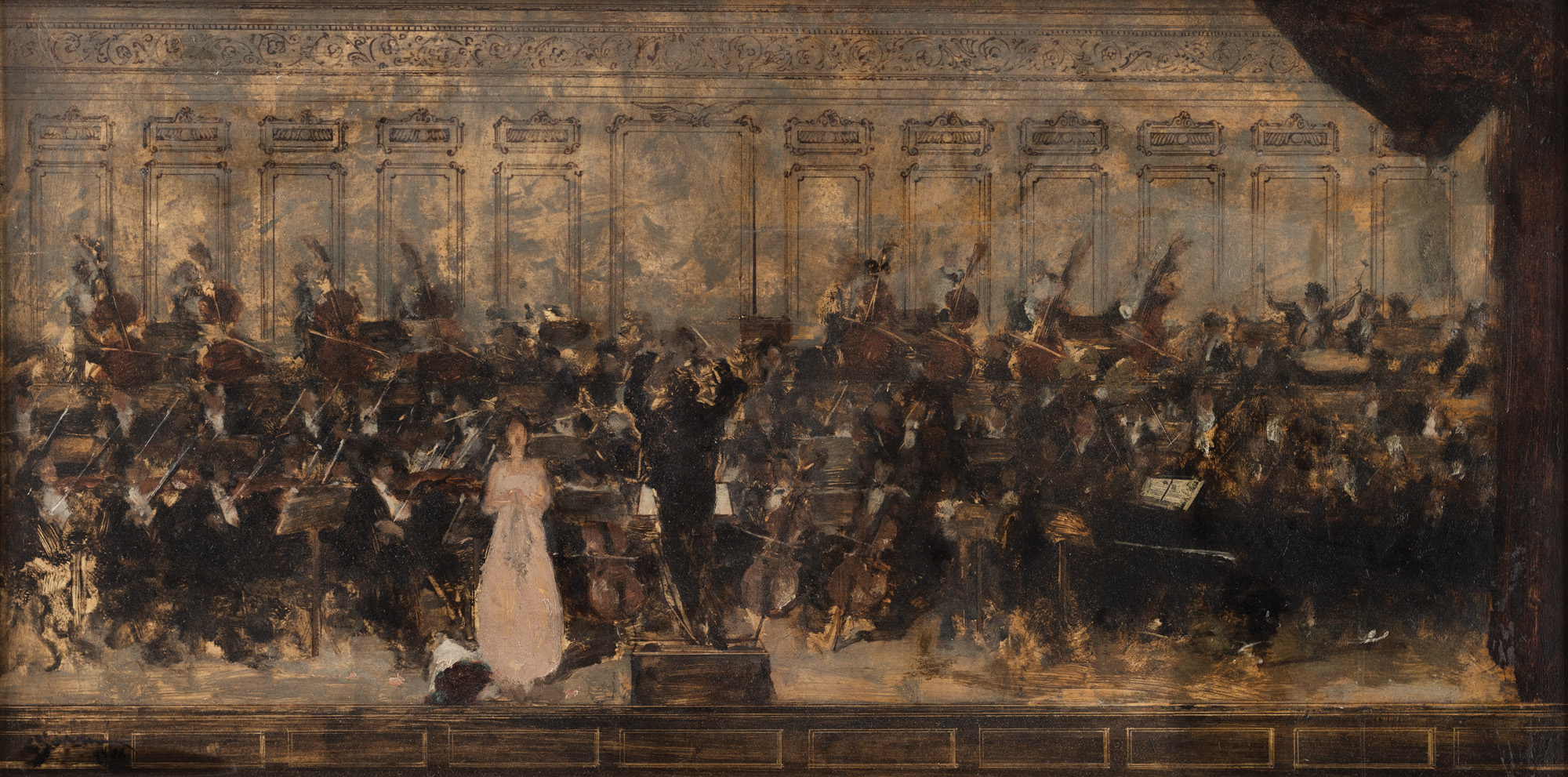
102. Concert at Ateneu (conducted by George Enescu) [1946]
The photos of the lot are informative and indicative, and cannot provide a highly detailed view of the object from all angles. We recommend a careful physical inspection of the lot before bidding.
102. Concert at Ateneu (conducted by George Enescu) [1946]
"Memories" by Eustatiu Gr. Stoenescu, published in "Oltenia Archives", Year XXII/1943, no. 125-130, pp. 346-351.
OPRESCU, Gheorghe, "Stoenescu", Publishing House of Schools, Bucharest, 1946.
oil on wood, 49.5 x 95.5 cm, signed and dated lower left, in black, "Stoenescu, 1946"
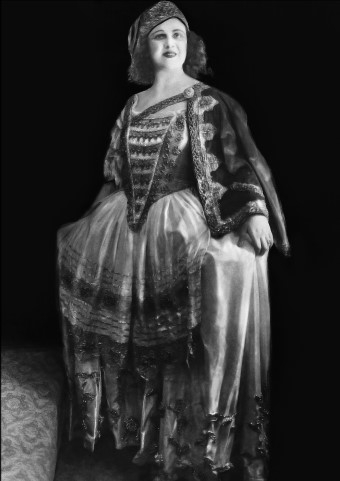
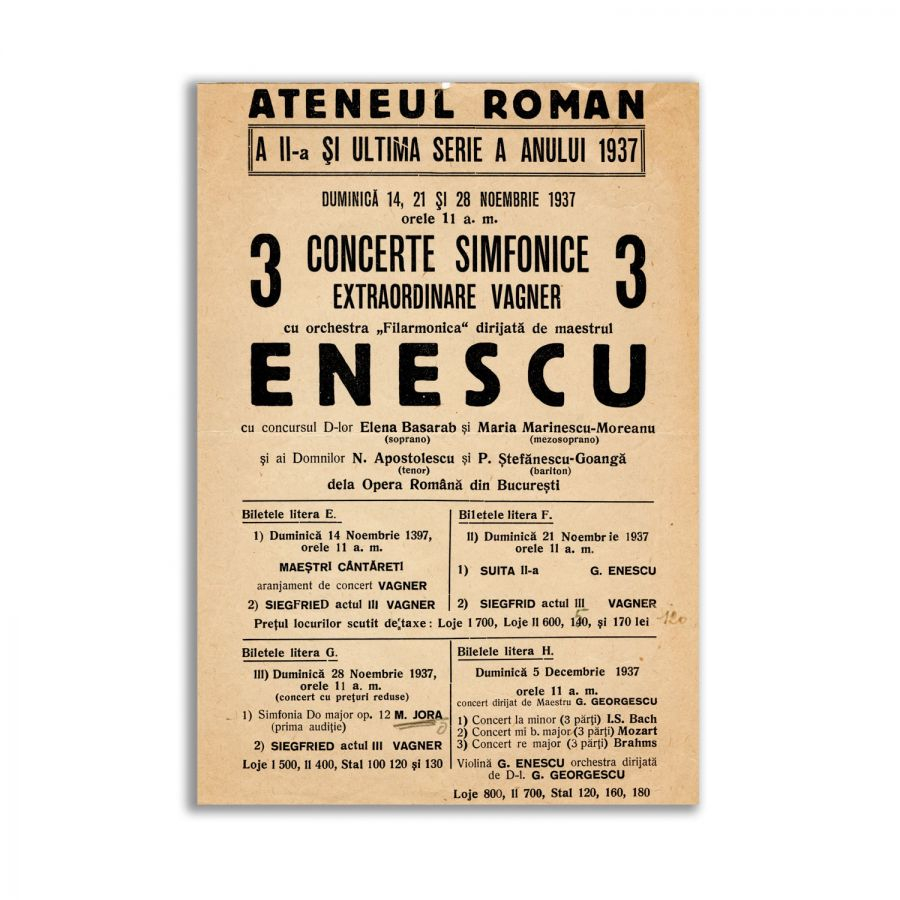
Eustatiu Stoenescu joined the Julian Academy in Paris at the young age of 16. The international journey for studies brought him closer to the art of Velázquez, Rembrandt or Whistler, artists he greatly admired. He arrived in Paris in 1900, therefore right in the midst of the famous Universal Exhibition, thus having the opportunity to enjoy the turmoil of artistic life in the French capital. He stayed as a guest at Mrs. Titulescu, who came to Paris to take care of Nicu (Nicolae Titulescu), a law student. In Paris, Stoenescu would be a colleague with Ressu and Steriadi in Jean Paul Laurens' workshop, but among these, he will be the one noticed by the professor and asked to work in his private workshop. Thus, a close relationship will be woven between the two - mentor and apprentice - the young student particularly appreciating the paternal care shown to him by the professor. Due to this new connection, Eustațiu Stoenescu discreetly enters the important artistic world of Paris at the beginning of the 20th century and meets personalities such as Auguste Rodin, Antoine Bourdelle or Paul-Albert Besnard. Rodin often came to Jean Paul Laurens' workshop, and sometimes addressed encouraging remarks to the young Romanian student. Stoenescu's early foray into the intersection of painting and music will be revealed through the laborious project undertaken by his master. Jean Paul Laurens undertook a prodigious research work for the theme of his famous painting "Music (Tribute to Beethoven)". He thus proceeded to invite contemporary musicians into his studio, one of whom was George Enescu himself. At the painter's initiative, George Enescu would perform various works for his restricted audience. Stoenescu was passionate about music, especially the violin - an instrument he had studied as a child. In Paris, he also explores the realm of music and discovers names such as Saint-Saens, Ravel, Viardot, Kreissler. Not surprisingly, therefore, in this work the painter brings together several of his favorite subjects and at the same time remembers the meeting with the great musician of Romanian origin. According to the notation on the verso, the work probably discloses a moment of the concert conducted by George Enescu at the Romanian Athenaeum in 1937. An epoch poster reveals the existence of "3 Extraordinary Symphonic Concerts Wagner with the Philharmonic Orchestra conducted by master Enescu" on the 14th, 21st and 28th of November 1937. The repertoire of the three concerts included "Siegfried Act III", Wagner; "Suite II", George Enescu; "Symphony in D Major Op. 12", Mihail Jora (in premiere); a Bach concert, a Mozart one, and a Brahms one. The concert on November 14, 1937 became particularly important as George Enescu received a second decoration from King Carol II. The concerts at the Athenaeum were attended by famous names of Romanian classical music: soprano Elena Basarab, mezzo-soprano Maria Marinescu-Moreanu, tenor N. Apostolescu and baritone P. Ștefănescu-Goangă. Elena Basarab was one of the renowned artists of the Bucharest lyrical stage. Showing early on her special vocation, she will be encouraged by acquaintances to continue her musical studies. The rich universal repertoire that she interpreted virtuously spanned several decades. Maria Marinescu-Moreanu was another charming and graceful appearance. Her voice impressed those around her who convinced her to deepen her conservatory courses, to the detriment of the Commercial Academy. With roots in the old Rally family, which owned the theater building in Braila, Petre Ștefănescu-Goangă emerged at the time as a gifted baritone and a dedicated pedagogue. It was George Enescu himself who advised him to study in Paris. Thus, starting from the few data that enroll the concerts in November 1937 in the gallery of landmarks, we can discern the painter's interest in representing the subject several years after attending the concert as a spectator. Stretched horizontally, Stoenescu's painting depicts the atmosphere of the concert night, with George Enescu conducting in the foreground, the numerous Philharmonic Orchestra in the second plan and the presence of a soprano in a significant detail. The distinguished atmosphere is supported by the elegant background, expressed in a diaphanous chromatics; the work actually represents an ideatic fragment of a fulfilled moment. The scene and the curtain immerse us in the gala atmosphere and also subject us to the precepts of the show convention.
For clarifications regarding the bidding procedure, hammer price costs, guarantee, payment, and collection terms for the winning lot, we recommend carefully reading/re-reading the Bidding Regulations.
For additional information regarding the lot and the auction, please contact the Art Consultants Department.