


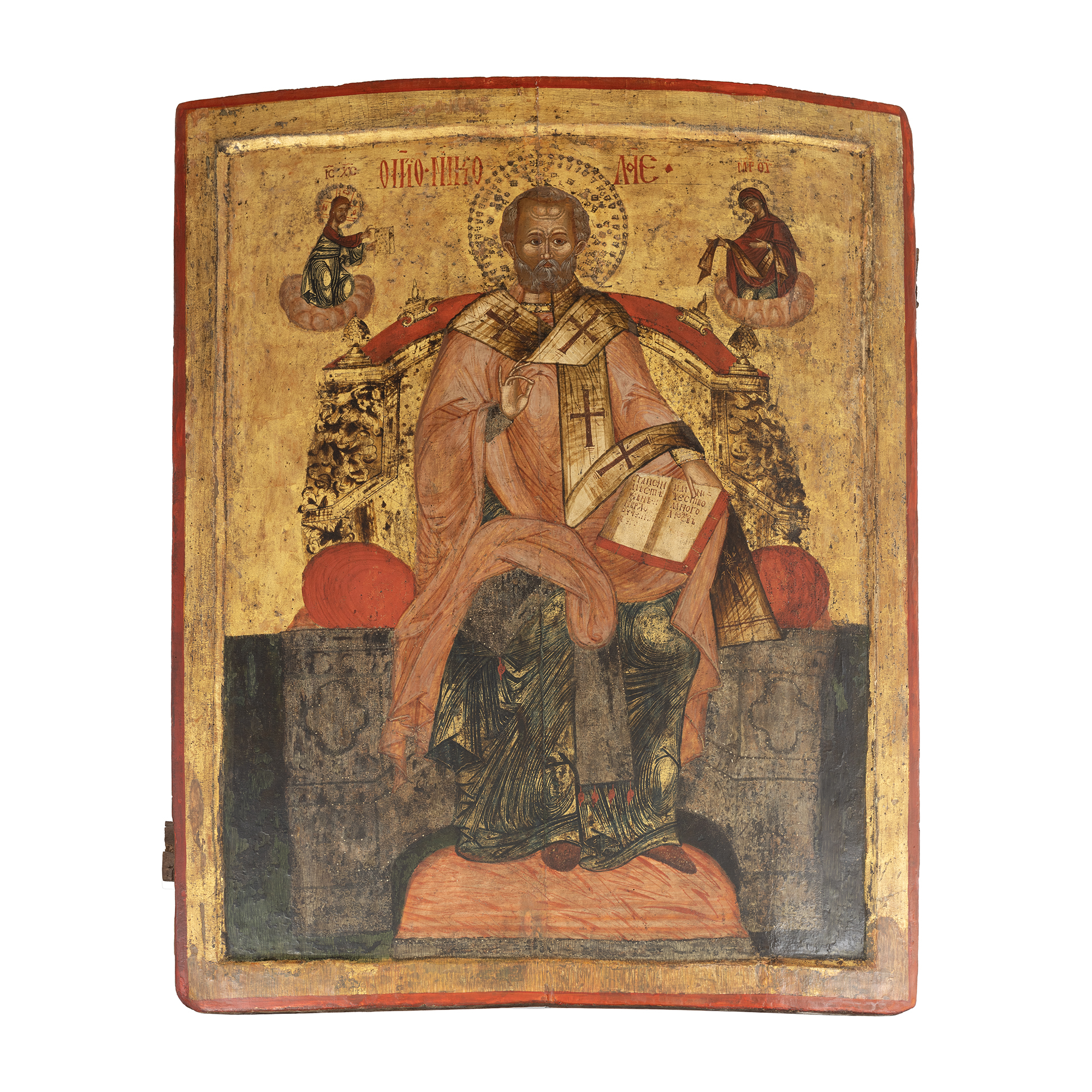
25Т. Imperial Icon on Wood, "Saint Bishop Nicholas Enthroned", attributed to Costandin Zugravul, Wallachia, Brâncovenesc school, the epoch of Constantin Brâncoveanu, last decade of the 17th century, museum piece
The photos of the lot are informative and indicative, and cannot provide a highly detailed view of the object from all angles. We recommend a careful physical inspection of the lot before bidding.
25Т. Imperial Icon on Wood, "Saint Bishop Nicholas Enthroned", attributed to Costandin Zugravul, Wallachia, Brâncovenesc school, the epoch of Constantin Brâncoveanu, last decade of the 17th century, museum piece
Starting price:
EUR 17.000
Sold
EUR 31.500
tempera and gold leaf on wood, 102 x 78 cm
Research information
Of high artistic value, the painting of the icon falls within the stylistic coordinates of Brâncovenesc painting, and through its entire bearing, which expresses wealth, pomp and opulence, it can be considered a princely commission. Constantinos, a painter of Greek origin active in Wallachia between 1658 and 1720, played an essential role in the development of Brâncovenesc art. Brought by Șerban Vodă Cantacuzino to paint the Biserica Doamnei in Bucharest in 1683, his talent was quickly recognized, which led Constantin Brâncoveanu to appoint him "master of painters" at the Hurezi Monastery in 1692, where he was responsible for one of the most successful pictorial ensembles in all of Romanian medieval art. Among his most important works are the frescoes of the Church of the Princely Court in Târgoviște (the first monument painted by the painters of the "Hurezi School" outside the Hurezi Monastery ensemble, in 1698), Dintr-un Lemn Monastery (the foundation of Preda Brâncoveanu from the year 1635), Ostrov Hermitage in Călimănești (1701), Polovragi Monastery (1703) and the Church within the Brâncoveanu ensemble at Mogoșoaia (1705). Regarding icon painting, only six icons belonging to Constantinos are known so far, of which only one is signed, the rest being attributed to him. His distinctive style represents a synthesis between traditional Byzantine art and echoes of the late Renaissance and Baroque. Thus, Constantinos significantly contributed to shaping the visual identity of the Brâncovenesc era, which gives birth to the first national style. There are specialists who discuss the hypothesis that the painter Constantinos, towards the end of his career, appreciating the art of the Russian iconographers, showed interest in their style of painting and also created icons close to the spirit and stylistics of the Russian period.
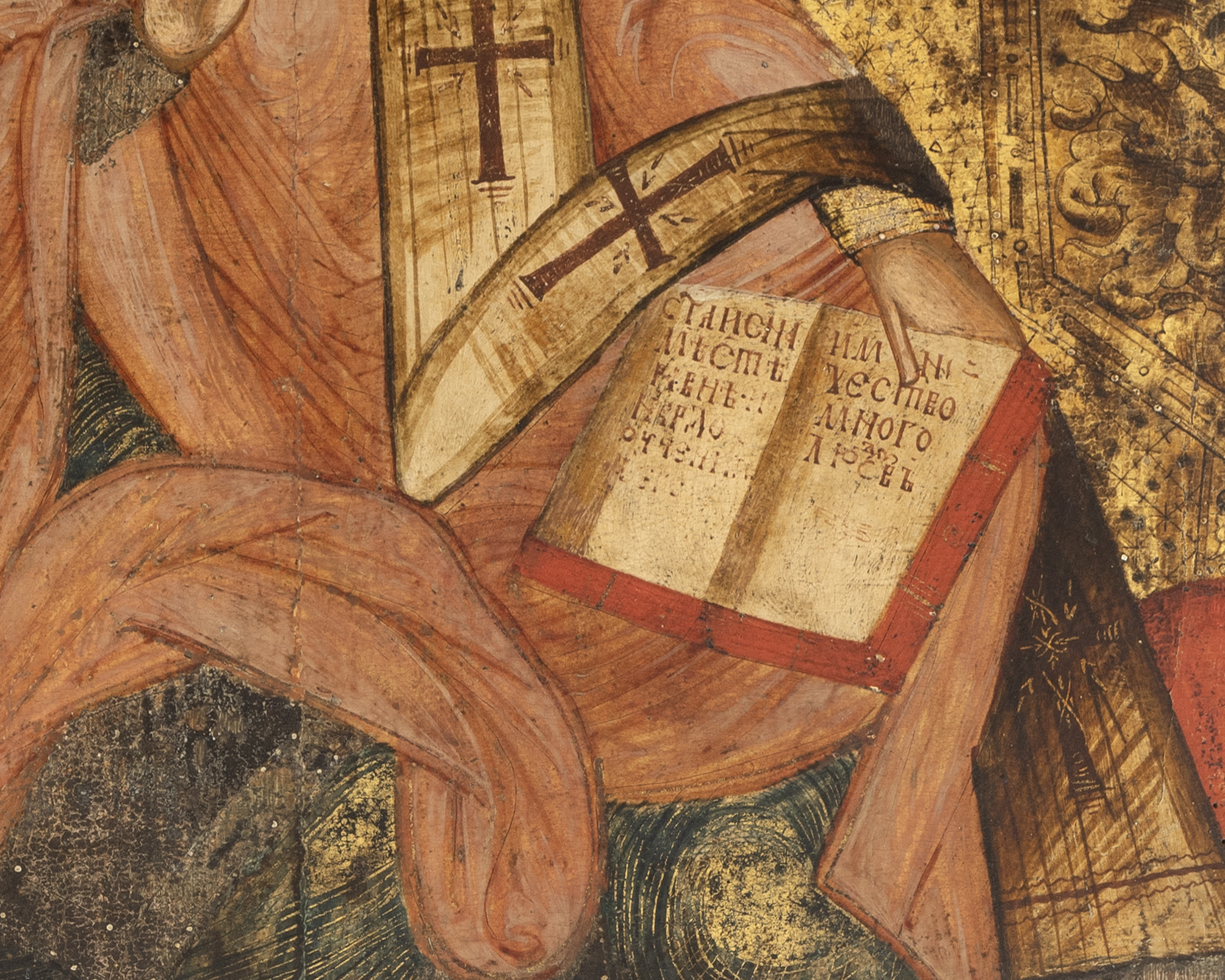
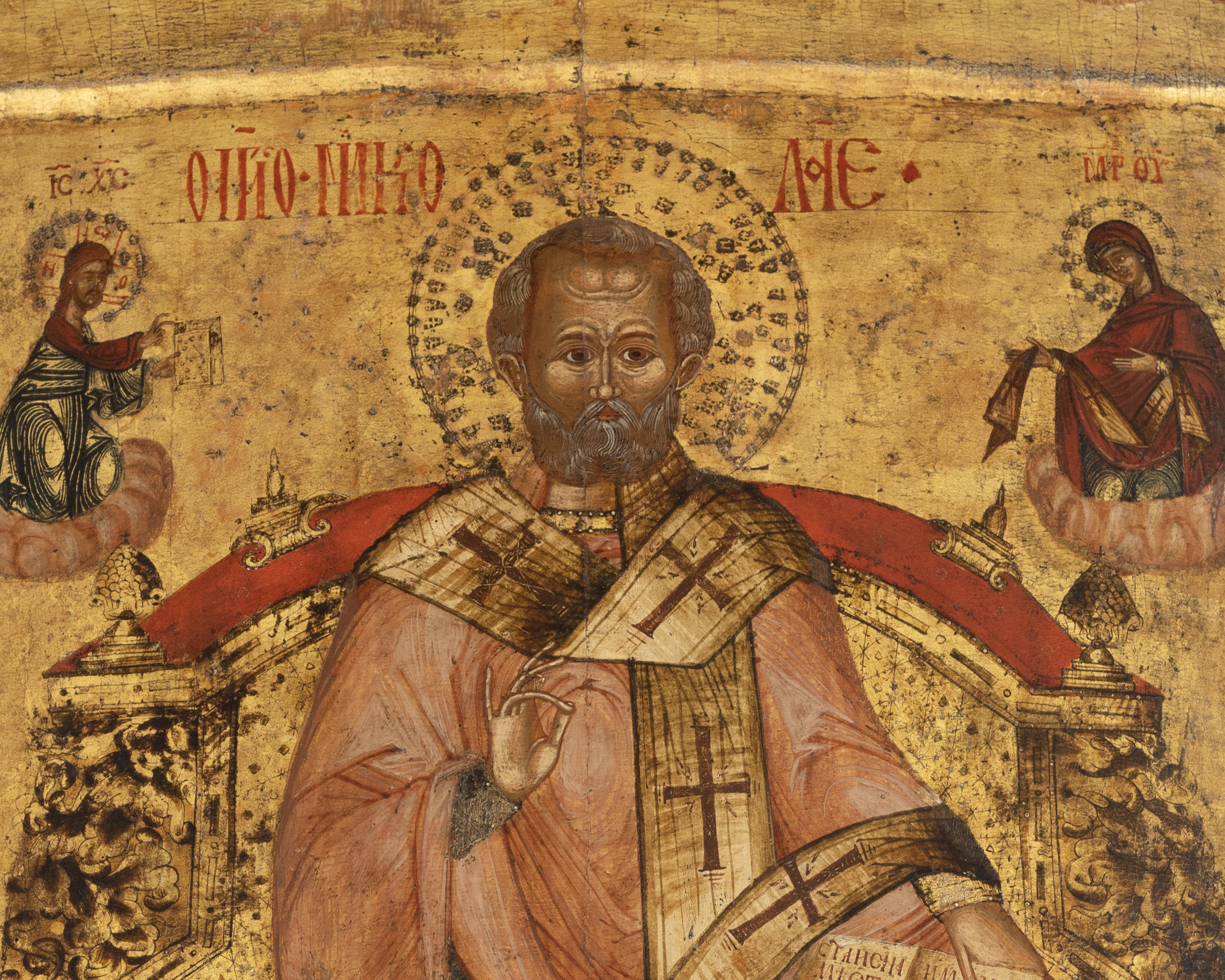
Iconographic and stylistic identification elements: Saint Nicholas is depicted sitting on a chair (following the same model as the series of icons he is part of). He is dressed in the bishop's robes of Myra of Lycia, without a mitre on his head. He is wearing a green tunic, stole of the same color, with red tassels, a pink-violet chasuble (Greek-influenced chromatic) and a white omophorion on top, with crosses rendered in reddish-brown. With his right hand, he blesses, and with his left, he supports the open Gospel on his knee, with a text in Slavonic. Small-sized, above his head, Jesus Christ offers him the Gospel, and the Mother of God, the omophorion (allusion to the Council of Nicaea, 325). Like the other icons in the series, the face of Saint Nicholas, as well as of the Savior and the Mother of God, are depicted in the style of Brâncovenesc painting, the painter demonstrating mastery in their modeling. The vivid chromatic, given by the combination of the dominant gold with red in various shades, blue and ochre, enhances the impression of splendor and wealth of the icon. The inscriptions designating Saint Nicholas are in Greek, and the text of the Gospel, in Slavonic; this is also true for the imperial icons with which it is a series.
Technical identification elements: The linden wood panel is reinforced at the back with two semi-buried beams, and the wood on the face is planed; quality primer, uniform over the entire surface, gold leaf, tempera on wood, varnish.
Conclusions: The icon of St. Nicholas, like the icons with which it is a series, is an authentic, valuable and representative work for the Brâncovenesc painting of icons, both from an iconographic, stylistic and technical point of view (A.D.).
For clarifications regarding the bidding procedure, hammer price costs, guarantee, payment, and collection terms for the winning lot, we recommend carefully reading/re-reading the Bidding Regulations.
For additional information regarding the lot and the auction, please contact the Art Consultants Department.
SESSION
Brought to you by
Similar lots
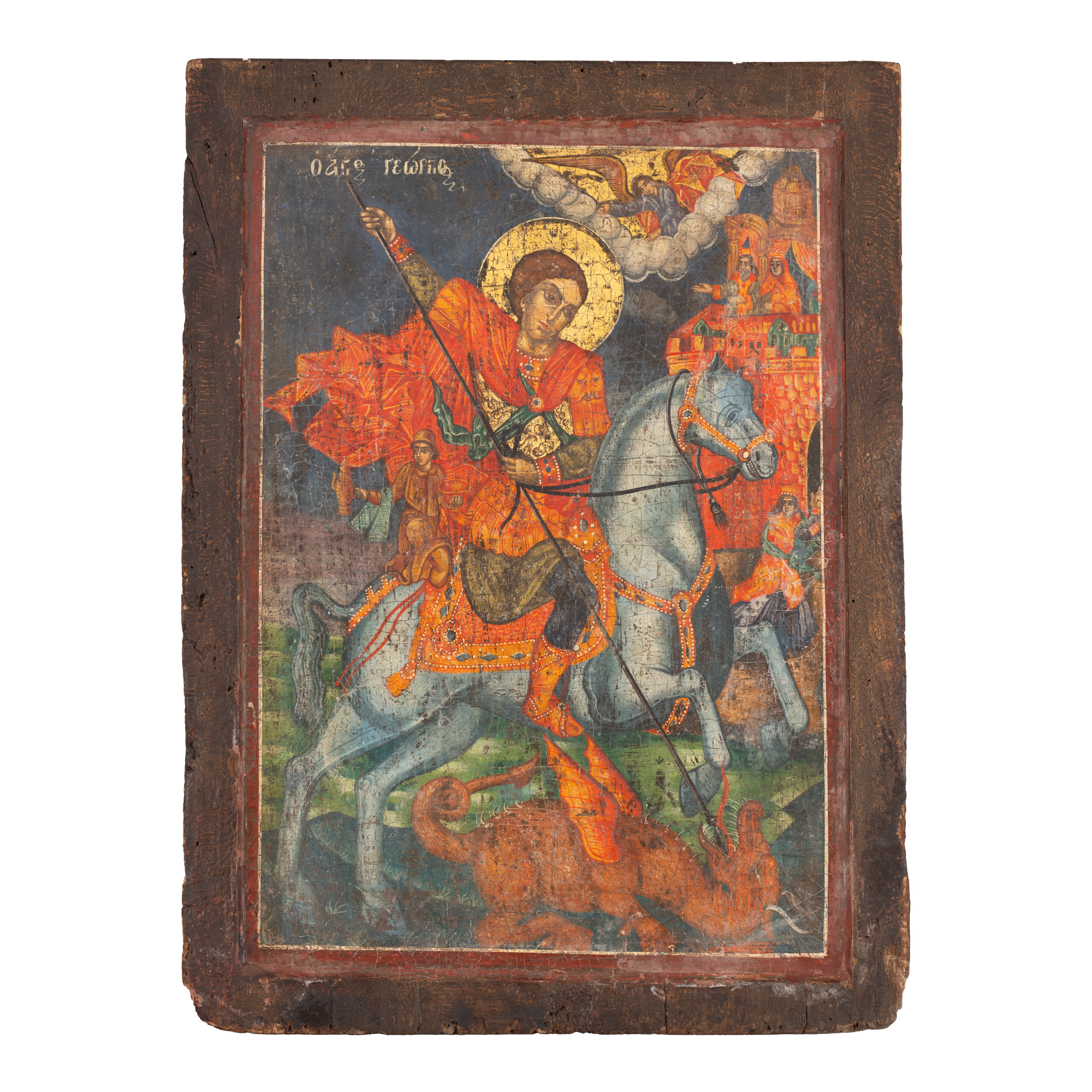
46. Icon on wood, "Saint George killing the dragon", Greek school, end of the 17th century-beginning of the 18th century
Starting price:
EUR 1.800
Sold
EUR 2.750
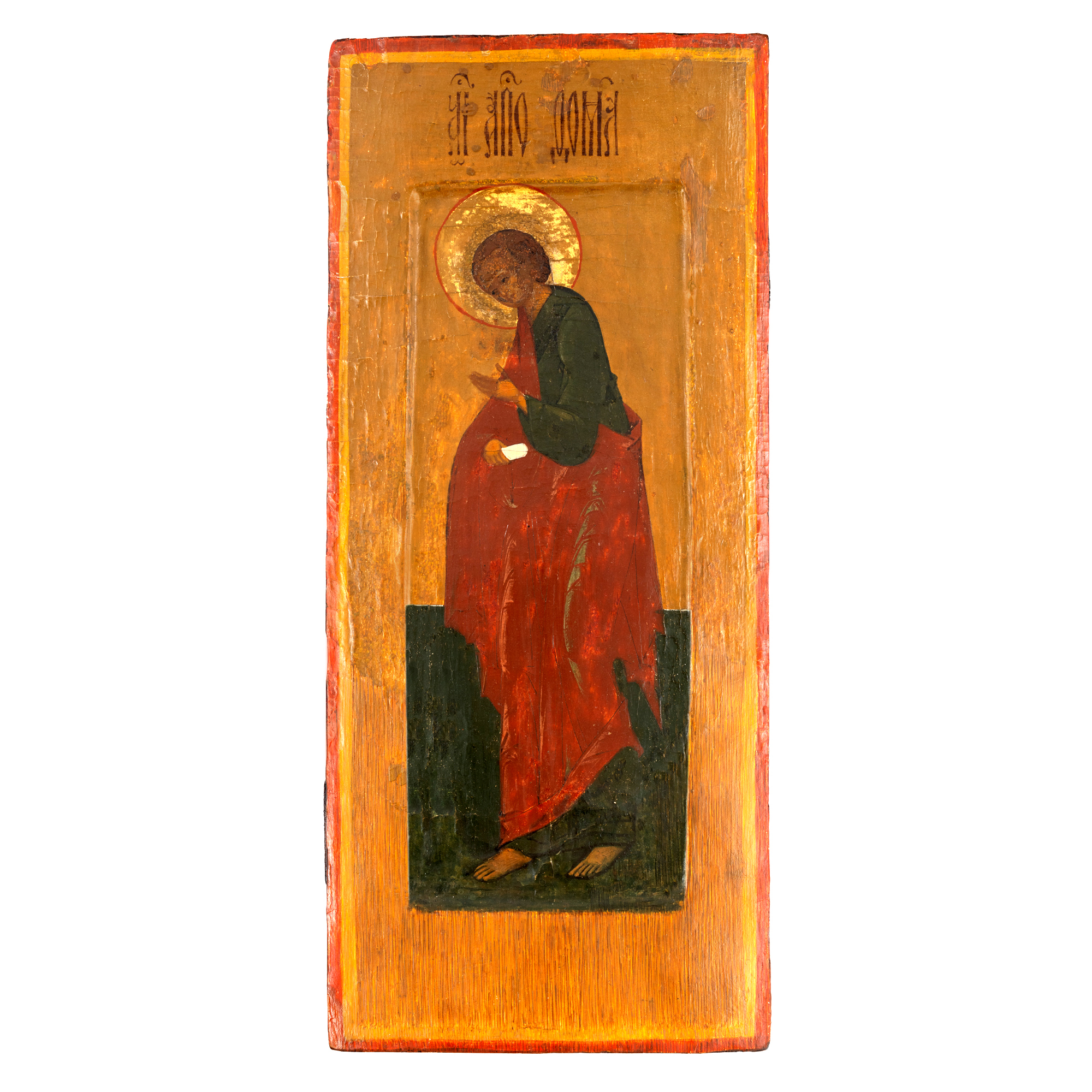
121F. Icon on wood, "Saint Apostle Thomas", Russian school, first half of the 17th century, rare piece
Starting price:
EUR 1.500
Sold
EUR 1.500