
132. George's Old Man's Courtyard in Brebu [1908-1910]
The photos of the lot are informative and indicative, and cannot provide a highly detailed view of the object from all angles. We recommend a careful physical inspection of the lot before bidding.
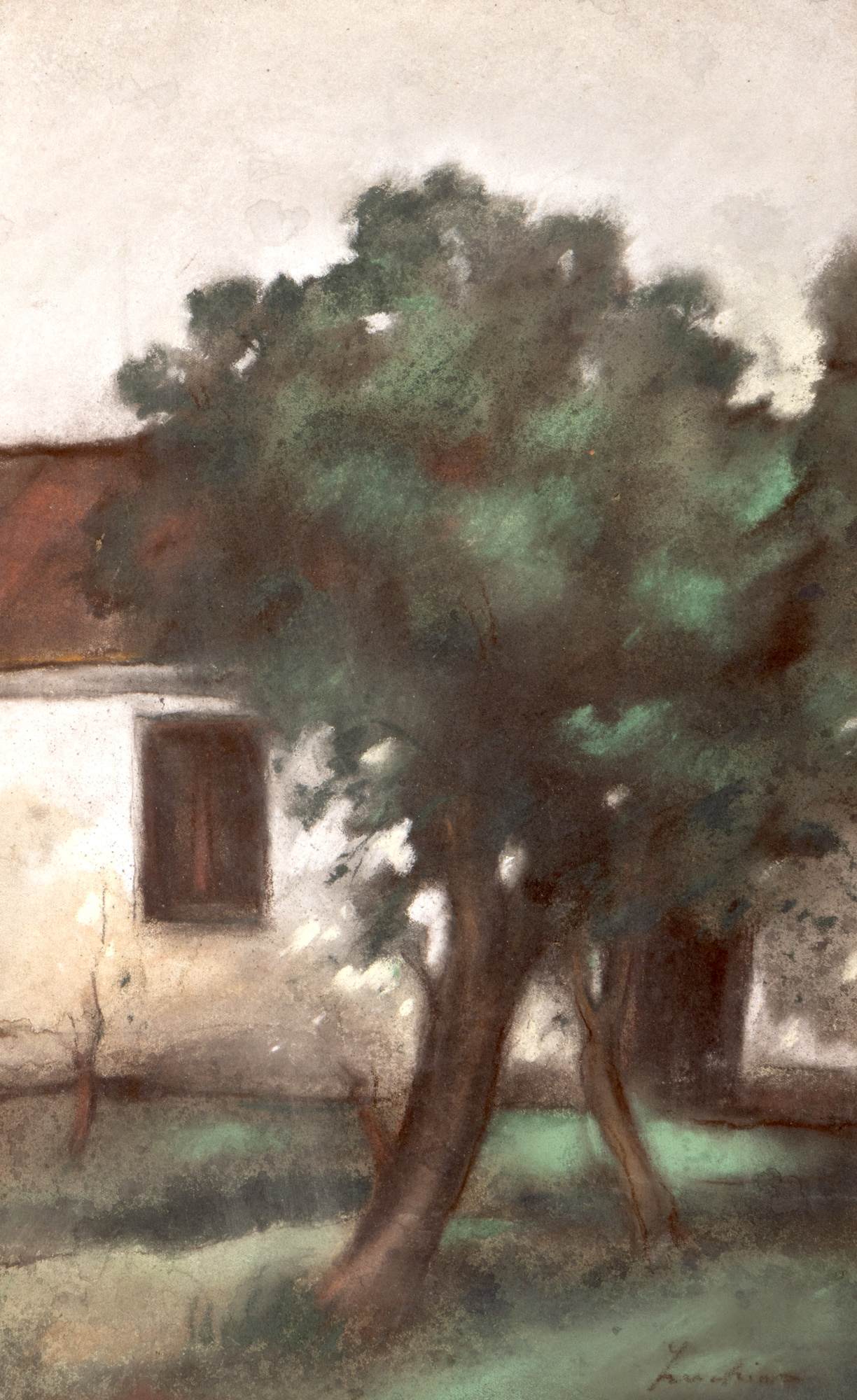
132. George's Old Man's Courtyard in Brebu [1908-1910]
1868, Ştefăneşti - 1916, Bucureşti
Not sold
Selling price
EUR 15.678
pastel on paper, 44 x 27.5 cm, signed at the bottom right, in brown, "Luchian"
Stefan Luchian, along with Nicolae Grigorescu and Ion Andreescu, is one of the masters of modern Romanian painting. At the turn of the 19th and 20th centuries, Stefan Luchian, receptive to the innovations of European art, was one of the artists who opposed academicism and salon art, enriching Romanian art with painting based on the traditions of the Romanian school, imbued with modernity. A supporter of the freedom and independence of art, rejecting the sterility of official art, he subscribed to the direction of realistic and progressive art. From the outset, he was preoccupied with expressing the truth related to the surrounding reality, following the model of Nicolae Grigorescu's innovative work, but also borrowing from the experience of the great realists of Western art, such as Courbet. Luchian went through the experience of French painting and learned a lot from Manet and Degas, from some impressionists and post-impressionists, including Cézanne, Gauguin and Van Gogh. From Grigorescu, he assimilated the means of realism and plein air painting, as well as aspects of impressionist technique, capturing atmospheric vibrations, variations of light, and lively color. On the other hand, he was able to realize the limitations reached by impressionism, finding affinities with the artistic vision of Corot, the precursor of impressionism, who, in his landscapes, painted under the impression of the first impression, respected the structure of forms. The stylistic synthesis of Luchian's painting recognizes the influence of Van Gogh, in the aspects related to the contribution of light brought by color and its constructive role, but also the impression left by the harmonies, rhythms and chromatic intensities of folk art. The innovation brought by Luchian in Romanian painting is that of having found the formula by which to give color a new attribute - light. His experiments related to the inclusion of light in pure color took place on the planes of different techniques - watercolor, pastel, oil - the artist trying to transfer from one technique to another the discoveries made. After returning from Paris, Luchian quickly became one of the most active artistic personalities, his painting bringing new subjects and approaches in Romanian art. However, his biography was marked, in 1901, by the onset of a spinal disease, which left him partially paralyzed, a moment that was to influence both his awareness of life and his subsequent artistic journey. His desire to be in nature marked one of the major changes in his life, until then Luchian was accustomed to the rhythm of the city, feeling comfortable in the world of Bucharest cafes. In an attempt to find the truth of his own existence, he instinctively turned to nature, which helped him regain direction, seeking to be in the midst of it more and more often. His first trips out of Bucharest were to Govora and Filipeştii-de-Pădure, in Prahova, in the summer of 1903, where his desire to work was enhanced by the simple and welcoming atmosphere of his cousin's house who hosted him and the beauty of the landscape. In the following years, Luchian would leave in the summers to paint in a quiet place in the country, upon his return opening an exhibition with the works created under the joy of living in nature. In landscapes like "Willows from Chiajna" from 1907, the commitment to life becomes even clearer, through the cheerful rhythms created by broad strokes and contrasts between bright colors and delicate tones. Luchian is a painter of summer nature, of warm light and of the celebration of plant life, most of his landscapes being lyrical evocations of the life-generating rhythms of the universe and of the joy of living. Luchian prefers during this period the technique of pastel, for material reasons and for convenience, his physical condition increasingly precarious making the process of mixing colors more difficult, but also because this medium suited what he wanted to express. He continues to paint in oil whenever he has the opportunity, for more complex compositions and uses pastel for subjects that require great precision of tones, such as portraiture or still life. However, landscape was the genre in which Luchian was able to express himself most fully through pastel, creating works that fully measure its originality. The years 1908 and 1909 mark an apotheosis in the landscape dimension of his work, the works created in the summer months in which he painted at Brebu and at Moineşti perfectly illustrating the feeling of absolute beauty and eternity that Luchian felt in front of nature. His stay at Brebu was beneficial to Luchian, helping him to regain his strength and bringing him fulfillment on the creative level, as can be seen from a letter in which he told the life there: "I rented three rooms and a kitchen in the courtyard of the monastery. I was very pleased and worked with so much love, as I can't remember ever working (...) I thought it was the last attempt I made with landscapes. It was too hard, too beyond my abilities. And what beautiful things! You couldn't get enough, looking at them. Especially the Doftana floodplain is a wonder, nothing else. What good is it that the road there crushed me and if it weren't for the splendor of nature, which cheers me up, I couldn't move anymore." In Moineşti, the enthusiasm for nature is even stronger: "I roamed territories and in the hills, and in the mountains, and in the field, but what can I tell you, they do not fit at all with the majesty and distinction of the landscapes from Moineşti. Blessed region and happy who will be able, at least as much as a grain, to lay out with paint on a piece of canvas a corner of this superb colossus." The culmination of his creation is marked by the deep feeling of communion with nature, the awareness of the short time remaining propelling him to retain as condensed, in his art, the awakening that he experienced when he was in nature. The works of this period are the result of all his strengths, which require the mobilization of all his resources and temperament (4), an exhausting effort, which cannot last long. At Brebu, he worked in pastel and colored pencils, techniques that allowed him to directly and accurately transpose the effects of light and color changes in plants under its action. The velvety nuances of pastel were suitable for his sensitivity, likening the delicacy of colored powder to the dust on butterfly wings. Through them, he tried to render what nature had most beautifully, gracefully and truthfully, seeing in her work perfection: "nature has this ambition: to succeed in everything it does". Petru Comarnescu said about the poetics that underlies Luchian's landscape work: "In dialogue with nature, he constantly wondered what vistas attracted him and what was characteristic of them, to mirror it. He took and gave, blending the outside world with his inner world, as realists always do, controlling everything by reason. That is why, even in landscapes, starting with those from youth and culminating with those from Brebu and Moineşti, he discovered beauties and truths and rendered them with a style of his own, which makes you distinguish from the first moment a work of Luchian from the works of others." "Mos Gheorghe's courtyard from Brebu" is part of the approximately twenty pastels made on the trip in the summer of 1908, mentioned by all the writings dedicated to him as making up one of the most happily balanced moments of his work (7). The Brebu moment can be considered as an apogee of pastel in Luchian's work, representing the full implementation of the light-color synthesis he constantly aspired to and which constitutes the great innovation brought by his painting (8). The present work is characteristic of the new vision that Luchian brings to the genre of the landscape, marking a difference in conception compared to the type of Grigorescian landscape. His predecessor had imposed this genre in Romanian art, being interested in capturing wide perspectives, the hilly relief he was particularly attached to. Luchian, however, focused his attention on corners of nature, characteristic details through which he summarized the entire view. His works from Brebu concentrate the atmosphere of the place, the artist believing in the ability of a tree or the wall of an old house to say more than the panorama of the entire region. In "Mos Gheorghe's yard from Brebu" we can feel Luchian's closeness to the places that brought him so much joy in the summer of 1908, where he had worked with much love and had been satisfied with what he achieved as never before. Choosing an angle from the courtyard of the monastery, the wall of a modest house, shaded by the crown of a tree, the artist wants to retain the spirit of the place, as well as thepeace in his soul. The light gently penetrates the image, making the fine green tones that evoke the fragility of the vegetation and the density of the foliage vibrate. The curved lines describe the geometry of nature - the curves of tree trunks and the roundness of crowns - while the straight lines evoke the simplest architecture, deliberately placed in the womb of nature, through which the artist expresses the ideal of simplicity. Pastel, with its delicate texture, is the ideal medium through which Luchian could have captured the fineness of the leaf, the softness of the grass, the clean walls receiving the green reflections. Through this work, together with the others made at Brebu, Luchian proved that the art of pastel is in no way inferior to oil, being more suitable and more expressive for some visions. "He found its virtues and took them further, like very few artists from all the history of the arts have succeeded", observed Petru Comarnescu.
For clarifications regarding the bidding procedure, hammer price costs, guarantee, payment, and collection terms for the winning lot, we recommend carefully reading/re-reading the Bidding Regulations.
For additional information regarding the lot and the auction, please contact the Art Consultants Department.
SESSION