The photos of the lot are informative and indicative, and cannot provide a highly detailed view of the object from all angles. We recommend a careful physical inspection of the lot before bidding.
KESSLER, Erwin, "The Self-Punisher. Stefan Bertalan, Florin Mitroi, Ion Grigorescu. Art and Romania in the '80s-'90s", Curtea Veche Publishing, Bucharest, 2009.
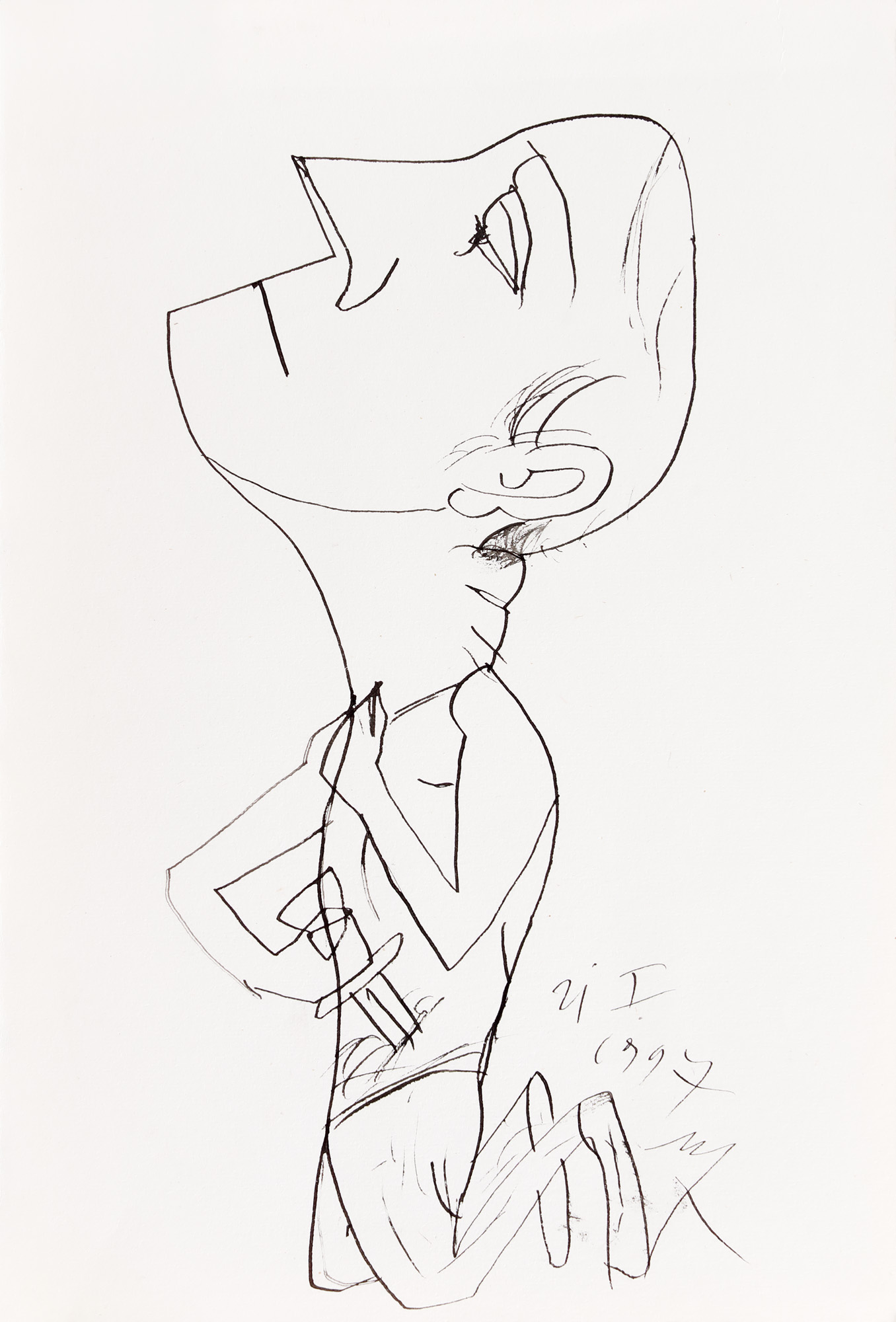
tuș pe hârtie, 35 x 25 cm, signed and dated bottom right, in black, "FM, 21.I. 1997"
Recognised both for his artistic and teaching activities, Florin Mitroi stands out through a brutal, visceral work, with esoteric nuances at times. Focused primarily on painting, Florin Mitroi would also find his vocation in graphic art or photography. His opus consists of a long series of portraits, which critics have often decoded in the key of a self-portrait that no longer fully emulates according to the model. The artist will be interested in the essentialisation of the figurative and the efficient synthesising of the deepest thoughts. We will thus penetrate the universe of self-portraits with a knife, a universe that extends throughout the last decade of the past century. These works come to us as diary pages, chaotically and frantically detached from the artist's notebook in his chase after the ideal. The titles are suggestive: "21.I.1997" or "14.X.1984" and place Mitroi's works in a specific chronology, through which important details about the artist's daily life are provided. Upon a closer look, we encounter complex processes of introspection and detachment, and sometimes even alienation. Mitroi's self-portraits capture states and experiences of all kinds, from grief and devastation to suspicion or resignation. As we chronologically go through the artist's opus, we distinguish a meticulous and closely planned relationship to self-mutilation. Violence emerges as a response to daily and spiritual disappointments and inadequacies, as a form of rebellion against the system and even as a protest over one's own person, subscribing to theses that the artist would in fact disavow, if possible. The self-violence that we identify in Mitroi's works appears as a reflex of the artist's defence in front of his working panels, without identifying guilt or any trace of victory. If in the works of the '80s the axe blade hovering above the bowed head of the character was predominant, from the '90s the punishing weapon will undergo a mutation and become a knife. Occasionally, the torture device takes distinct shapes, it lengthens, shortens, doubles in volume or is directly presented in a different guise. Initially the weapon was levitating around the body of the character, later on the artist would assume responsibility and take the action in his own hands. From here on, the protagonist seems to take over the torture instrument and consciously direct it towards the jugular plexus, veins, or directly towards the heart. The aggressiveness in his art will be directly related to a society that is, apparently, non-violent. Thus, we encounter the brutality which brims over to the background, transcending the precepts of form and proposing a complex deciphering of the author's intentions. Florin Mitroi's art thus facilitates an ideal framework for a profound research, oriented towards oneself, art, and the world that will result in works of an oppressive suffering, which the artist will never disavow.
For clarifications regarding the bidding procedure, hammer price costs, guarantee, payment, and collection terms for the winning lot, we recommend carefully reading/re-reading the Bidding Regulations.
For additional information regarding the lot and the auction, please contact the Art Consultants Department.
By choosing "Accept all cookies" you agree to the use of cookies to help us provide you with a better user experience and to analyse website usage. By clicking "Adjust your preferences" you can choose which cookies to allow. Only the essential cookies are necessary for the proper functioning of our website and cannot be refused
Cookie settings
Our website stores four types of cookies. At any time you can choose which cookies you accept and which you refuse. You can read more about what cookies are and what types of cookies we store in our Confidentiality Policy.
are necessary for technical reasons. Without them, this website may not function properly.
are necessary for specific functionality on the website. Without them, some features may be disabled.
allow us to analyse website use and to improve the visitor's experience.
allow us to personalise your experience and to send you relevant content and offers, on this website and other websites.