The photos of the lot are informative and indicative, and cannot provide a highly detailed view of the object from all angles. We recommend a careful physical inspection of the lot before bidding.
VLAHUTA, Alexandru, "Painter Grigorescu - His Life and Work", Alexandru Vlahuță, Bucharest, 1910.
PETRAȘCU, N., "N. Grigorescu", Bucovina Typography, Bucharest, 1930.
OPRESCU, George, "Nicolae Grigorescu", Meridiane Publishing House, Bucharest, 1963.
CEBUC, Alexandru, "Grigorescu", Official Monitor, 2017.
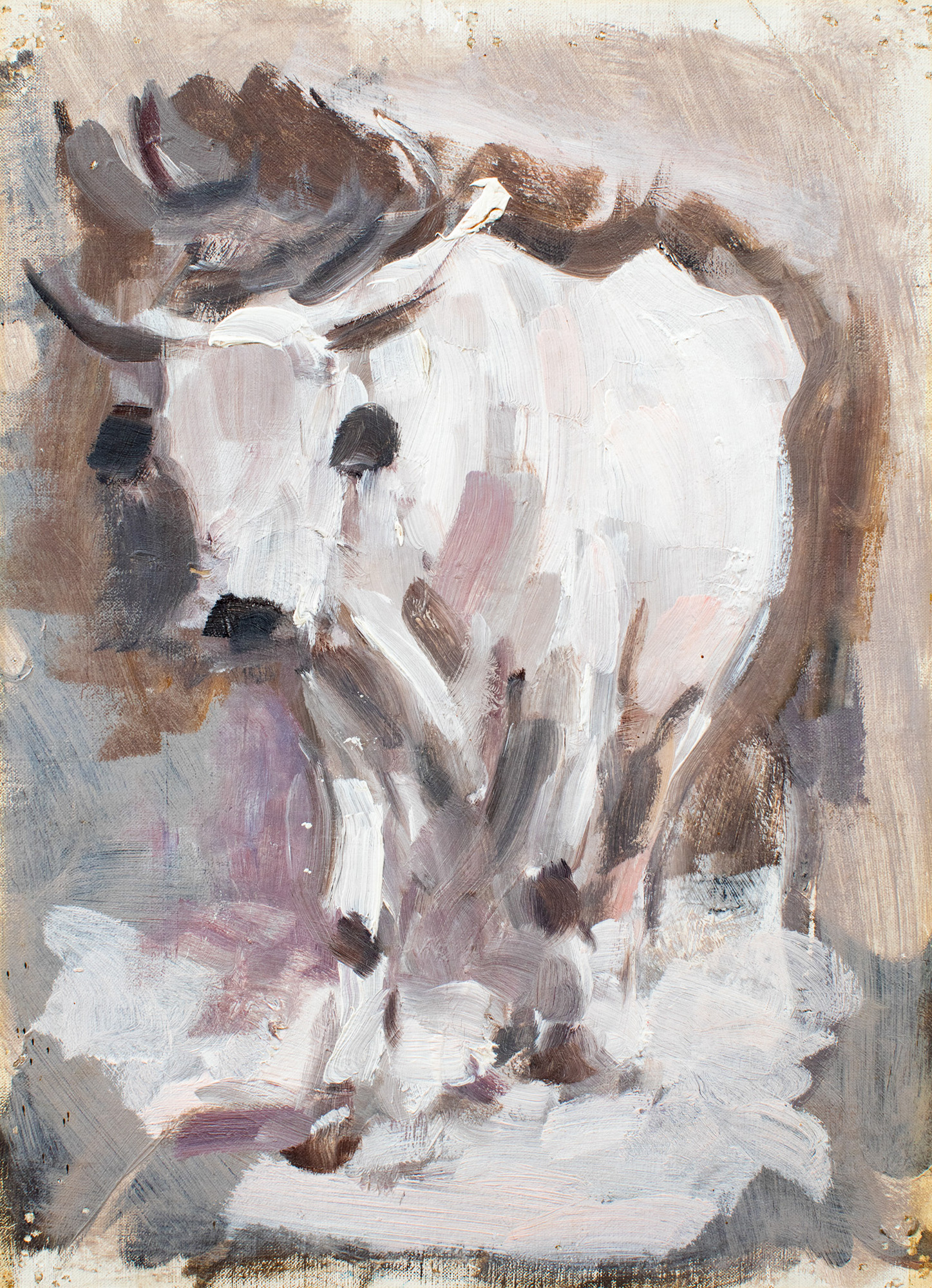
oil on canvas applied on copper board, 32.5 x 22.5 cm
Research information
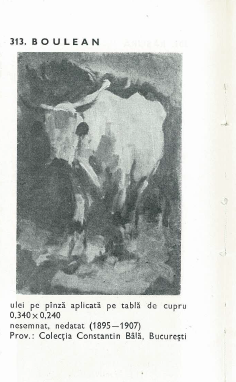
The artwork was part of the retrospective exhibition "Nicolae Grigorescu", Art Museum of the RPR, November 16, 1984-1985 and is reproduced in the exhibition catalogue under the name "Boulean", cat. 313.
PROVENANCE
Irina Crăciun Angelescu Collection.
Constantin Bălă Collection.
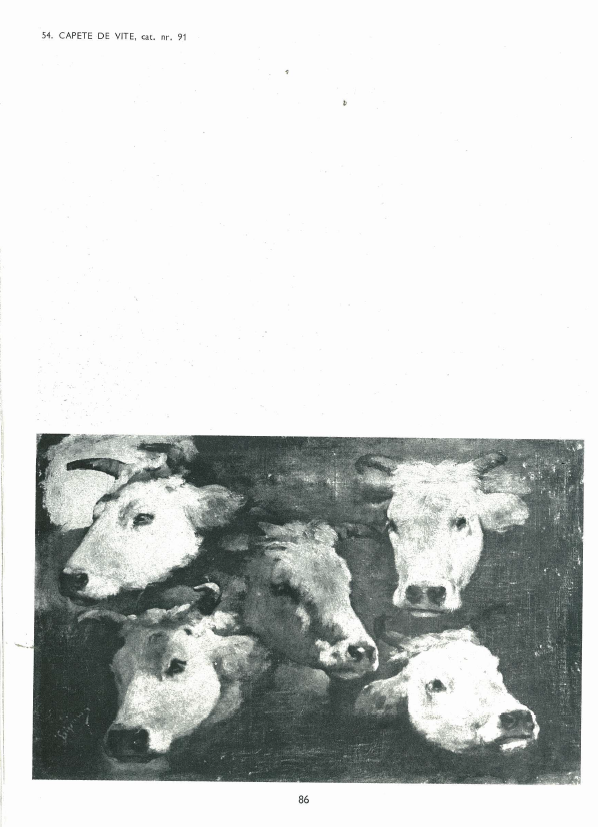
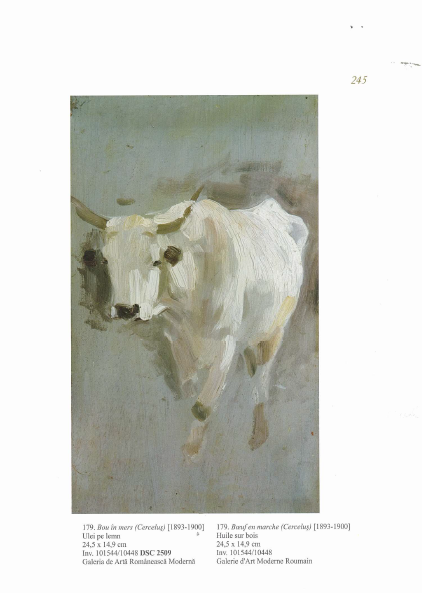
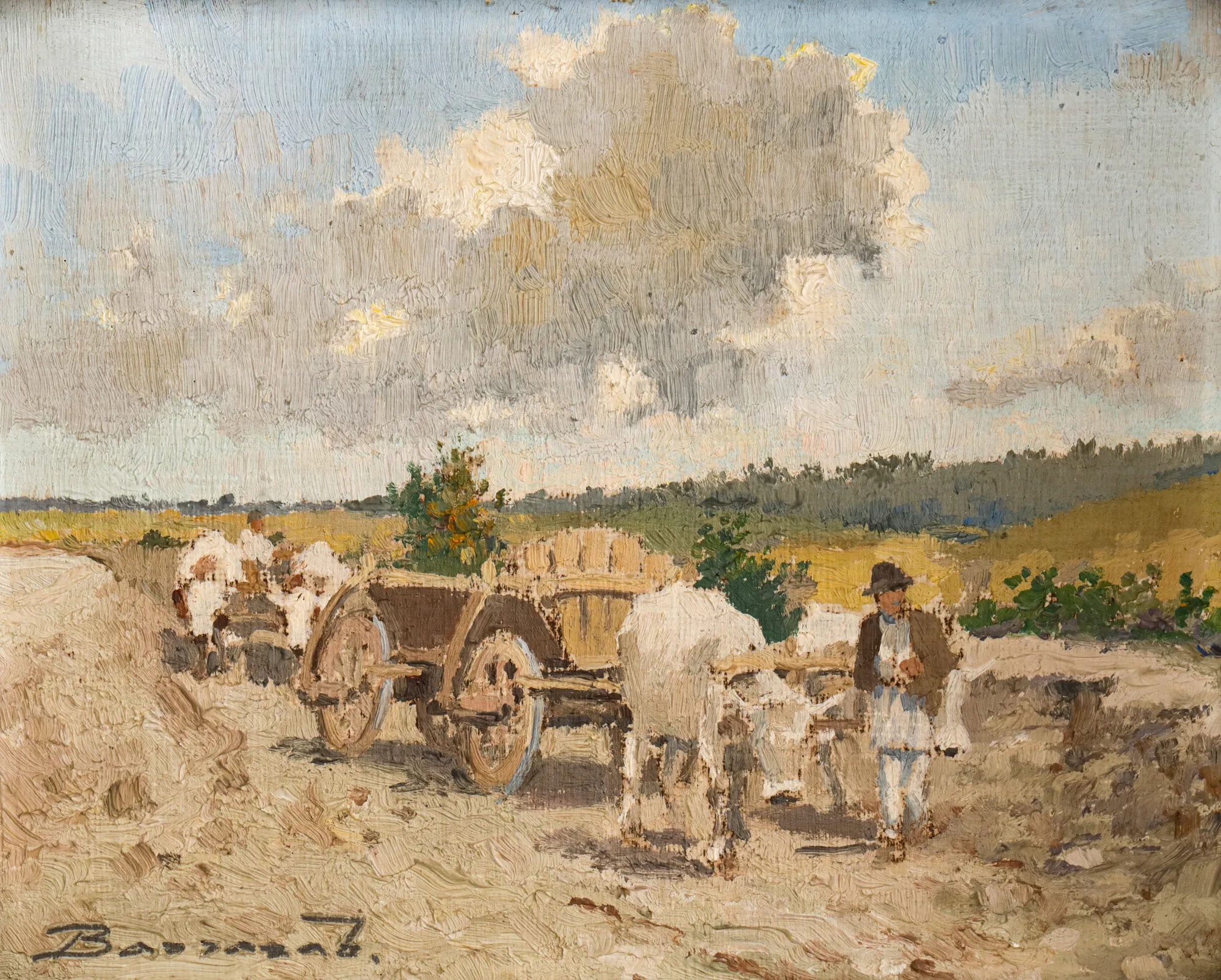
"He had, one summer, in Câmpina, a beautiful Moldovan ox, named ”Ghiocel” (Snowdrop), and, gentle, it seemed to come to pose alone in the morning, in the middle of the courtyard [...] standing so beautifully, as if he knew the great mystery that takes place at that hour. In the evening, when the painter was walking thoughtfully, hands behind his back, from one end of the courtyard to the other, Ghiocel was following him, with an affectionate friendship for that good and silent man." Thus Alexandru Vlahuţă describes Ghiocel, the protagonist of this work, but also the subject of numerous studies and sketches done by Nicolae Grigorescu in pencil or charcoal, and the subject of numerous oil sketches and finished works. The artist takes animal painting as a favorite motif in his work and repeats this motif throughout multiple works, especially in his maturity stage. Throughout his life, he will make a consistent study of a representative from the bovine family and will include the working and suffering companion of the village man in many of his works. He will study the oxen with extraordinary patience and will portray them with genuine sympathy in his canvases. He will paint endless picturesque strains, herds returning from the field, groups caught as they approach or at the moment of their departure from the foreground. After the resounding success of his personal exhibition in Paris, at the Marinet Hall, Grigorescu definitively returns home in 1887. He will initially live in Bucharest, intending to settle in Câmpina from 1891. Located in the middle of nature and people, surrounded by vegetation and numerous animals from the countryside, the artist will transcribe landscapes, faces, and silhouettes of peasants, as well as portraits of oxen, representatives of work, gentle, with a particular endurance ability. As Alexandru Vlahuță recalls in the volume dedicated to the painter, the landscape appears, in Grigorescu's work, as "a window wide open to the light from outside". From Barbizon to Câmpina, the main concern of the Romanian artist will revolve around nature. Prahova Valley will prove to be prolific in Grigorescu’s creation, offering him numerous painting motifs. The domestic animal from the immediate vicinity of the peasant households will acquire the status of the leitmotif of the work and will embody, over the centuries, that "national specific" spoken of when Grigorescu's personality is evoked. Interested in animal anatomy, he will undertake a detailed study of muscles and bones, a game of tension and relaxation which will result in a panoply of works dedicated to the motif. In the artist's work, oxen enjoy great freedom of expression. We often find oxen that walk gently, unyoked oxen, or oxen that do not pull uphill - clear proof of care and attention to the animal. Representative of plein-air painting, Ghiocel appears in this work in a quasi-synthesized rendering in a study where we certainly glimpse solar reflections. Predominant are the shades of white, to which the painter borrows from the grey or brown tones of the shadows and marking details. The protagonist is caught in motion, stepping towards an uncertain topos, located outside the canvas limits. Stricken with pneumonia in 1907, he will be led to his eternal rest exactly as he described the custom in his paintings -“ in a wagon with four oxen ”(as N. Petrașcu notes in the album dedicated to Grigorescu).
For clarifications regarding the bidding procedure, hammer price costs, guarantee, payment, and collection terms for the winning lot, we recommend carefully reading/re-reading the Bidding Regulations.
For additional information regarding the lot and the auction, please contact the Art Consultants Department.
By choosing "Accept all cookies" you agree to the use of cookies to help us provide you with a better user experience and to analyse website usage. By clicking "Adjust your preferences" you can choose which cookies to allow. Only the essential cookies are necessary for the proper functioning of our website and cannot be refused
Cookie settings
Our website stores four types of cookies. At any time you can choose which cookies you accept and which you refuse. You can read more about what cookies are and what types of cookies we store in our Confidentiality Policy.
are necessary for technical reasons. Without them, this website may not function properly.
are necessary for specific functionality on the website. Without them, some features may be disabled.
allow us to analyse website use and to improve the visitor's experience.
allow us to personalise your experience and to send you relevant content and offers, on this website and other websites.