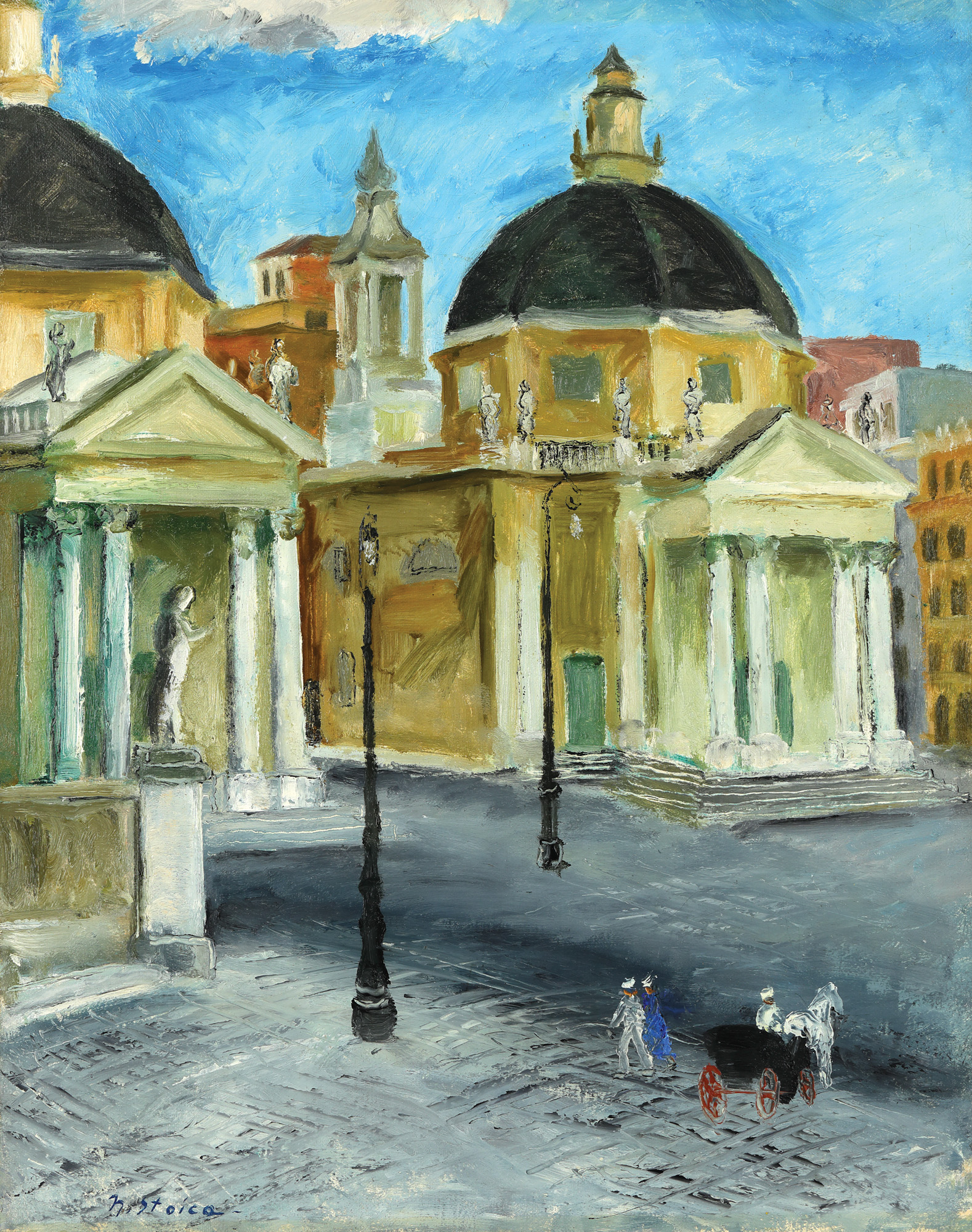
The photos of the lot are informative and indicative, and cannot provide a highly detailed view of the object from all angles. We recommend a careful physical inspection of the lot before bidding.
PĂULEANU, Doina, "Singularity and Imaginary Reconstruction. Romanian Painters in Brittany (1876-1940)", Arcade Publishing, Bucharest, 2010.
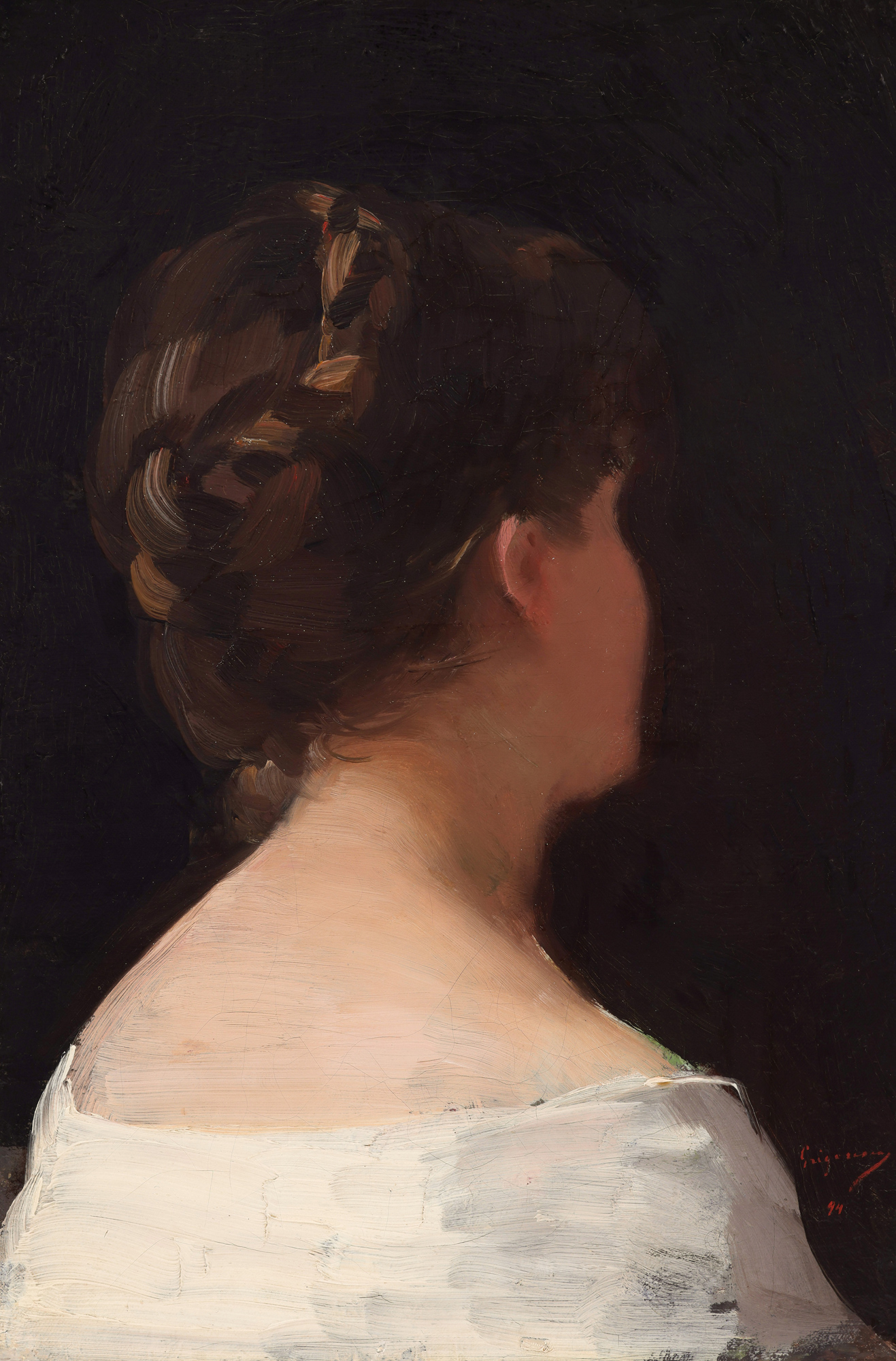
ulei pe pânză, 41 x 27 cm, signed and dated bottom right, in red, "Grigorescu, (18)94"
PROVENANCE
the collection of Prof. Costin Murgescu, corresponding member of the Academy, and the filmmaker Ecaterina Oproiu.
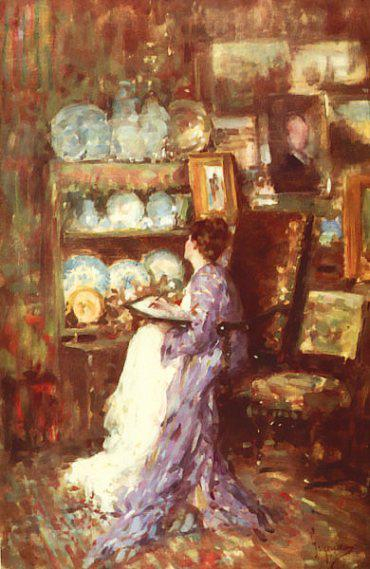
An overview of Nicolae Grigorescu's work reveals his enthusiasm for the human subject. We find countless sketches and oil paintings dedicated to peasant girls and shepherds, but also elegant female silhouettes, placed in fairy-like natural settings, in corners and inside workshops. Exhibition catalogs and numerous monographs and albums dedicated to the artist reveal his interest in a certain family, whose portraits continually succeed especially in a certain period of his creation. We therefore find the Pester Wirth sisters from Iasi dominating the surfaces of his canvases and boards. The four sisters, Luiza, Ana Zettina (wife of Vasile Alexandrescu Urechia), Carlotta, and Emilia (married to Dona, mother of collector Iosif Dona) will become the central subject of some of the most spectacular works painted by the Romanian artist. Thorough research by art historian Doina Păuleanu has brought to attention a certain character who repeatedly appears in the master's work. This is, therefore, about the so-called "prima-donna assoluta" of that time - Carlotta Leria. We tend to think that the protagonist of the work could be the well-known opera singer. She went to study in Paris under the patronage of Queen Elisabeta. She formed there under the direction of Paulina Viardot, and then stopped in Milan, where she had the chance to be a student of Sangiovanni. She would integrate, successively, into the body of operas from Milan, Geneva, Nice, London and she would even be the court soprano in Vienna. Her returns to the country culminated in perfect artistic performances, so the reputed opera singer indissolubly linked her destiny to her native sources. The trips organized abroad, both for educational-cultural and recreational purposes, brought Nicolae Grigorescu closer to the themes, motifs and subjects he was to take over in his work. During 1873-1874, the excursion to Italian lands would facilitate the painter's meeting with young Carlotta Leria, and their paths would often cross in Paris. Carlotta Leria, one of the four Pester Wirth sisters, arrived in Paris in 1870, where in addition to her own artistic activity she will carry out a prodigious teaching activity, within the Institute of Mrs. Barral on Rue Vaugirard 96. The Breton period in Nicolae Grigorescu's work will therefore frequently feature the face and body of the soprano from Iasi. The artist will dedicate important portraits to this muse and will slip her gracious silhouette into many seascapes. Perhaps the seascapes will be the ones that will consecrate the protagonist's presence in Grigorescu's work, the Black Sea coast becoming a frequent meeting place for the two. Grigorescu's love for the sea landscape can be identified especially from 1876, when he was already in France, but the painter had also come to know the native coast - Constanța being present in his art from 1881. There was therefore, in addition to the well-known Breton period, also a short local stage of marine landscape in the artist's work. The two will thus be linked by their love for nature and especially by their love for the maritime space. But Carlotta also appears in works such as the "Corner of the Workshop", a work currently in the collection of the National Art Museum of Romania. The corner of the workshop reveals the elegant silhouette of the same character seen in half profile. We identify the same graceful young woman and the same compositional details that reveal the delicate elongation of the neck as in the work at hand. The female character seen from behind aligns with the mysterious character that pervades the relationship between the two. Rendered in half-profile, with her hair elegantly braided at the back, Grigorescu's muse is notable for the perfect grace she presents herself with. Carlotta will thus be a delicate appearance, with a porcelain aspect rendered by diaphanous strokes. It is notable the contrast between the muse's open complexion and the dark background, as well as the finely distributed light or the subtle contours that define and fill the forms. Viewed under the auspices of the date: 1894, the work reveals a possible last vestige of their relationship. In May 1895, Carlotta was telling Grigorescu the following words: ”l’expression de tout ma peine d’avoir manqué le plaisir de vous voir”, invoking the appearance of a singing lesson that had interfered with their meeting. "His great love" (and also an unfulfilled love), as art critic and historian Doina Păuleanu appreciates, Carlotta Leria marked Nicolae Grigorescu's existence in a profound way, becoming his muse and at the same time an energetic thought, pictorial motive and a solid grammar of affection. About the soprano from Iasi, Barbu Ștefănescu Delavrancea noted: "Miss Leria sings...sweet, attractive, lost, strong and passionate sounds flow incessantly, animated by much of the crowd's admiration [...] Her voice is clear, sonorous, golden, youthful: transitioning from pianissimo to focoso with unimaginable skill; attacking the notes with certainty, her voice subjugates, does not impose: it steals, does not threaten; it caresses, does not crush; even when it grows, when it arises full of passion, when it hits the supreme note, when it unties the tragic situation of the scene, it is more like those quick and gloomy storms, which appear more to be admired, and which disappear without lightning and rain, revealing again the clarity from before...". She was also appreciated as a very good singing teacher by her students. The echoes of her personality were thus heard not only in the field of classical music, but also in pedagogy; and her status as a painted muse brought her closer to one of the most representative personalities of Romanian art.
For clarifications regarding the bidding procedure, hammer price costs, guarantee, payment, and collection terms for the winning lot, we recommend carefully reading/re-reading the Bidding Regulations.
For additional information regarding the lot and the auction, please contact the Art Consultants Department.
By choosing "Accept all cookies" you agree to the use of cookies to help us provide you with a better user experience and to analyse website usage. By clicking "Adjust your preferences" you can choose which cookies to allow. Only the essential cookies are necessary for the proper functioning of our website and cannot be refused
Cookie settings
Our website stores four types of cookies. At any time you can choose which cookies you accept and which you refuse. You can read more about what cookies are and what types of cookies we store in our Confidentiality Policy.
are necessary for technical reasons. Without them, this website may not function properly.
are necessary for specific functionality on the website. Without them, some features may be disabled.
allow us to analyse website use and to improve the visitor's experience.
allow us to personalise your experience and to send you relevant content and offers, on this website and other websites.